Localization updates rarely make headlines. They arrive in point releases, buried under feature announcements and UI refreshes, and the people who care about them — accountants in Bucharest, tax specialists in Mexico City, finance teams in Abidjan — tend not to write blog posts about their excitement. But these updates quietly reshape how businesses in specific markets interact with their tax authorities, and Odoo 18.4 delivers three that deserve attention.
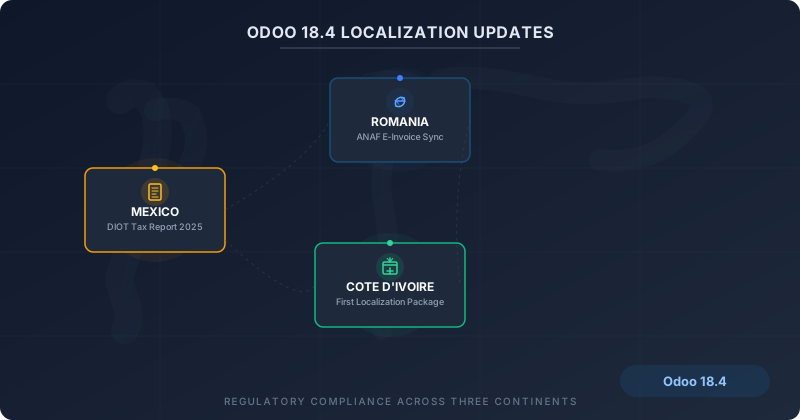
This release brings full ANAF e-invoice synchronization to Romania, rebuilds Mexico’s DIOT report from the ground up to match 2025 SAT requirements, and ships Odoo’s first localization package for Côte d’Ivoire. Each change targets a different compliance pain point, but together they illustrate how Odoo’s localization strategy has matured from basic chart-of-accounts templates into genuine regulatory integration.
Romania Gets Real-Time ANAF Synchronization
Romania’s ANAF (Agenția Națională de Administrare Fiscală) has been tightening its e-invoicing requirements steadily since 2022, when it mandated electronic invoicing for B2G transactions and began expanding the mandate to B2B. For Odoo users in Romania, the previous workflow was tedious: export invoices from Odoo, upload them to the ANAF SPV portal manually, then download received invoices from the same portal and enter them back into the system. Every step was a manual handoff, and every handoff was an opportunity for something to fall out of sync.
Odoo 18.4 eliminates that workflow entirely. The new ANAF integration provides bidirectional synchronization directly from within Odoo. Sent invoices are transmitted to ANAF and their processing status — accepted, rejected, pending validation — syncs back automatically. There’s no need to log into the SPV portal to check whether an invoice was received and validated. The status updates appear on the invoice record itself.
On the receiving side, the integration downloads invoices from ANAF directly into Odoo. Vendor bills that arrive through Romania’s e-invoicing system show up in the purchase journal without manual data entry. For companies processing hundreds of vendor invoices per month, this alone justifies the update — the hours previously spent downloading XML files from the SPV portal and re-keying data are simply gone.
The implementation handles the authentication flow with ANAF’s OAuth-based system, manages the digital certificate requirements, and maintains the connection state so that synchronization runs on schedule without manual intervention. It’s the kind of integration that sounds straightforward in a feature list but requires significant work to get right, particularly around error handling when ANAF’s servers return unexpected responses or when certificate renewals are needed.
Mexico’s DIOT Report Gets Its 2025 Overhaul
Mexico’s DIOT (Declaración Informativa de Operaciones con Terceros) has always been one of the more complex tax reports in Odoo’s localization ecosystem. It requires breaking down every third-party transaction by tax type, supplier classification, and payment method — and the SAT (Servicio de Administración Tributaria) periodically revises what columns are required and how transactions should be categorized.
The 2025 revision is substantial. Odoo 18.4 rebuilds the DIOT report with new columns that align with the latest SAT specifications. Tax groups now have default accounts assigned automatically, which means less manual configuration when setting up a new Mexican company in Odoo. Previously, getting the DIOT mappings correct required an implementation consultant who knew exactly which accounts to assign to which tax groups — a configuration step that was easy to get wrong and painful to debug when the report output didn’t match SAT expectations.
The IEPS (Impuesto Especial sobre Producción y Servicios) tax breakdown is now reported per customer, giving businesses that deal with special production and services taxes a clearer view of their IEPS obligations across their customer base. This is particularly relevant for companies in sectors like food and beverage, telecommunications, and fuel distribution, where IEPS applies at varying rates depending on the product category.
Invoice lines now support eight distinct tax objects, up from the limited set in previous versions. This granularity matters because SAT’s classification system requires different tax treatments for different types of goods and services on the same invoice. A single invoice to a restaurant supplier, for example, might include items subject to standard IVA, items with IEPS, and exempt items — each requiring its own tax object classification in the CFDI.
Perhaps the most practical improvement: a single invoice can now reference multiple CFDI origins. In real-world Mexican accounting, credit notes, payment complements, and invoice corrections frequently need to reference more than one original document. Previous versions forced workarounds — splitting transactions or maintaining separate tracking spreadsheets — that the new implementation handles natively.
Côte d’Ivoire Joins the Localization Map
For the first time, Odoo ships a base localization package for Côte d’Ivoire. This isn’t a minor addition — it represents Odoo’s continued expansion into West African markets where adoption of cloud-based ERP systems has been accelerating, driven partly by regional economic integration under OHADA (Organisation pour l’Harmonisation en Afrique du Droit des Affaires) accounting standards.
The package includes a chart of accounts aligned with the SYSCOHADA framework, the standard accounting system used across francophone Africa. It comes with preconfigured taxes matching Ivorian tax law, including standard and reduced VAT rates. Fiscal positions are set up to handle the common scenarios — domestic sales, exports within ECOWAS, and transactions with companies in other OHADA member states.
A VAT return template is included out of the box, structured to match the format required by the Direction Générale des Impôts. For businesses in Côte d’Ivoire that were previously running Odoo with a generic chart of accounts and manually adapted tax configurations, this localization package replaces hours of initial setup with a working foundation that can be customized rather than built from scratch.
The Pattern Behind These Changes
These three updates look unrelated on the surface — a European e-invoicing integration, a Latin American tax report rebuild, and an African market entry — but they follow a consistent pattern in Odoo’s localization strategy. Each responds to a regulatory shift that makes manual compliance workflows untenable.
Romania’s ANAF mandate is expanding, and businesses that were tolerable uploading a few invoices manually each month cannot sustain that approach as B2B e-invoicing becomes universal. Mexico’s SAT continues to add complexity to its reporting requirements, and the DIOT in particular has become detailed enough that generating it outside the ERP — in spreadsheets or standalone tax tools — introduces more risk than it removes. Côte d’Ivoire’s growing economy and OHADA standardization create a market large enough to justify dedicated localization work.
This is how Odoo’s localization coverage has grown from a handful of European countries to over 70 fiscal localizations. The work isn’t glamorous — it’s reading tax authority specifications, implementing file formats, and testing against government validation services — but it’s the work that determines whether a business can actually run on Odoo in a given country.
What It Means in Practice
For a Romanian company processing invoices through Odoo, the ANAF sync means the accounting team stops context-switching between their ERP and a government portal. Sent invoices are tracked in one place. Received invoices arrive in the system automatically. The compliance surface area — the set of places where things can go wrong — shrinks dramatically.
For a Mexican company filing its DIOT, the rebuilt report means the monthly close process gets shorter. Tax classifications that previously required manual review now flow from correctly configured tax groups. IEPS breakdowns that used to require custom reports are available natively. Multiple CFDI origins on a single document eliminate one of the more common workarounds that Mexican Odoo users had developed over the years.
For a company in Côte d’Ivoire evaluating ERP options, an official localization package changes the calculus. Instead of budgeting for a consultant to build a chart of accounts from scratch, the foundation is there. The VAT return works. The fiscal positions are correct. The project starts from configuration rather than construction.
None of these changes will trend on social media. They won’t appear in keynote demos. But for the businesses they affect, they represent the difference between software that understands their regulatory environment and software that makes them work around it. That’s the real measure of localization quality — not how many countries appear on a coverage map, but how deeply the system integrates with the rules that govern daily operations in each one.