Building automation rules in enterprise software has traditionally required either a developer or someone who thinks like one. You need to know the correct model names, field references, trigger conditions, and the specific syntax for conditional logic. It works, but it creates a bottleneck: every new automation request goes through the technical team, and simple rules that should take five minutes to define end up in a sprint backlog.
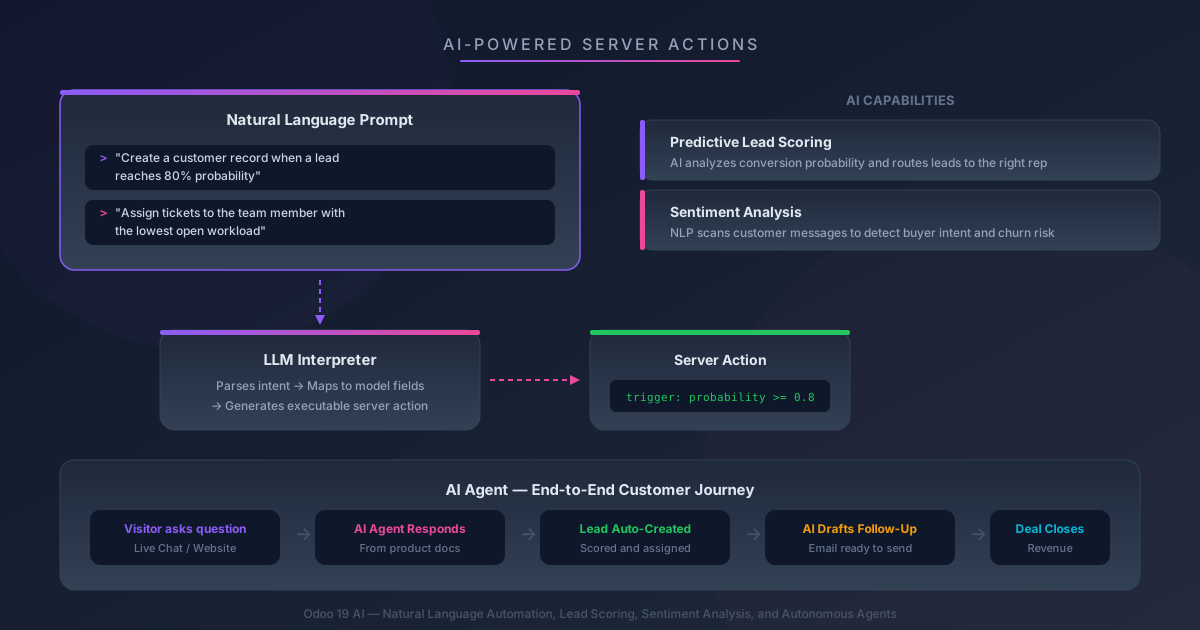
Odoo 19 eliminates that bottleneck entirely. You can now create server actions — the triggers and automated workflows that power everything from lead assignment to inventory alerts — by describing what you want in plain English. Type “Create a customer record when a lead reaches 80% probability” and the system figures out the model, the trigger condition, the field mapping, and the action type on its own.
How Natural Language Server Actions Work
Under the hood, the feature passes your natural language description to a large language model that understands Odoo’s data architecture. The LLM parses your intent, identifies the relevant models and fields, determines the appropriate trigger event, and generates an executable server action. You review the generated configuration before activating it, so there’s still a human checkpoint — the AI proposes, you approve.
The practical implications are significant. A sales manager who wants to auto-assign high-value leads to senior reps can describe that rule in thirty seconds. A support team lead who needs tickets routed to the person with the lightest current workload types that as a sentence, not as a chain of technical configuration steps. The barrier between “I know what I want the system to do” and “the system actually does it” effectively disappears.
Predictive Lead Scoring
The AI capabilities extend well beyond server action creation. The CRM module now includes predictive lead scoring that analyzes historical conversion data to assign probability scores to incoming leads. The model considers factors like lead source, industry, company size, engagement history, and response patterns to predict how likely each opportunity is to close.
What makes this different from the simple weighted scoring that existed in earlier versions is that the model improves continuously. As more deals close (or don’t), the scoring adjusts. A lead source that produced high-value customers six months ago but has since declined in quality will see its contribution to the score decrease automatically — no manual recalibration required.
Lead assignment ties directly into the scoring. Leads above a configurable probability threshold get routed to the appropriate team member based on language, region, or product specialization. The routing rules themselves can be defined using the same natural language interface, closing the loop between scoring and action.
Sentiment Analysis in Customer Communications
The CRM now applies natural language processing to incoming customer messages — emails, live chat transcripts, and support tickets — to detect sentiment and buyer intent. A message that reads enthusiastic about a product demo gets flagged differently from one that expresses frustration about pricing.
The practical application is churn risk detection. When a customer whose tone has been positive for months suddenly shifts to neutral or negative, the system flags the account for attention. Sales reps see the sentiment trend alongside the deal pipeline, giving them early warning to intervene before the opportunity goes cold or the existing customer starts evaluating competitors.
This works at scale in a way that manual review cannot. A sales team handling 200 active conversations can’t realistically read every message for tone shifts. The AI does it continuously and surfaces only the accounts that need human attention.
Autonomous AI Agents
The most ambitious addition is the AI Agent framework, which chains multiple AI capabilities into end-to-end automated workflows. A typical sequence works like this: a visitor lands on the company website and asks a question through live chat. The AI agent responds using knowledge from the company’s product documentation, sales materials, and FAQ content. During the conversation, it identifies buying intent and automatically creates a CRM lead.
That lead is then scored using the predictive model, assigned to the best-fit sales rep based on the routing rules, and the agent drafts a personalized follow-up email for the rep to review and send. The entire journey from anonymous website visitor to qualified pipeline opportunity happens without anyone manually creating records, assigning owners, or drafting emails.
The agents are knowledge-aware. You point them at specific document sources — product specs, pricing sheets, implementation guides — and they answer within that context. They don’t hallucinate features or make up pricing because their responses are grounded in the documents you provide, not in general training data.
Enterprise-Only, With Good Reason
It’s worth noting that the AI features in Odoo 19 are Enterprise-exclusive. Community Edition users won’t find the natural language server actions, predictive lead scoring, or AI agent framework in their installation. Given the compute costs of running LLM inference and the integration complexity with external AI providers, this makes commercial sense — though it does widen the gap between the two editions.
For Enterprise customers, the AI features integrate with external providers including OpenAI and Google Gemini. The configuration happens at the system level, and the AI capabilities become available across modules once the provider connection is established. There are no per-query charges within Odoo itself; the costs flow through whatever provider agreement the company has in place.
The Bigger Picture
What Odoo 19’s AI layer represents is less about any single feature and more about removing friction from a class of tasks that have always required technical skill. Every ERP vendor is adding AI capabilities, but most are bolting them onto existing workflows as assistants and copilots. Odoo’s approach of embedding AI into the server action framework — the core automation engine that powers the entire platform — means the AI isn’t just offering suggestions. It’s building the operational infrastructure.
For businesses that have customization backlogs measured in months, the ability for operational teams to define their own automation rules without writing code or waiting for a developer could prove to be the most practically valuable feature in the entire release. Not the flashiest, but the one that saves the most time across the most teams.