For years, Australian businesses running Odoo had exactly two options for getting bank transactions into their accounting system: manually downloading CSV files from their bank’s website, or paying for a third-party aggregation service. Neither was great. The CSV route meant someone had to remember to export statements regularly, and the third-party services added yet another subscription to the pile.
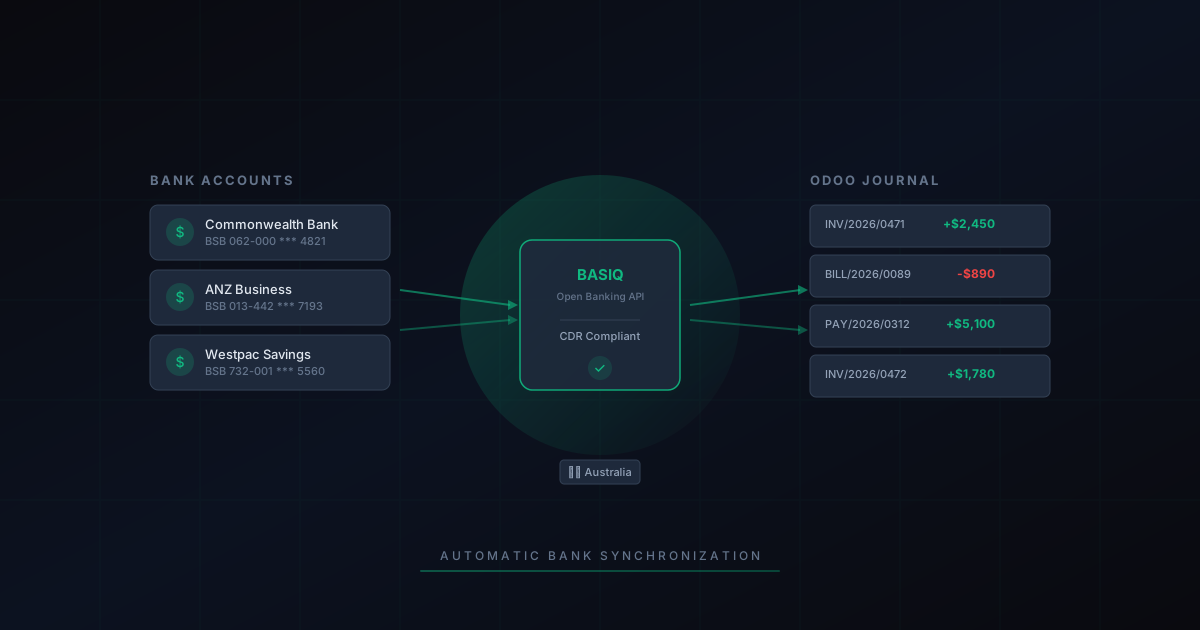
That changes now. Odoo has added Basiq — an Australian open-banking aggregation platform — as a native bank synchronization provider. The integration pulls transactions directly from participating Australian financial institutions into Odoo’s accounting module, automatically, without any ongoing fees for Odoo users.
What Basiq Actually Does Under the Hood
Basiq operates as a multi-account aggregation layer that sits between Australian banks and software platforms like Odoo. It uses Australia’s Consumer Data Right framework — the same regulatory infrastructure that powers open banking across the country — to securely access transaction data with the account holder’s explicit consent.
The practical effect is straightforward: once connected, bank transactions flow into Odoo automatically. No exports, no uploads, no reconciliation spreadsheets sitting in someone’s downloads folder. Every transaction from every connected account shows up in the bank reconciliation screen, ready to be matched against invoices and bills.
What makes the Basiq integration notable is the price tag — or rather, the absence of one. The service is free for Odoo users. Australian businesses have long been accustomed to paying monthly fees for bank feed services through other providers, so a no-cost option built directly into their ERP removes both a cost line and a vendor relationship from the equation.
The CDR Compliance Angle
Australia’s Consumer Data Right regime is one of the more carefully constructed open-banking frameworks in the world. Unlike screen-scraping approaches that some aggregators have historically used — where a service literally logs into your bank with your credentials and reads the page — CDR establishes a formal, API-driven data-sharing protocol between banks and accredited data recipients.
Basiq operates within this framework, which means the data sharing happens through official bank APIs rather than credential-based workarounds. Businesses must explicitly opt in to sharing their banking data, and the consent is granular: you choose which accounts to share, with whom, and can revoke access at any time.
For accounting teams, this matters beyond the theoretical. CDR compliance means the connection is sanctioned by the banks themselves. There’s no risk of a bank locking your account because it detected suspicious login activity from an aggregation service. The data flows through proper channels, with proper authorization, and proper audit trails.
Setting It Up Takes About Five Minutes
The connection process follows the pattern that anyone who has used open banking in Australia will recognize. From within Odoo’s accounting module, you initiate a bank synchronization and select Basiq as the provider. The system redirects to Basiq’s consent flow, where you select your bank, authenticate with your banking credentials through the bank’s own interface, and approve the data-sharing arrangement.
Once authenticated, you choose which specific accounts to connect to Odoo. A business with accounts at Commonwealth Bank, ANZ, and Westpac can connect all of them through separate Basiq connections, each going through its own consent flow. The transactions start flowing once the connection is established — there’s no waiting period or batch processing delay.
The documentation is clear about one detail that matters in practice: each banking institution requires its own connection process. You can’t connect three banks in one go. But each individual connection takes only a minute or two, and once established, it runs continuously without further intervention.
Why This Matters for Australian Odoo Users
The Australian market has been something of an outlier in the Odoo ecosystem. While European users have long had direct bank connections through providers like Ponto and Salt Edge, and North American users could connect through Plaid, Australian businesses were often left managing bank feeds through manual processes or expensive third-party integrations.
Basiq fills that gap in a way that feels native rather than bolted on. The integration sits alongside the existing bank synchronization providers in Odoo’s setup, uses the same reconciliation workflows, and produces the same journal entries. An accountant who has used Odoo with Ponto in Europe would find the Basiq experience identical in terms of day-to-day workflow.
The timing aligns with a broader push from Odoo to deepen its Australian localization. With payroll support already expanding to cover SuperStream compliance and STP Phase 2 reporting, adding native bank feeds rounds out the accounting side of the equation. An Australian business can now run its entire financial operation — invoicing, bills, bank reconciliation, payroll, and tax reporting — without leaving Odoo or paying for auxiliary services.
The Competitive Landscape Shifts
For the accounting software market in Australia, this move puts pressure on competitors who charge separately for bank feed access. Xero has long positioned its automatic bank feeds as a core selling point, and MYOB has invested heavily in similar capabilities. Odoo offering the same functionality at no additional cost — on top of a platform that handles everything from CRM to manufacturing — changes the calculus for businesses evaluating their software stack.
It also signals something about where ERP platforms are heading. The expectation is shifting from “we integrate with banks” to “bank data just appears.” The plumbing should be invisible. Basiq’s role as infrastructure — regulated, secure, standardized — makes it possible for platforms like Odoo to offer bank connectivity as a baseline feature rather than a premium add-on.
For the roughly 10,000 Australian businesses already running Odoo, the upgrade path is simple: connect Basiq through the existing bank synchronization settings and stop downloading CSV files. For businesses evaluating Odoo for the first time, it removes one of the few remaining checkboxes that Australian accounting teams cared about.