Sustainability reporting has been one of those tasks that lives permanently in spreadsheet purgatory. The accounting team exports purchase data. Someone in operations manually classifies each line item by emission category. A consultant applies factors from a database that may or may not match the company’s actual supply chain geography. The final report arrives months after the period it covers, and nobody quite trusts the numbers.
Odoo 19 takes a fundamentally different approach. Its new ESG module treats carbon tracking as a by-product of normal business operations rather than a separate reporting exercise. When the finance team books an invoice, the system already knows the product category, the supplier’s location, and the transport method. The ESG module applies emission factors to that data automatically, in real time, and the sustainability dashboard updates before anyone has to open a spreadsheet.
How the Emission Calculation Actually Works
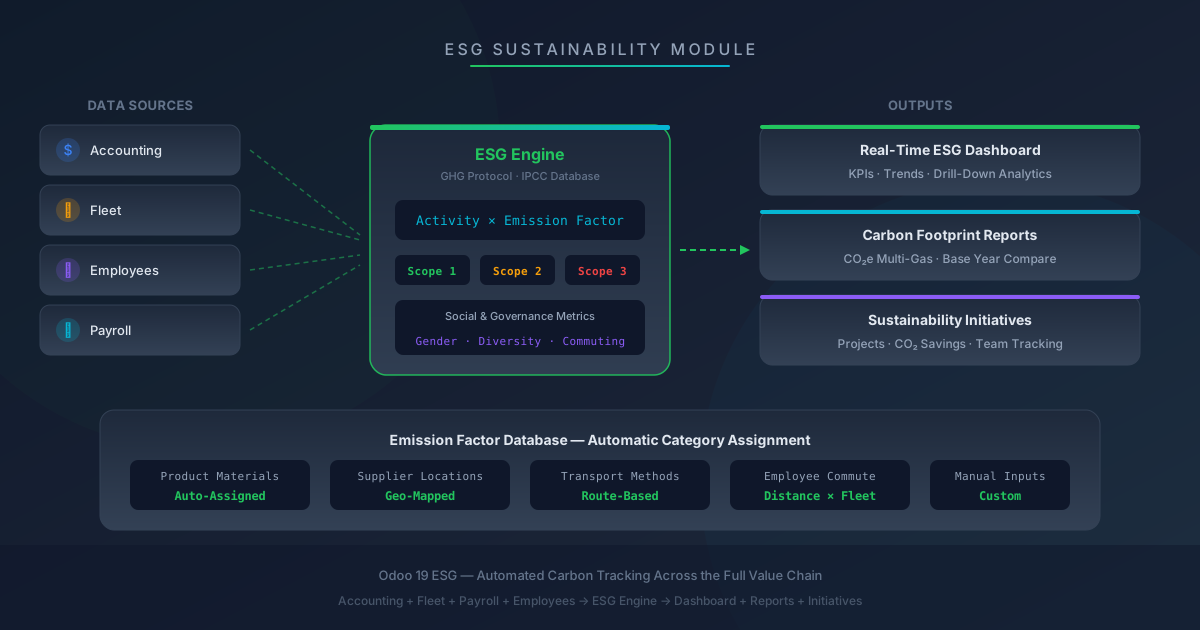
The core formula is straightforward: activity data multiplied by the corresponding emission factor. What makes the implementation interesting is where the activity data comes from and how the emission factors are assigned.
The module pulls from four primary sources inside Odoo. Accounting records provide purchase and expense data — everything from raw material procurement to office supply orders. Fleet data contributes vehicle mileage and fuel consumption. The Employees module provides headcount and commuting patterns. And Payroll data feeds into workforce-related calculations.
Each data source maps to specific emission scopes. Scope 1 covers direct emissions from owned vehicles and facilities. Scope 2 handles purchased electricity and heating. Scope 3 — the category that represents up to 90% of most companies’ total footprint — captures everything from supplier manufacturing to employee commuting to downstream product use.
The IPCC Emission Factor Database
Odoo 19 ships with an extensive emission factor database drawn from the IPCC (Intergovernmental Panel on Climate Change) and aligned with both the GHG Protocol and the French Bilan Carbone methodology. When your procurement team purchases materials, the system assigns the relevant emission factor based on three dimensions: product category, supplier geography, and transportation method.
This automatic assignment is what separates the module from bolted-on sustainability tools. In a typical carbon accounting workflow, someone has to manually map each expense line to an emission factor — a process that’s tedious, error-prone, and often months behind reality. With the factors built into the product categorization that already exists in Odoo’s procurement flow, the mapping happens at transaction time.
The database supports multi-gas breakdowns, not just CO₂. It tracks CO₂ equivalent across the Kyoto Protocol gases, giving companies that operate in regulated industries or report to CDP the granularity they need without maintaining parallel tracking systems.
Employee Commuting Calculations
One of the more thoughtful implementations covers employee commuting, which falls under Scope 3 and is notoriously difficult to measure accurately. The module uses home-to-work distance from the employee record, cross-references attendance frequency to determine actual commuting days (rather than assuming five days a week), and applies vehicle emission factors in grams per kilometer from the fleet data.
For companies with hybrid work policies, this matters. A blanket assumption of daily commuting would overstate emissions by 30–40% for a workforce that averages three days in the office. The attendance integration brings the calculation closer to reality without requiring employees to self-report their commuting patterns.
The Dashboard and Reporting Layer
The ESG dashboard provides real-time visibility into emissions through KPIs, trend lines, and drill-down analytics. You can slice the data by scope, by time period, by department, or by emission source. Base-year comparison is built in, which is essential for companies that set reduction targets — you pick a reference year and the dashboard shows progress against it automatically.
Reports are export-ready, formatted for the GHG Protocol reporting standard. For European companies facing the Corporate Sustainability Reporting Directive (CSRD) requirements, having the data already structured in the right format saves weeks of preparation time each reporting cycle.
Beyond Carbon: Social and Governance Metrics
The module extends beyond environmental data into social and governance territory. It tracks workforce composition — gender breakdown across roles and departments, diversity metrics, and pay equity indicators. These pull directly from the HR and Payroll modules, so the data stays current as the organization evolves.
There’s also a Sustainability Initiatives section built on Odoo’s project management framework. Teams can define initiatives, estimate CO₂ savings for each task, assign responsible members with deadlines, and track completion. It turns sustainability from a reporting obligation into an operational workflow.
Who Needs This
The module targets mid-market companies that face increasing sustainability reporting requirements but lack the budget for dedicated carbon management platforms. The enterprise sustainability software market has been dominated by tools that cost six figures annually and require dedicated implementation teams. Having carbon tracking embedded in the ERP that already manages purchasing, accounting, and HR data changes the economics dramatically.
For companies operating in the EU, the CSRD mandate is expanding to cover more organizations each year. For those in the Gulf states, ESG disclosure requirements are tightening as part of national sustainability agendas. And for companies selling to enterprise buyers, the ability to provide accurate Scope 3 data to customers who need it for their own reporting is becoming a commercial requirement, not a nice-to-have.