If you’ve ever tried to explain inventory valuation to someone outside of accounting, you know the look you get. Eyes glaze over somewhere around “weighted average cost” and they check out completely by the time you reach journal entries. But here’s the thing: inventory valuation is the bridge between your warehouse and your balance sheet, and if that bridge is built wrong, every financial report your company produces is quietly lying to you.
Odoo 19 has taken that bridge apart and rebuilt it from scratch. The new inventory valuation framework is the most significant overhaul this part of the system has seen in years, introducing a clean separation between perpetual and periodic valuation methods, explicit support for three costing strategies, proper handling of both Continental and Anglo-Saxon accounting standards, and — critically — a migration path for companies upgrading from earlier versions that doesn’t require a weekend of manual journal entries.
Perpetual vs. Periodic: Two Philosophies, One System
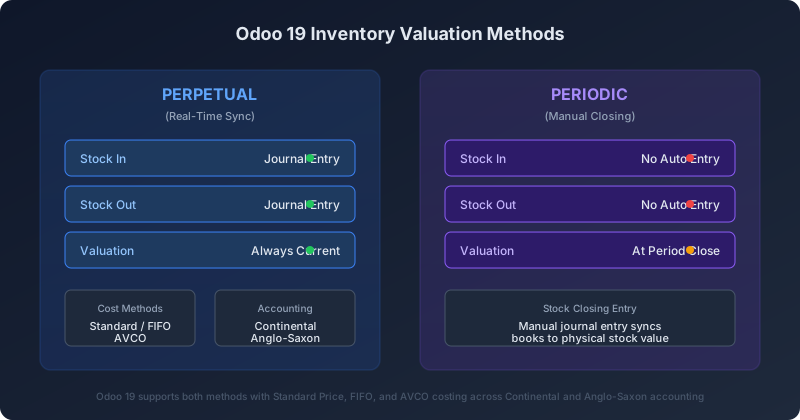
The core architectural decision in Odoo 19’s valuation framework is the explicit split between perpetual and periodic valuation. These aren’t just configuration options — they represent fundamentally different philosophies about when your accounting books should reflect what’s happening in your warehouse.
Perpetual valuation does exactly what the name implies: every stock movement generates a journal entry in real time. When goods come in, the system debits your stock valuation account and credits a stock input account. When goods go out, the reverse happens. Your balance sheet is always current because the accounting system is updated the moment inventory moves. This is the method most companies want, and for good reason — it gives you an accurate picture of your assets at any given moment without waiting for month-end reconciliation.
Periodic valuation takes the opposite approach. Stock movements happen without generating journal entries. Instead, the accounting team manually creates a stock closing entry at the end of each period — monthly, quarterly, annually, whatever the business requires — to synchronize the books with the physical stock value. This is common in smaller businesses or in industries where the operational overhead of tracking every individual stock movement in the general ledger isn’t justified by the accuracy it provides.
The important thing about Odoo 19’s implementation is that both methods are first-class citizens. Previous versions handled perpetual valuation well but treated periodic as an afterthought. The new framework gives periodic valuation its own dedicated workflow, complete with a structured stock closing entry process that walks accountants through the reconciliation instead of leaving them to figure out the journal entries on their own.
Three Cost Methods, Each With Its Own Trade-Offs
Layered on top of the valuation method choice is the costing strategy. Odoo 19 supports three: Standard Price, FIFO (First In, First Out), and AVCO (Average Cost). Each serves a different type of business, and picking the wrong one can create months of accounting headaches before anyone notices.
Standard Price assigns a fixed cost to each product. The value of your inventory is simply quantity multiplied by the standard price. It’s clean, predictable, and easy to understand, which makes it popular with manufacturers who control their input costs and don’t experience significant price fluctuations from purchase to purchase. The downside is that standard prices need periodic review — if your actual purchase costs drift from the standard, you’re building up variances that will eventually need to be addressed.
FIFO assumes that the oldest inventory is sold first. Each unit carries the actual cost at which it was purchased, and when you sell or consume stock, the system uses the cost of the earliest remaining units. This gives you the most accurate cost of goods sold figure in environments where purchase prices change frequently, but it also means the system is tracking individual cost layers for every product — which adds computational complexity and makes certain reports harder to interpret at a glance.
AVCO recalculates the average cost of a product every time new stock is received. If you have 100 units at ten dollars each and you receive 50 more at twelve dollars each, your new average cost becomes $10.67. It smooths out price fluctuations without ignoring them entirely, which makes it a solid middle ground for businesses that want accuracy without the complexity of individual cost layer tracking.
Continental and Anglo-Saxon: The Accounting Standard Split
One of the subtler aspects of the new valuation framework is its explicit handling of Continental and Anglo-Saxon accounting standards. This distinction matters more than most ERP users realize, because it determines when cost of goods sold is recognized — and getting the timing wrong means your profit margins are misstated until the error is corrected.
In Continental accounting (common across most of Europe), expenses are recognized when the vendor bill is posted. The cost of goods shows up in your expense accounts at the moment you record the liability to your supplier, regardless of when you actually sell those goods to a customer.
Anglo-Saxon accounting (used primarily in the US, UK, and Commonwealth countries) takes a different approach: COGS is recognized when the customer invoice is posted. The cost stays on the balance sheet as an asset until the sale is recorded, at which point it moves to the income statement. This creates a tighter match between revenue and the cost of generating that revenue, but it also means the system needs to track the flow of costs through interim accounts with more precision.
Odoo 19 handles both standards through the account configuration on product categories. The system uses different journal entry patterns depending on which standard is active, and the account setup guides make it clear which accounts serve which purpose under each standard. This is a meaningful improvement over previous versions, where the distinction existed but wasn’t always surfaced clearly enough for accountants to configure with confidence.

The Valuation Report: Four Numbers That Tell the Whole Story
The new Inventory Valuation Report in Odoo 19 is built around four components: Initial Balance, Inventory Loss, Stock Variation, and Ending Stock. It sounds simple, and that’s precisely the point. Previous valuation reports tried to show everything at once and ended up being useful only to people who already understood what they were looking at. The new structure tells a story that flows from beginning to end.
Initial Balance is your opening stock value at the start of the reporting period. Inventory Loss captures everything that reduced your stock value without a corresponding sale — scrap, damage, inventory adjustments from cycle counts, theft, expiration. Stock Variation is the net change from normal business operations: purchases coming in, sales going out, returns in both directions. Ending Stock is the result of those three numbers combined, and it should match (or closely approximate) the physical value of what’s sitting in your warehouse.
When those numbers don’t match, the report becomes a diagnostic tool. A large Inventory Loss figure that doesn’t correspond to known scrap events suggests a counting problem or an unrecorded damage event. A Stock Variation that doesn’t align with purchasing and sales records points to missing or miscategorized transactions. The report doesn’t just tell you what your inventory is worth — it tells you whether you can trust that number.
Stock Closing Entries: Periodic Valuation Done Right
For businesses using periodic valuation, the stock closing entry process in Odoo 19 is where the rubber meets the road. At the end of each period, the accounting team needs to create journal entries that bring the general ledger in line with the actual stock value. In previous versions, this was largely a manual exercise — you pulled the valuation numbers, calculated the difference, and created the journal entries yourself.
Odoo 19 structures this process into a guided workflow. The system calculates the difference between the book value and the stock value based on the valuation report, and generates the corresponding journal entry for review. The accountant can inspect it, adjust if needed, and post it. It’s not fully automated — periodic valuation inherently requires human judgment — but it eliminates the error-prone step of manually computing the closing adjustment.
Accrual Entries: Revenue Recognition Based on Delivery, Not Invoicing
A less obvious but equally important part of the new framework is the accrual entry system. In many businesses, the timing of invoices doesn’t match the timing of deliveries. You might deliver goods to a customer in March but not invoice until April. Or you might receive goods from a vendor in February but not get billed until March. In both cases, the economic event (the delivery) happened in one period, but the accounting event (the invoice) happens in another.
Odoo 19’s accrual entries close this gap by allowing businesses to recognize revenue and expenses based on when goods are actually delivered, not when invoices are processed. This produces more accurate period-end financial statements and eliminates the kind of lumpy revenue and expense patterns that make month-over-month comparisons unreliable.
For companies that operate on accrual-basis accounting (which is most companies of any significant size), this isn’t optional — it’s a requirement. But implementing it has traditionally required careful manual tracking or custom automation. Having it built into the core valuation framework means it works out of the box, with the same data that’s already flowing through the inventory and accounting modules.
The Migration Path: Upgrading Without Burning It All Down
Perhaps the most pragmatically important part of the Odoo 19 valuation overhaul is the migration path. Companies running earlier versions of Odoo with established inventory valuation configurations face a real challenge: the new framework reorganizes how stock interim accounts work, which means existing balances need to be rebalanced during the upgrade.
Odoo 19 provides two migration options. The first is a server action that automates the rebalancing — it reads the existing interim account balances, calculates what needs to move where under the new structure, and creates the adjustment entries. The second is a manual process for companies that prefer to review and create the journal entries themselves, with clear documentation of exactly which accounts need to be debited and credited.
The fact that both options exist is significant. Automated migration works for most companies, but accountants at larger organizations often insist on reviewing every journal entry that touches core accounts. Having a documented manual path means the finance team doesn’t have to trust a black-box migration script with numbers that ultimately end up on audited financial statements.
What This Means for the Accounting Team
The inventory valuation overhaul in Odoo 19 is fundamentally an accounting feature, and its success will be measured by how well it serves the people who close the books every month. The dual-method support means companies can choose the valuation approach that matches their accounting practices, not the one that the ERP happens to support best. The structured valuation report gives accountants a reliable starting point for period-end reconciliation. The guided closing entry process reduces the risk of errors in one of the most consequential parts of the monthly close.
Most importantly, the migration path means companies can actually adopt these improvements without a greenfield reimplementation. Inventory valuation is one of those areas where historical data matters enormously — you can’t just switch to a new system and ignore five years of cost layer data. Odoo 19’s approach of providing both automated and manual migration options suggests that the development team understands this constraint and designed accordingly. For the accounting teams who will ultimately live with this system, that attention to the transition is arguably more important than any individual feature.