Payroll is where ERP ambitions meet local reality. A platform can promise to run your entire business from a single interface, but if it can’t calculate the right statutory deductions for the country where your employees actually work, it’s just a fancy invoicing tool. Odoo has been steadily closing these gaps, and the latest round of payroll localizations adds two significant entries to the map: Kenya and a substantially reworked Australia.
Kenya: From Zero to Compliant
The Kenyan payroll localization is entirely new — not an incremental update to something that existed before, but a ground-up implementation of the statutory framework that Kenyan employers must follow. For the growing number of East African businesses running Odoo, this eliminates the need for external payroll software or manual calculations that invite errors.
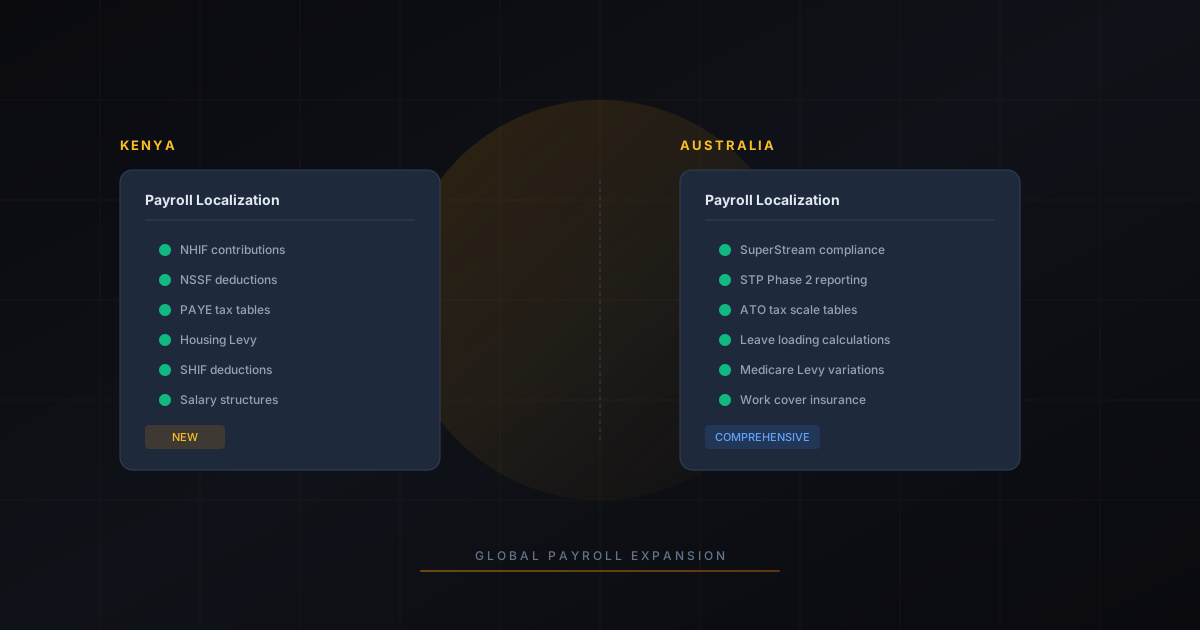
The localization covers the full stack of Kenyan statutory deductions. NHIF contributions — the National Hospital Insurance Fund that provides basic healthcare coverage — are calculated according to the current graduated scale based on gross salary. NSSF deductions follow the National Social Security Fund rates, including the newer Tier I and Tier II contribution structures that Kenya introduced in recent years.
PAYE — Pay As You Earn — uses the Kenya Revenue Authority’s progressive tax bands, applied automatically based on taxable income after allowable deductions. The system handles the tax relief amounts that reduce the effective tax burden, including personal relief and insurance relief where applicable.
Two newer statutory requirements are also baked in. The Housing Levy, which Kenya introduced to fund affordable housing development, applies as a percentage of gross salary with matching employer contributions. SHIF — the Social Health Insurance Fund that recently replaced aspects of the NHIF framework — is calculated according to current rates, ensuring employers stay compliant with the evolving regulatory landscape.
The salary structures are preconfigured to reflect typical Kenyan employment arrangements, with the statutory deductions wired into the correct sequence so that PAYE is calculated after NHIF, NSSF, and other pre-tax deductions are applied. This ordering matters — getting it wrong means either underpaying or overpaying taxes, both of which create problems with the KRA.
Australia: Depth Over Breadth
While Kenya represents a new market entry, the Australian payroll overhaul is about depth. Australia’s payroll requirements are notoriously complex — a thicket of federal and state regulations, industry-specific awards, and reporting obligations that have sent many international software vendors running in the other direction.
The centerpiece of the Australian localization is SuperStream compliance. SuperStream is the Australian government’s electronic standard for superannuation data and payments — the system that ensures employer contributions to employee retirement funds flow through standardized channels rather than ad-hoc bank transfers. Getting SuperStream wrong can mean penalties from the ATO, so having it handled natively in the payroll module removes a significant compliance burden.
Single Touch Payroll Phase 2 reporting is the other major compliance feature. STP Phase 2 expanded the reporting requirements that employers must submit to the Australian Taxation Office with each pay run, adding granular breakdowns of income types, tax treatment codes, and country-specific payment categories. The Odoo implementation generates these reports directly from payslip data, formatted for ATO submission without manual data entry.
The Details That Actually Matter
Beyond the headline compliance features, the Australian localization addresses the practical details that trip up payroll teams. ATO tax scale tables are built in — the graduated withholding rates that determine how much income tax to deduct from each pay period based on the employee’s claimed tax-free threshold, dependents, and other factors.
Leave loading calculations handle the peculiarly Australian practice of paying employees an additional percentage on top of their annual leave entitlement — typically 17.5%, though the rate varies by award and enterprise agreement. It’s the kind of detail that doesn’t exist in most other countries and tends to be forgotten by international software vendors until someone files a complaint.
Medicare Levy variations are supported, covering the scenarios where employees claim reductions or exemptions based on income thresholds, family status, or other qualifying criteria. The system handles both the standard Medicare Levy and the Medicare Levy Surcharge that applies to higher-income employees without private health insurance.
Work cover insurance — the workplace injury insurance that Australian employers are required to carry — is factored into the payroll calculations with state-specific rates and industry classifications. This is another area where getting the details wrong creates real financial exposure, particularly for businesses operating across multiple Australian states with different work cover schemes.
The Strategic Play Behind the Localizations
Adding Kenya and deepening Australia in the same release cycle tells a specific story about Odoo’s expansion strategy. Kenya represents the East African market — one of the fastest-growing technology adoption regions on the continent, with a vibrant startup ecosystem and an increasing number of mid-sized businesses looking for integrated business software. Getting payroll right is the entry ticket.
Australia, by contrast, is about proving that Odoo can handle first-world regulatory complexity at a level that competes with entrenched local players like MYOB and Xero. A basic Australian payroll module has existed for some time, but the SuperStream and STP Phase 2 additions move it from “technically possible” territory into “we can actually run this in production” territory.
For businesses in either market, the practical question is simple: can you now run payroll entirely within Odoo, without a separate payroll service? For Kenya, the answer is yes, with the caveat that new localizations typically need a few pay cycles in production to shake out edge cases. For Australia, the answer is getting close to yes — the SuperStream and STP coverage are the features that were previously missing from the checklist.
Neither localization is a moonshot. They’re the kind of methodical, regulation-by-regulation work that doesn’t generate flashy demos but determines whether a business can actually sign a contract. In the ERP world, payroll compliance is table stakes — and Odoo just added two more countries to its hand.