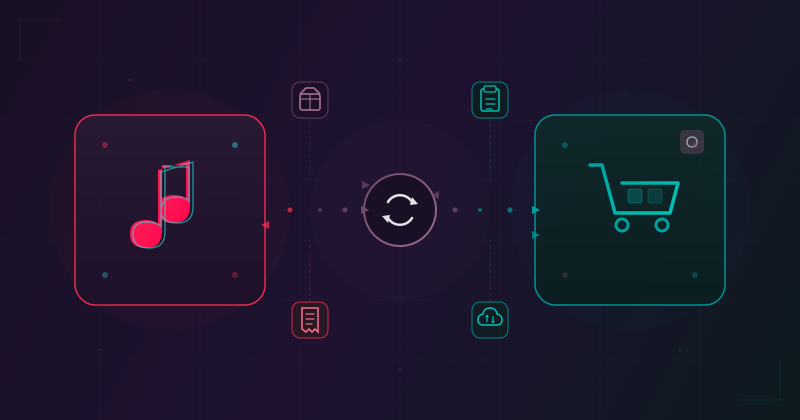
TikTok Shop has quietly become one of the fastest-growing e-commerce channels on the planet. What started as a “live selling” experiment bolted onto a short-video app now processes billions of dollars in merchandise across Southeast Asia, Latin America, and an expanding footprint in Europe and the United States. For brands and sellers who have built their back-office operations on Odoo, the question has been unavoidable: how do you connect the storefront where your customers are scrolling to the ERP where your inventory, fulfillment, and accounting actually live?
Odoo’s answer just shipped. A native TikTok Shop connector is now part of the platform’s Sales module, handling order synchronization, inventory updates, product catalog mapping, logistics coordination, and payment reconciliation — all without leaving the Odoo interface. It’s not a third-party plugin or a middleware service that sits between two systems and charges per transaction. It’s a first-party integration that treats TikTok Shop the same way Odoo already treats its own e-commerce front end.
Eighteen Marketplaces, One Back Office
The connector supports 18 TikTok Shop marketplaces spanning three continents. In the Americas, that covers the United States, Mexico, and Brazil. Across Asia, sellers can connect accounts in Indonesia, Malaysia, the Philippines, Singapore, Thailand, Vietnam, Japan, and South Korea. European coverage includes the United Kingdom, Ireland, France, Germany, Italy, Spain, and the Netherlands.
Each marketplace operates as its own seller account inside TikTok Shop, and Odoo mirrors that structure. A business selling skincare in the US and electronics in Southeast Asia can manage both channels from a single Odoo instance, with separate inventory pools, pricing, and fulfillment rules per marketplace. The multi-account architecture means sellers aren’t forced to collapse distinct regional operations into a single configuration — each marketplace gets its own connection, its own catalog mapping, and its own order pipeline.
Orders Flow In, Inventory Flows Out
The core of any marketplace connector is the order-inventory loop, and Odoo’s implementation handles both directions. When a customer places an order on TikTok Shop, the connector pulls it into Odoo as soon as it reaches the “awaiting shipment” or “awaiting collection” status. The order arrives with all the line-item detail — products, quantities, shipping address, payment status — and drops into the standard Odoo sales workflow. From there, it follows whatever fulfillment process the business already has in place: warehouse picking, packing, carrier assignment, delivery tracking.
Going the other direction, Odoo pushes available product quantities back to TikTok Shop on a synchronization schedule. When warehouse stock changes — whether from incoming purchase orders, manufacturing completions, or sales on other channels — the connector updates TikTok Shop’s available quantity to match. This is the kind of real-time inventory accuracy that prevents the twin nightmares of marketplace selling: overselling products you don’t have, and underselling because your listed quantities are stale.
Catalog Mapping That Meets You Where You Are
Product catalog synchronization is where marketplace connectors tend to get complicated, and Odoo’s approach acknowledges that sellers come to this integration from different starting points. The connector supports two catalog mapping workflows: importing the TikTok Shop catalog into Odoo, or mapping existing Odoo products to TikTok Shop item IDs.
The import path is straightforward. Sellers who already have a populated TikTok Shop catalog can pull those products into Odoo, creating new product records that are pre-linked to their TikTok counterparts. This is ideal for businesses that started selling on TikTok before adopting Odoo, or for sellers who maintain TikTok-exclusive product lines that don’t exist in their ERP yet.
The mapping path works in reverse. Businesses that already have a well-organized Odoo product catalog can link those existing records to TikTok Shop items without duplicating data. This prevents the product sprawl that plagues multi-channel operations — one canonical product record in the ERP, connected to however many marketplace listings it appears on. When a product description changes, a price updates, or a variant is discontinued, the change propagates from a single source of truth.
Logistics Without Leaving the ERP
TikTok Shop has its own logistics ecosystem, with supported carriers and fulfillment-by-marketplace (FBM) options that vary by region. The connector integrates with that logistics layer, allowing sellers to arrange package pickups with supported logistics providers directly from within Odoo. Delivery status updates for FBM orders flow back into the system, so warehouse teams and customer service representatives can track shipments without switching between platforms.
The practical benefit here is workflow consolidation. A warehouse manager processing outbound shipments doesn’t need to check TikTok Seller Center for FBM pickup schedules while simultaneously managing carrier dispatches through Odoo’s Inventory module. Both streams converge in the same operational view. For businesses fulfilling hundreds of social commerce orders per day, eliminating that context-switching adds up fast.
Payment Reconciliation That Actually Closes the Books
Marketplace payment flows are notoriously messy from an accounting perspective. The marketplace collects payment from the customer, takes its commission, and remits the balance to the seller — sometimes daily, sometimes weekly, sometimes in opaque lump sums that are difficult to match against individual orders. The TikTok Shop connector addresses this by pulling payment data into Odoo and connecting it to the corresponding sales orders, giving the accounting team a clean trail from customer payment to marketplace settlement to bank deposit.
This is the kind of feature that doesn’t make headlines but saves hours of manual reconciliation work every month. Without it, finance teams end up maintaining spreadsheets to bridge the gap between what TikTok reports and what the bank statement shows. With it, the reconciliation happens inside the same accounting module that handles every other revenue stream.
Why This Matters for Mid-Market Sellers
The significance of a native TikTok Shop connector goes beyond just adding another marketplace to Odoo’s supported list. It signals that social commerce has crossed the threshold from “experimental marketing channel” to “core revenue stream that needs proper ERP integration.”
For the past several years, brands selling on TikTok Shop have relied on a patchwork of third-party connectors, iPaaS platforms like Zapier or Make, or manual processes to bridge the gap between social commerce and back-office operations. Each of those approaches introduces latency, cost, and failure points. A native connector eliminates the middleware layer entirely, giving sellers the same tight integration with TikTok Shop that they already have with Odoo’s own Website and eCommerce modules.
The timing matters too. TikTok Shop is aggressively expanding into new markets, and sellers who can operationalize that channel quickly — with real-time inventory sync, automated order processing, and clean financial reporting — have a meaningful advantage over competitors still stitching things together manually. The connector also sits alongside Odoo’s existing Shopee integration, suggesting a broader marketplace strategy where social and traditional e-commerce platforms are treated as equal citizens in the ERP’s multi-channel architecture.
For sellers who have been waiting for their ERP to catch up with where their customers actually shop, this connector closes one of the last major gaps. TikTok Shop is no longer an island that needs its own operational workflow — it’s just another channel feeding into the same orders, inventory, and accounting engine that runs the rest of the business.