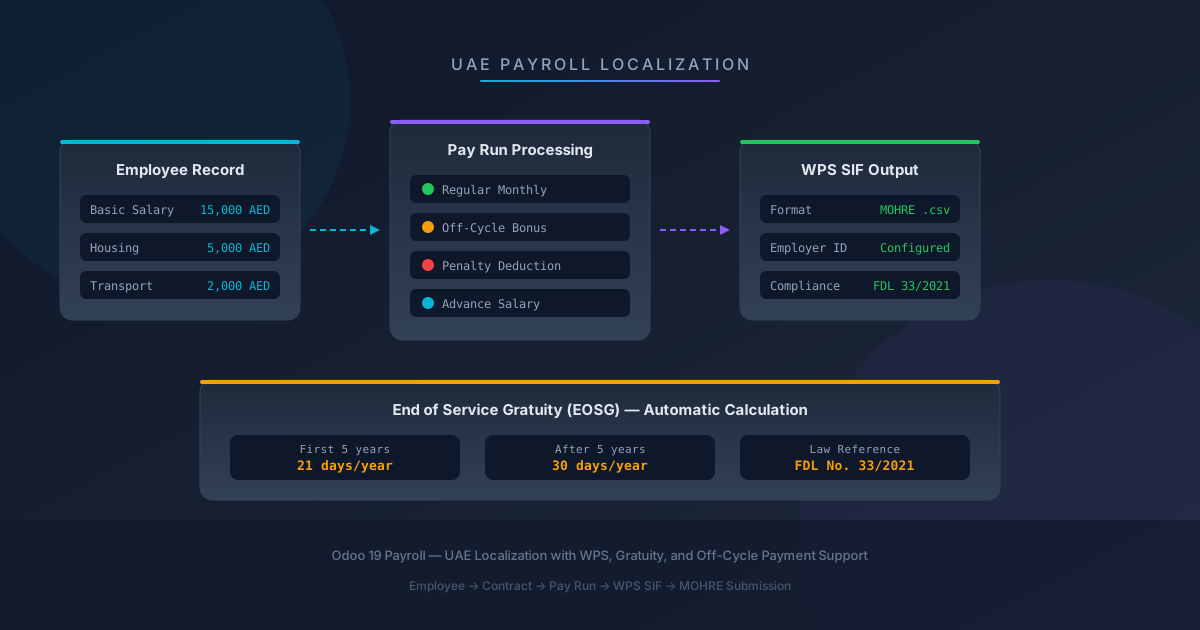
Running payroll in the UAE has always meant juggling two realities: the company’s internal salary structure and the government’s Wage Protection System requirements. Every month, employers submit Salary Information Files to MOHRE-approved banks proving that employees received exactly what their contracts promise. Get the format wrong, miss a deadline, or submit inconsistent data, and the penalties pile up fast.
Odoo 19 just made that entire process significantly less painful. The latest update to the UAE payroll localization introduces instant off-cycle payments, tighter WPS integration, and a payroll interface that finally treats the employee record and contract as a single entity instead of two disconnected screens.
Off-Cycle Payments That Actually Work
The headline change is a new instant payment structure for salaries, bonuses, and penalties that fall outside the regular monthly cycle. In previous versions, handling an advance salary or a mid-month bonus meant creative workarounds — manual journal entries, standalone payslip runs with adjusted dates, or worse, processing the payment outside Odoo entirely and reconciling later.
Now there’s a dedicated off-cycle payment type sitting alongside the regular monthly pay run. You select the payment category — advance salary, penalty deduction, or ad-hoc bonus — and the system generates a compliant payslip with the correct salary rules applied. The payment flows through the same WPS pipeline as regular payroll, which means the SIF file includes it automatically. No separate submission, no manual reconciliation.
Pay Runs Replace Batches
The old “Batches” concept is gone. In its place, Odoo 19 introduces Pay Runs — a guided workflow that walks payroll specialists through each stage of processing, from draft through validation to payment. The terminology change is more than cosmetic. The new interface surfaces each step explicitly, with validation checks at every stage that catch errors before they reach the bank.
Multiple bank accounts per employee are now supported natively. For companies with staff who split salary deposits between a savings account and a current account — common in the UAE where many employees send a portion of their salary to home-country accounts — this eliminates a significant manual overhead.
The Contract and Employee Record Merge
Anyone who has used Odoo payroll in previous versions knows the frustration of toggling between the employee profile and the contract form. Salary details live on the contract, personal details on the employee record, and tracking a promotion means checking both screens and hoping the dates line up.
Odoo 19 merges these into a unified record with a timeline view. You can see every contract change, salary revision, transfer, and role update in a single chronological view. For auditing purposes — and in the UAE, audits are frequent — this is a genuine improvement. No more piecing together employment history from scattered records.
WPS Compliance on Autopilot
The Wage Protection System integration tightens up in several ways. The SIF file generation now happens from a single configuration screen under Payroll → Configuration → Settings, where you set your Employer Unique ID and preferred output format. From there, generating the MOHRE-compliant CSV or TXT file is a one-click operation — either per individual payslip or for an entire pay run batch.
Emiratisation data tracking is also built in. The system maintains the nationality and visa data needed for MOHRE reporting, and the SIF output includes the required fields automatically. For companies approaching Emiratisation quota thresholds, this visibility matters — the data is always current because it’s tied to the employee record that HR updates as part of their normal workflow.
End-of-Service Gratuity Calculations
The gratuity calculation engine now follows Federal Decree-Law No. 33 of 2021 out of the box. For the first five years of service, the system calculates 21 days of basic salary per year. After five years, it switches to 30 days per year. The total is capped at two years’ gross salary, as the law requires.
What makes this useful beyond simple math is the integration with the contract timeline. When an employee’s basic salary changes mid-year — a promotion, a cost-of-living adjustment — the gratuity calculation uses the correct salary for each period automatically. Previous versions required manual override, and most companies ended up calculating gratuity in spreadsheets and entering the result as a lump sum.
Working Entries and Attendance
A smaller but meaningful change: payroll specialists can now choose whether working entries should include extra hours based on Attendance records. This is configurable per company, so organizations that pay overtime based on time tracking can enable it while those on fixed salaries can leave it off. The setting lives at the company level, not the employee level, which keeps the configuration manageable for multi-entity setups common in UAE free zones.
What This Means for UAE Operations
The combination of off-cycle payments, automated WPS file generation, merged employee-contract records, and compliant gratuity calculations closes most of the gaps that previously pushed UAE companies toward dedicated payroll platforms or custom development. For small and mid-sized employers running their operations on Odoo, this update removes the strongest argument for maintaining a separate payroll system.
The timing matters too. UAE labor law enforcement has been tightening consistently, with MOHRE increasing the frequency of WPS compliance checks. Having the submission pipeline built into the same system that manages contracts, attendance, and accounting means fewer opportunities for data to fall out of sync — which is where most compliance failures originate.