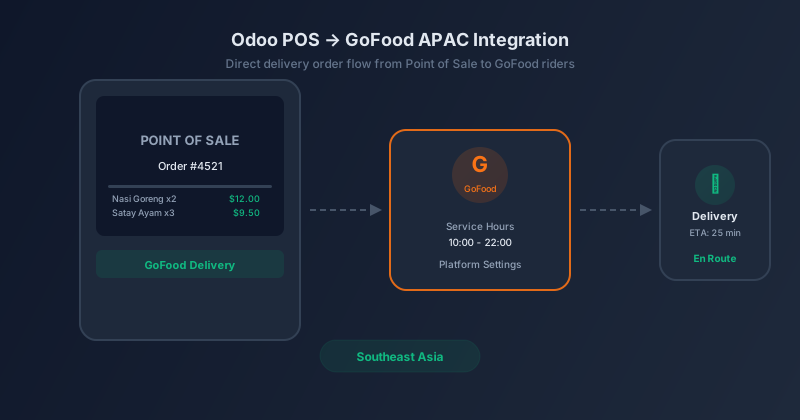
If you run a restaurant anywhere in Southeast Asia, your delivery business probably runs through GoFood or GrabFood. Until now, managing those orders alongside your dine-in traffic meant toggling between a delivery tablet and your POS system — two screens, two product catalogs, two pricing structures that inevitably drift out of sync. That just changed.
Odoo’s Point of Sale module has added native support for APAC food delivery platforms, starting with GoFood and including GrabFood. The integration doesn’t route through a middleware layer or a third-party aggregator. Orders from delivery apps flow directly into the same POS interface where walk-in customers are served, using the same product catalog, the same kitchen workflow, and the same end-of-day reporting.
How the Setup Works
The configuration has two layers: platform-wide settings and per-outlet details. At the platform level, you define service hours — when your restaurant accepts delivery orders — and which products are available on delivery platforms versus dine-in only. This means you can keep your lunch-only specials off GoFood during dinner service, or offer a delivery-exclusive menu that doesn’t clutter your in-house POS.
For GoFood specifically, the setup involves connecting to the GoBiz Developer Portal to obtain API credentials — a Client ID and Client Secret pair that authenticates the link between your Odoo instance and GoFood’s infrastructure. Once those credentials are entered in Odoo’s provider configuration, each physical restaurant location gets linked to its corresponding GoFood outlet using the GoBiz Outlet ID.
This per-outlet linking is more than just an ID mapping. Each outlet can maintain its own pricelist for delivery orders. That’s significant for multi-location operators: your downtown restaurant can charge delivery prices that reflect its market, while your suburban location runs a different rate card, all managed from the same Odoo backend.
Menu Synchronization Without the Manual Data Entry
One of the most tedious parts of working with food delivery platforms has always been menu management. You update a price in your POS, then remember you need to update it on GoFood, then realize the description is slightly different on GrabFood, and before long your menus are a mess of inconsistencies that confuse customers and create accounting headaches.
The integration includes a menu synchronization mechanism that pushes your Odoo product catalog — names, descriptions, prices, and availability — to the connected delivery platform. When you change a price or add a new item in Odoo, the delivery platform reflects the change. The POS product catalog becomes the single source of truth, which is where it should have been all along.
Order Flow: From App to Kitchen
When a customer places a GoFood order, it arrives in the POS as a delivery order with full details — items, quantities, special instructions, and customer information. The restaurant staff sees it alongside their regular orders, which means the kitchen doesn’t need a separate screen or a different process for delivery prep.
The system also handles the less pleasant side of delivery operations: order rejections. If the kitchen can’t fulfill an order — an ingredient ran out, the kitchen is backed up, or the order came in after the cutoff time — the POS provides structured rejection reasons that feed back to GoFood. This keeps the restaurant’s platform reputation clean by providing context rather than silent cancellations.
Why This Matters Beyond Convenience
The real value here isn’t just fewer screens to look at. It’s the data consolidation. When delivery orders and dine-in orders run through the same system, the end-of-day close captures everything. Inventory drawdowns are accurate because every sold item — whether it walked out the door on a plate or in a delivery bag — came from the same stock count. Revenue reporting doesn’t require manually combining numbers from two systems. And the accounting entries are correct from the start, because the delivery revenue, platform commissions, and product costs all flow through the same journal structure.
For multi-location restaurant groups operating across Indonesia, Thailand, Vietnam, and the broader APAC region, this eliminates an entire category of operational friction. The delivery platform integration is the piece that was missing from Odoo’s restaurant POS story in this part of the world, and GoFood — with GrabFood alongside it — is the right place to start.