The Problem With “How Many Years?”
Ask an Italian accountant how they depreciate a delivery van and they’ll give you a percentage — 20%, straight off the ministerial tables. Ask the same question in most ERP systems and you’ll get a duration field: five years, enter it here, and the software will divide the purchase price accordingly. The math arrives at the same place, but the logic starts from opposite ends, and when tax authorities publish rates as percentages, forcing accountants to reverse-engineer a duration introduces rounding errors and audit friction that nobody needs.
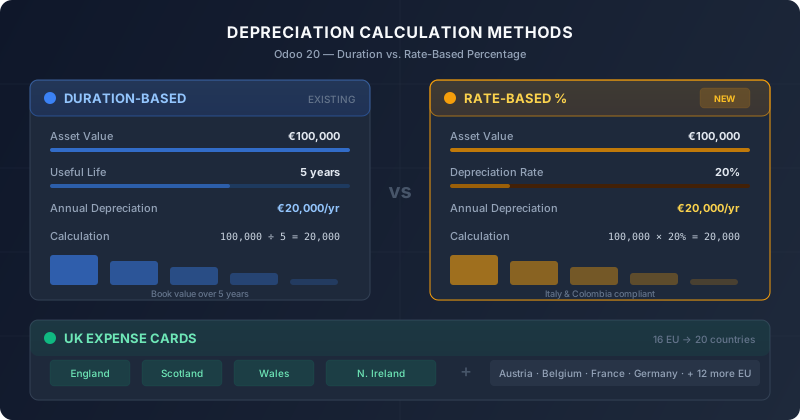
Odoo 20 now lets you define depreciation by rate. Instead of entering a useful life in months or years, you enter the annual depreciation percentage directly. The system multiplies the depreciable base by that rate each period. It’s a small toggle in the depreciation model configuration, but it closes a gap that has kept Italian and Colombian businesses reaching for workarounds since those localizations first shipped.
Why Italy and Colombia Needed This First
Italy’s civil code and its ministerial coefficient tables prescribe depreciation rates by asset category — 20% for vehicles, 12% for furniture, 15% for electronic equipment. Colombian tax law works similarly: the Estatuto Tributario defines maximum rates rather than fixed useful lives. Both regimes expect the depreciation schedule on your books to reference the rate, not a derived duration.
Until now, the only option was to convert: a 20% rate becomes a 5-year life, a 12% rate becomes 8.33 years (round to 8 or 100 months and accept the penny discrepancy). For companies managing dozens of asset categories, that conversion layer was a persistent source of minor mismatches between what the tax tables say and what the depreciation board shows. Auditors noticed. Now the numbers match because they’re calculated the same way the regulation specifies.
“Asset Models” Become “Depreciation Models”
Alongside the rate-based calculation, Odoo has renamed Asset Models to Depreciation Models. It’s not just a label change. The rename signals a conceptual shift: the model defines how the asset loses value, not what the asset is. A depreciation model now carries the method (straight line, declining, declining-then-straight-line, or none), the computation basis (prorata or constant periods, with an optional day-count toggle), and either a useful life or a depreciation rate — depending on which calculation mode you choose.
The settings interface has been reorganized into three tabs: Asset (the core identification and account mapping), Depreciation Board (the schedule and method configuration), and Bills (the automation rules that connect incoming vendor bills to new asset records). It’s a cleaner separation that makes it harder to misconfigure the relationship between an asset account and its depreciation behavior.
Splitting a Vendor Bill Into Multiple Assets
Here’s a workflow that anyone managing capital equipment has wanted: you receive a vendor bill with a single line for “Office Furniture — 12 desks” totaling €24,000. Accounting needs one asset record per desk because each one has its own location, its own useful life in practice, and might be disposed of independently. Previously, you’d either create 12 manual asset entries or ask the vendor for 12 separate lines on the invoice.
Odoo 20 adds a Split function accessible from the Journal Items smart button on the asset form. Select a vendor bill line that generated an asset, split it, and the system creates multiple asset records from that single line — each with its own depreciation schedule, its own book value, and its own lifecycle. It’s the kind of feature that saves fifteen minutes per bill for companies with high-volume capital purchases, and over a year, those minutes compound into real operational capacity.
The Full Disposal Toolkit
Asset disposal has also been restructured into distinct actions: Dispose (write off to zero), Sell (record proceeds and recognize gain or loss), Re-evaluate (adjust the book value mid-life), Pause (freeze depreciation during downtime or storage), and Activate Depreciation (resume after a pause). Each action generates the appropriate journal entries automatically. The old process of manually constructing disposal journal entries and hoping you remembered to reverse the accumulated depreciation is gone.
UK Businesses Get Expense Cards
In a separate but equally welcome change, Odoo’s expense card feature — the corporate cards that integrate directly with the expense tracking module — has expanded from 16 EU countries to 20. The new additions are England, Scotland, Wales, and Northern Ireland, each listed individually rather than as a blanket “United Kingdom” entry, reflecting how the system maps company addresses to country eligibility.
For UK-based businesses running Odoo, this fills a post-Brexit gap. When the UK left the EU, it dropped off the original expense card availability list, which was tied to European payment infrastructure. Re-adding the four UK nations means companies registered in London, Edinburgh, Cardiff, or Belfast can now issue and reconcile Odoo expense cards without routing through a subsidiary registered in an EU member state. The existing 16 EU countries — Austria, Belgium, Croatia, Cyprus, Estonia, Finland, France, Germany, Greece, Ireland, Italy, Latvia, Lithuania, Luxembourg, Malta, and the Netherlands, plus Portugal, Slovakia, Slovenia, and Spain — remain unchanged.
What This Means in Practice
The depreciation changes are targeted but high-impact. If you run an Italian or Colombian localization, rate-based depreciation eliminates the conversion step that has been a source of audit findings for years. If you manage assets in any other country, you now have the option to work in percentages when that’s what your internal policy or insurance schedules use. And if you’re in the UK, your finance team can finally stop envying the expense cards that their EU counterparts have had since launch.