There’s a ceiling that every growing Odoo deployment eventually hits. Not a hard crash — more like a slow suffocation. Dashboards take seven seconds instead of two. Month-end reports that used to generate during a coffee break now need a lunch break. The search bar develops a noticeable lag that makes power users quietly furious. The database is doing too many things at once, and no amount of PostgreSQL tuning or index optimization can change the fundamental math: one database instance serving thousands of users has a throughput ceiling, and the ceiling gets lower every time someone opens a pivot table.
Odoo 20 addresses this head-on with native read-replica database support — the kind of infrastructure change that doesn’t make for exciting screenshots but fundamentally alters what size of organization can run on Odoo without architectural gymnastics.
The Problem With a Single Database
Every ERP system runs on a simple premise: one database holds the truth. Sales orders, inventory counts, accounting entries, employee records — it all lives in one PostgreSQL instance. When a warehouse worker scans a barcode, it writes to that database. When the CFO opens the profit-and-loss report, it reads from the same database. When an integration pulls order data through the API, same database.
This works beautifully at scale ranges that cover most businesses. Odoo 17 could comfortably serve around 2,000 to 3,000 concurrent users. Version 18 pushed that to roughly 5,000 through framework optimizations and smarter caching. Version 19 added another layer of UI performance gains — the much-touted 40% speed improvement across the interface — which helped, but the database bottleneck remained unchanged underneath.
The issue isn’t write operations. A busy Odoo instance might process a few hundred writes per second during peak hours — creating invoices, confirming orders, posting journal entries. That load is manageable. The problem is reads. Dashboards, reports, searches, list views, kanban aggregations, pivot tables, and graph views all generate read queries. A single dashboard widget might fire a dozen queries. Multiply that by a few hundred users with dashboards open, add a batch of scheduled reports generating in the background, and the read load dwarfs the write load by an order of magnitude.
Those read queries compete with write transactions for the same database resources — CPU, memory, I/O bandwidth, and connection pool slots. A heavy report scanning millions of journal entries can starve write operations of the connections they need to confirm a sales order. This is the architectural constraint that no amount of query optimization can fully solve: reads and writes are competing for the same physical resources.
How Read Replicas Change the Equation
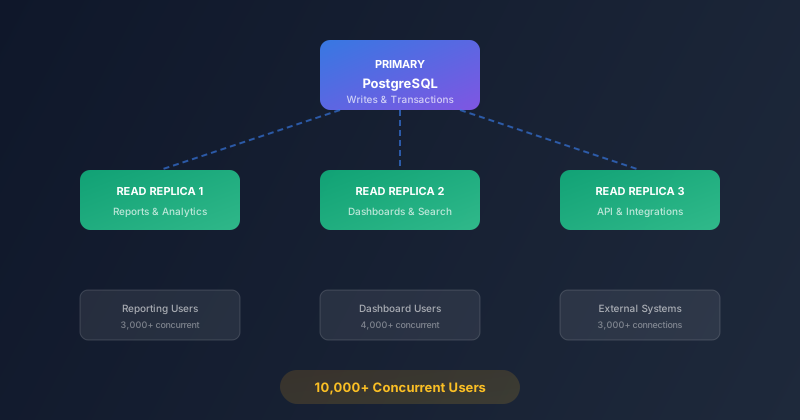
The concept behind read replicas is not new. Large-scale web applications have used them for decades. The primary database handles all write operations — the canonical source of truth for every transaction. One or more replica databases receive a continuous stream of those changes through PostgreSQL’s built-in streaming replication. The replicas are read-only copies, typically lagging behind the primary by a few milliseconds at most.
What Odoo 20 introduces is the application-level intelligence to route queries to the right place. When a user creates a sales order, that write goes to the primary. When the same user opens their dashboard a moment later, those read queries route to a replica. The routing is transparent — the user doesn’t know or care which database answered their request. The framework makes the decision based on the operation type.
This separation has an outsized impact on performance. The primary database, unburdened of the heaviest read load, can process writes faster and with lower latency. The replicas, freed from competing with write locks and transaction isolation overhead, can serve dashboards and reports at full speed. Each replica can be sized and tuned independently — a replica dedicated to reporting might have more memory allocated for query caching, while an API-serving replica might be optimized for connection throughput.
What Gets Routed Where
Not every read operation is a candidate for replica routing. Odoo 20 categorizes read operations based on their consistency requirements. After a user writes data — say, confirming an order — any immediate reads from that same user need to see the write they just made. Showing stale data to the person who just changed it would be disorienting. These read-after-write scenarios continue hitting the primary.
The operations that route to replicas are the heavy, non-interactive reads: dashboard aggregations, scheduled report generation, search queries in list and kanban views, pivot table computations, and external API calls that pull data for integrations. These operations tolerate a few milliseconds of replication lag without any user-visible impact. A dashboard showing this month’s revenue doesn’t become wrong because it’s 50 milliseconds behind the latest invoice posting.
The framework also handles edge cases around transactions. If a background job writes data and then immediately queries it — a common pattern in scheduled actions and automation rules — the framework keeps those queries on the primary to avoid stale-read bugs. Only queries that originate from a new request context, with no preceding writes in the same transaction, are eligible for replica routing.
The Numbers: From 5,000 to 10,000 and Beyond
The headline figure making the rounds is 10,000 concurrent users, up from the roughly 5,000 ceiling that Odoo 19 could handle in optimized deployments. But the more interesting number is the reporting throughput. In single-database deployments, heavy reporting jobs — the kind that finance teams run at month-end, scanning every journal entry from the past year — could degrade interactive performance for everyone else on the system. With reporting routed to a dedicated replica, the CFO can generate their consolidated profit-and-loss while the sales team keeps quoting without noticing a thing.
The scaling is also more linear than what vertical hardware upgrades offer. Doubling the RAM and CPU on a single database server doesn’t double the throughput — there are diminishing returns from lock contention, context switching, and I/O bottlenecks. Adding a second read replica, by contrast, roughly doubles the read capacity because the workload distributes across independent instances with their own memory and CPU. This is the difference between scaling up and scaling out, and it’s the reason that every major database-backed application eventually adopts some form of read replication.
What This Means for Deployment Architecture
For Odoo.sh hosted deployments, the read-replica setup will be handled at the platform level — provisioning replicas becomes a configuration choice rather than an infrastructure project. For self-hosted deployments, organizations need to set up PostgreSQL streaming replication, which is a well-documented and widely understood practice. The Odoo server configuration gains new parameters for specifying replica connection strings and routing policies.
The practical implication for most organizations is that the hardware cost of scaling Odoo shifts. Instead of investing in progressively larger single-server configurations — the 64-core, 512GB RAM machines that large Odoo deployments sometimes end up on — organizations can distribute across multiple smaller instances. Three modestly sized database servers, one primary and two replicas, can outperform a single large server while costing less and providing better fault tolerance.
It also changes the conversation around real-time integrations. One of the persistent challenges with large Odoo deployments has been external systems that poll the API frequently — business intelligence tools, warehouse management systems, e-commerce frontends pulling stock levels. Each of these connections adds read load to the primary database. With replicas, these integrations can point at a dedicated instance, completely isolating their impact from interactive users.
The Broader Significance
Read replication is table stakes for enterprise database applications, and its absence from Odoo has been a legitimate objection raised during enterprise evaluations for years. CIOs comparing Odoo against SAP or Oracle could point to the single-database architecture as a scalability concern — a fair criticism, even if the actual user count for most Odoo deployments never approached the ceiling.
By shipping native read-replica support in version 20, Odoo removes that objection from the evaluation checklist. The 10,000 concurrent user figure puts it in range for large manufacturing groups, retail chains with hundreds of locations, and distributed service organizations that might have thousands of field workers accessing the system simultaneously. These are the market segments where Odoo has been gaining ground against traditional enterprise ERP vendors, and removing the database architecture constraint clears a significant barrier to those larger deals.
The timing coincides with Odoo Experience 2026, scheduled for September 24–26 in Brussels, where version 20 will be officially unveiled. Between the read-replica architecture, the agentic AI capabilities that have been previewed, and the redesigned mobile experience, this release is shaping up to be the most infrastructure-focused Odoo version in years — less about new modules and more about making the existing platform viable at a scale that previous versions couldn’t reach.