Commission Plans Get a Proper Architecture
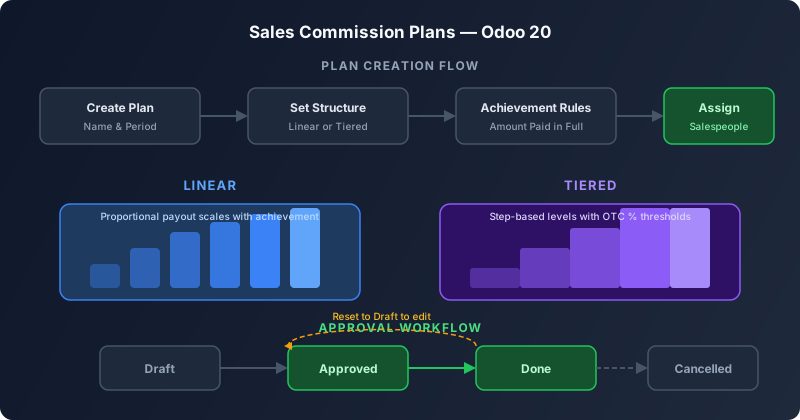
For several versions, Odoo’s sales commission setup felt like an afterthought bolted onto the Sales module. You could define a plan, set some rules, and hope the configuration held together as your sales team grew. With Odoo 20, the commission system has been rebuilt from the ground up. The plan creation form now walks administrators through a structured sequence: name the plan, define an effective period capped at one year, choose a target frequency, and — critically — select a Structure type that determines how payouts are calculated.
That Structure field is new, replacing what used to be called “Based on.” It presents two clean options: Linear and Tiered. The rename isn’t cosmetic. It reflects a fundamental change in how Odoo thinks about commission math — not as a property of individual rules, but as an architectural decision that shapes the entire plan.
Linear Plans: Proportional Payouts That Scale Smoothly
A Linear commission plan does exactly what the name suggests. As a salesperson’s achievement climbs toward their target, the payout scales proportionally. Hit 60% of your target, earn roughly 60% of the maximum commission. There are no cliffs, no thresholds to clear — just a steady upward slope from zero to the ceiling. This model works well for teams where consistency matters more than big swings, and where management wants every incremental deal to feel rewarding.
The Linear structure is also the simpler one to configure. Set the target, set the maximum commission amount, and the system handles the interpolation. For sales organizations that previously cobbled together proportional logic using custom code or external spreadsheets, this is a native solution that finally removes the workaround.
Tiered Plans: Step-Based Commission Levels With OTC Thresholds
Tiered plans introduce a step function. Instead of a smooth curve, payouts jump at defined thresholds — each level carrying its own commission rate or fixed amount. The configuration lives in a dedicated Commissions tab where administrators add levels, each tied to an OTC (on-target commission) percentage. Sorting, filtering by OTC percentage, and deleting entries all work directly in the table, which means plan managers can build and iterate on complex multi-tier structures without leaving the form.
This is the model that aggressive sales cultures have always wanted from Odoo. It lets organizations create accelerators — the classic “hit 100% of quota and your commission rate doubles for everything above it” pattern that drives top performers. Previously, building this kind of structure required third-party modules or manual spreadsheet calculations applied outside the system. Now it’s a dropdown selection and a few rows in a table.
A New Achievement Metric: Amount Paid in Full
The achievement rules section — where administrators define what actually counts toward a salesperson’s target — gains a notable new option: Amount Paid in Full. This metric ties commission eligibility not just to closing a deal or generating an invoice, but to the customer actually paying. For businesses that deal with long payment cycles, disputed invoices, or high-value contracts where the gap between “sold” and “collected” can stretch for months, this changes the incentive structure fundamentally.
It’s a subtle but powerful shift. Sales teams incentivized on booked revenue often have no reason to care what happens after the handshake. Tying commissions to collected revenue aligns the salesperson’s interest with the company’s cash flow — a principle that compensation consultants have been recommending for years, but that most ERP systems make surprisingly difficult to implement natively.
Bulk Salespeople Assignment and the Dynamic Target Toggle
Assigning salespeople to a commission plan used to be a one-at-a-time affair. Odoo 20 adds bulk assignment, letting administrators add multiple reps to a plan in a single operation. Each assignment carries its own From and To date range, and when the plan’s Structure is set to “per Salesperson,” a Sum of Achievements column appears that aggregates each rep’s progress in real time. The system also auto-fills an Other Plans column showing what other commission plans each salesperson is enrolled in — a small but important visibility feature that prevents double-counting or conflicting incentives.
Alongside bulk assignment, the plan form now includes a Dynamic Target toggle. When enabled, the target adjusts based on the salesperson’s enrollment period relative to the plan’s effective dates. A rep who joins a quarterly plan halfway through gets a prorated target instead of being measured against the full quarter — an obvious fairness feature that was previously missing.
The Approval Gate: Draft, Approved, Done, Cancelled
Commission plans now follow a formal lifecycle. Every plan starts in Draft, where it can be freely edited. Once the configuration is final, an administrator approves it, locking the plan from further changes. This is a deliberate friction point — it prevents someone from tweaking commission rates mid-quarter after results start coming in, which is exactly the kind of move that destroys trust between sales teams and management.
If a plan does need to be edited after approval — a legitimate scenario when business conditions change — it must first be explicitly reset to Draft. This creates an audit trail: the plan was approved, then deliberately reopened, then re-approved. That paper trail matters for compliance, for internal governance, and for the kind of sales compensation disputes that every growing organization eventually encounters.
Why This Matters Beyond the Sales Team
Commission structures sound like a narrow Sales module concern, but they ripple through an entire organization. Finance needs to accrue commission liabilities. HR needs to understand total compensation. Executives need to model how different incentive structures affect margins. By giving commissions a proper architecture — with typed structures, auditable approval gates, and metrics tied to actual collections — Odoo 20 turns what was essentially a tracking tool into a compensation management system that finance and HR teams can actually trust.