For decades, AFIP—the Administración Federal de Ingresos Públicos—was the three-letter acronym that every Argentine business, accountant, and ERP administrator learned to navigate. Tax filings, electronic invoicing, withholding certificates, customs declarations: everything flowed through AFIP’s systems. That era is over. Argentina has consolidated its revenue functions under a new entity called ARCA, the Agencia de Recaudación y Control Aduanero, and the ripple effects are reaching every piece of software that touches Argentine fiscal compliance.
What ARCA Actually Changes
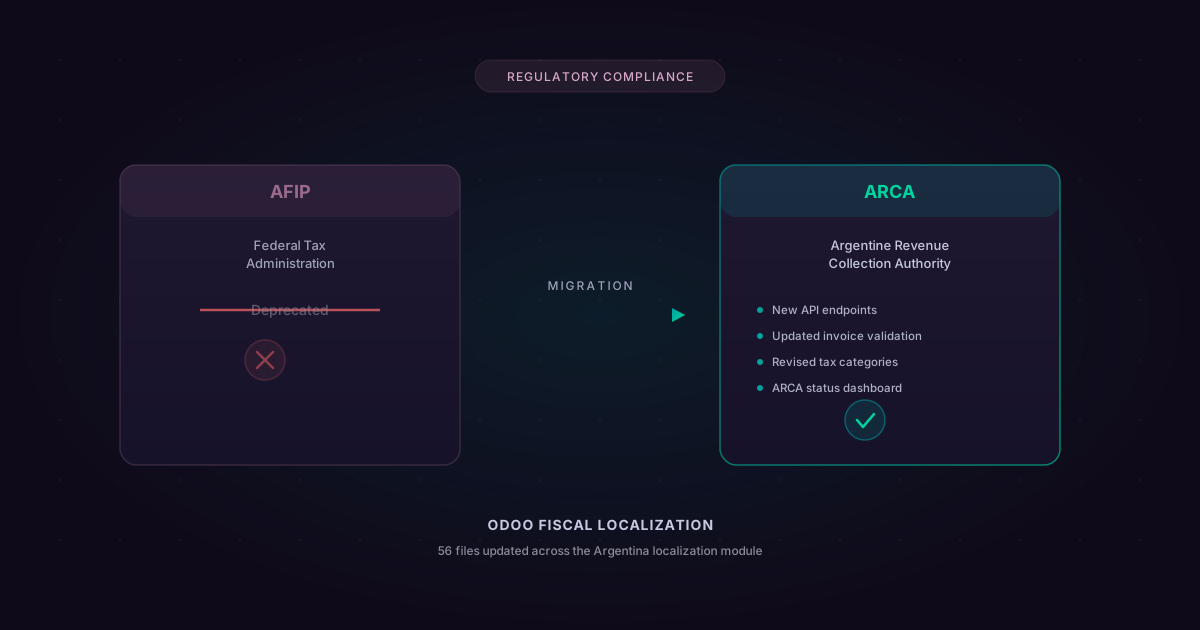
The transition from AFIP to ARCA is not a cosmetic rebranding exercise. While the core tax obligations remain largely the same—businesses still need to issue electronic invoices, report withholdings, and file periodic returns—the infrastructure underneath has shifted. ARCA introduces new API endpoints for invoice submission and validation, a redesigned status dashboard for monitoring document processing, and revised categorization schemes for taxpayer registration.
For businesses running their operations through an ERP system, this means every integration point that previously communicated with AFIP’s servers needs to be updated. The authentication flows are different. The response formats have changed. The status codes that indicate whether an invoice was accepted, rejected, or held for review carry new identifiers. And every screenshot, help page, and configuration guide that referenced AFIP by name is now stale.
The Scale of Odoo’s Response
Odoo’s Argentina localization update touches 56 files across the documentation codebase, with roughly 670 lines added and 700 removed. That ratio—nearly one-to-one between additions and deletions—tells the story clearly. This is not a feature expansion. It is a systematic replacement of one institutional identity with another, carried out across every layer of the localization stack.
The old AFIP authentication status screenshots have been pulled and replaced with new ARCA status imagery. Configuration guides that previously walked users through AFIP certificate setup now reference ARCA’s credential provisioning process. Payment method documentation, tax setup workflows, and invoice verification procedures have all been rewritten to reflect the new authority’s terminology and interface patterns.
Why This Matters Beyond Argentina
Regulatory rebrands like this are a stress test for ERP localization architecture. A well-designed localization module should be able to absorb a change like AFIP-to-ARCA without requiring fundamental structural work—the tax logic itself hasn’t changed, after all. What changes is the plumbing: endpoint URLs, field labels, status enumerations, and the visual assets that help users understand what they’re looking at.
The fact that Odoo was able to ship this as a documentation and configuration update rather than a core code rewrite suggests the localization framework is maturing in the right direction. The tax calculation engine, the invoice generation pipeline, and the withholding logic all continue to function as before. The layer that changed is the one that maps those internal operations onto the external regulatory interface—exactly the layer that should be modular enough to swap.
What Odoo Users in Argentina Need to Do
For existing Odoo deployments in Argentina, the migration path is straightforward but not automatic. Administrators will need to update their fiscal position configuration to reference ARCA instead of AFIP, re-authenticate their electronic invoicing credentials against the new authority’s certificate infrastructure, and verify that their invoice validation workflows are communicating with the correct endpoints.
The updated documentation provides step-by-step guidance for each of these tasks, including new screenshots of the ARCA status dashboard that replaces the old AFIP status panel. Users who had grown accustomed to monitoring their invoice submission status through the AFIP interface will find the ARCA equivalent in roughly the same location within Odoo’s accounting module, but with updated visual cues and status indicators.
The Broader Pattern in Latin American Tax Compliance
Argentina’s AFIP-to-ARCA transition is part of a broader trend across Latin America, where governments are modernizing and consolidating their tax collection infrastructure. Brazil’s ongoing tax reform, Colombia’s DIAN electronic invoicing mandates, Chile’s SII system evolution, and Mexico’s CFDI versioning all represent variations on the same theme: national tax authorities are digitizing faster than most business software can keep up.
For ERP vendors competing in these markets, the ability to ship localization updates quickly and comprehensively is no longer a nice-to-have. It is table stakes. A business that cannot issue compliant electronic invoices does not have an inconvenient software limitation—it has a legal problem. Odoo’s decision to treat the ARCA migration as a documentation-level update, shipped within the normal release cycle rather than as an emergency patch, reflects a localization pipeline that can absorb regulatory change without breaking stride.