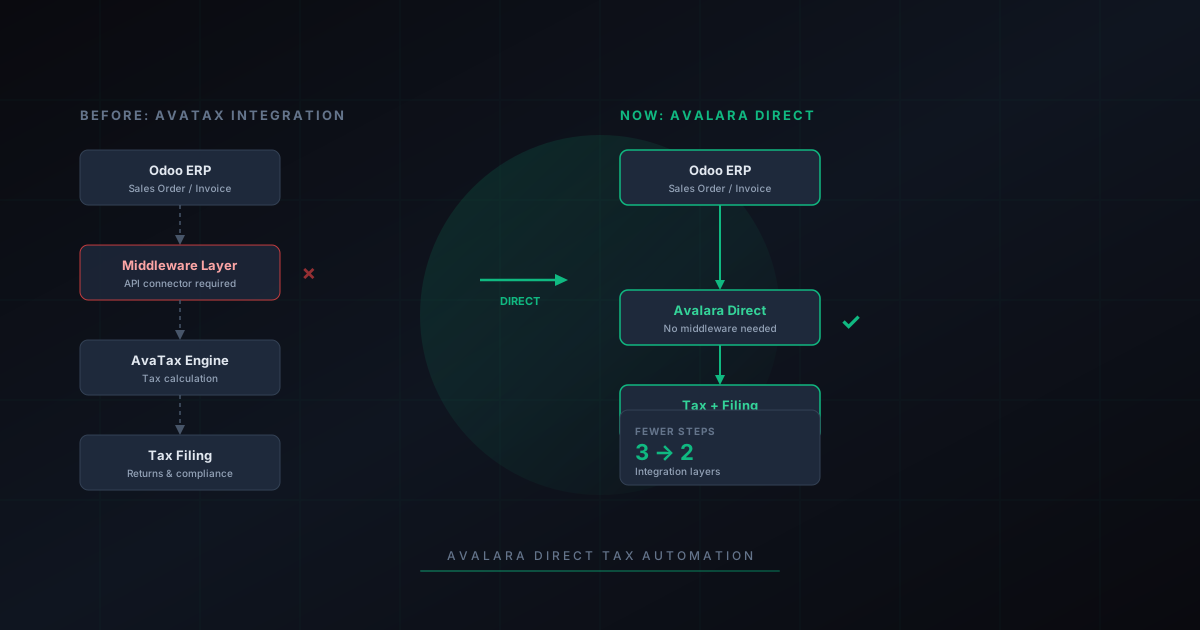
For years, Odoo’s tax automation story has been “install the AvaTax connector, configure the API credentials, and hope the middleware layer doesn’t introduce latency on every invoice line.” It worked, but the architecture reflected an era when third-party tax engines were bolted onto ERPs rather than woven into them. That era just ended.
Odoo has restructured its entire Avalara integration from the ground up. The old AvaTax Integrationpage — the single entry point for everything tax-automation-related — has been replaced by a broader Avalara Integration hub that distinguishes between the company (Avalara), the tax calculation engine (AvaTax), and a new direct connection path called Avalara Direct.
The Naming Problem That Masked a Real Architectural Gap
The previous documentation used “AvaTax” and “Avalara” interchangeably, which was technically inaccurate and practically confusing. AvaTax is a specific tax calculation engine — the thing that looks at a line item, checks the origin and destination addresses, and returns the correct tax rate. Avalara is the company that provides AvaTax along with a portfolio of other compliance services: tax filing, returns, exemption certificate management, and address validation.
By collapsing everything under the AvaTax label, the old documentation obscured the fact that businesses needed to maintain a connector layer between Odoo and Avalara’s services. Every tax calculation on every invoice line made a round trip through that connector. For high-volume operations processing thousands of invoices daily, the middleware wasn’t just an architectural nicety — it was a bottleneck and a point of failure.
What Avalara Direct Actually Changes
Avalara Direct is exactly what it sounds like: a direct connection between Odoo and Avalara’s tax services that bypasses the traditional connector architecture. Instead of routing every tax calculation through a middleware layer that translates between Odoo’s data format and Avalara’s API, Avalara Direct handles the communication natively.
The setup reflects this simplification. Where the old AvaTax flow required installing a connector module, configuring API credentials in a separate settings panel, mapping tax codes between systems, and then testing the connection, Avalara Direct collapses those steps. The integration settings live directly in Odoo’s accounting configuration, and the connection doesn’t require a separate module to manage the translation layer.
This matters most for address validation. Avalara Direct validates shipping and billing addresses against Avalara’s database inline — as part of the normal invoice workflow rather than as a separate API call through the connector. When a sales order includes an address that Avalara can’t match to a valid tax jurisdiction, the validation catches it before the tax calculation runs, not after.
The AvaTax Engine Isn’t Going Away
Odoo hasn’t deprecated AvaTax. The tax calculation engine remains the core of how Avalara determines tax rates, and businesses already running the AvaTax connector can continue doing so. The restructuring gives them a second option, not an ultimatum.
The practical difference comes down to how the tax calculation happens. With the traditional AvaTax path, Odoo sends transaction data to the connector, the connector formats it for Avalara’s API, Avalara returns the calculation, and the connector translates it back into Odoo’s format. With Avalara Direct, the middle two steps collapse into one.
For businesses evaluating which path to take, the decision hinges on existing infrastructure. Companies with heavily customized AvaTax connector configurations — custom tax code mappings, specific exemption handling rules, or integrations that depend on the connector’s intermediate data transformations — may want to stay on the traditional path until they can validate their customizations against the Direct architecture. Everyone else gets a faster setup and a simpler operational model.
The Portal and Returns Integration
The restructured documentation also surfaces Avalara Portal access more prominently. The portal — Avalara’s web interface for managing tax filings, reviewing transactions, and handling returns — was always available to Avalara subscribers, but the old documentation buried it under AvaTax-specific setup instructions.
Now it sits alongside the Avalara Direct and AvaTax engine documentation as a peer-level concern. The message is clear: tax calculation (whether through Direct or AvaTax) is only half the story. Filing returns, managing exemptions, and auditing transactions happen in the Avalara Portal, and the integration extends to cover that full lifecycle rather than stopping at the point where tax rates hit invoice lines.
What This Means for Multi-State and Cross-Border Sellers
The businesses that benefit most from Avalara Direct are the ones that feel the middleware pain most acutely: companies selling across dozens of US states with different tax rules, or cross-border e-commerce operations that need real-time tax calculations on every cart update. For them, every millisecond of latency in the tax calculation pipeline translates directly to slower checkout experiences or delayed invoice processing.
Avalara Direct doesn’t change what taxes get calculated — that’s still the AvaTax engine’s job, and the rates come from the same jurisdiction database. What it changes is how fast those calculations reach Odoo and how many moving parts sit between an invoice line and its final tax amount. Fewer layers means fewer failure points, and in tax compliance, reliability matters as much as accuracy.