Sales tax in the United States is a nightmare of overlapping jurisdictions. A single address can sit inside a state tax zone, a county surcharge zone, a city rate zone, and a special district that funds local transit — each with its own rate, its own exemption rules, and its own update schedule. Small businesses using flat rate tables or manual calculations inevitably get it wrong, and the penalty for getting it wrong is an audit letter.
Odoo has supported Avalara’s AvaTax engine for a while, but the integration always pointed at Avalara Direct — the enterprise tier that comes with dedicated account management, filing services, and pricing that reflects those extras. For a 50-person business doing 200 invoices a month, the value proposition was hard to justify when the main need was just “calculate the right tax rate automatically.”
Avalara Included is Odoo’s answer to that gap. It’s the same AvaTax calculation engine — same precision at the state, county, and city level — packaged as a pay-per-transaction service that runs on Odoo’s In-App Purchase credit system. One credit per posted invoice or credit note. No annual contract, no account manager, no minimum transaction volume.
Who This Is Actually For
Avalara Included targets businesses in the United States, Canada, and Brazil that need automated tax calculation but don’t need the full compliance suite. The typical profile: a company with nexus in multiple states, selling products or services that require real-time tax rate lookups, but processing fewer than 5,000 taxable transactions per year.
That 5,000 threshold matters. Businesses that exceed it annually need to transition to an Avalara Direct plan, which adds filing and remittance services along with higher transaction limits. Avalara Included is explicitly positioned as the stepping stone — accurate calculation without the enterprise overhead, with a clear upgrade path when volume justifies it.
There are scope limitations to note. The service uses the company’s registered address as the tax origin by default. Warehouse-based origin taxation — where the tax rate depends on which warehouse ships the goods — requires enabling a specific Point of Sale setting. And excise taxes are out of scope entirely: tobacco, vape, fuel, and other industry-specific excise calculations still need specialized tax solutions.
Setup in Five Minutes, Not Five Meetings
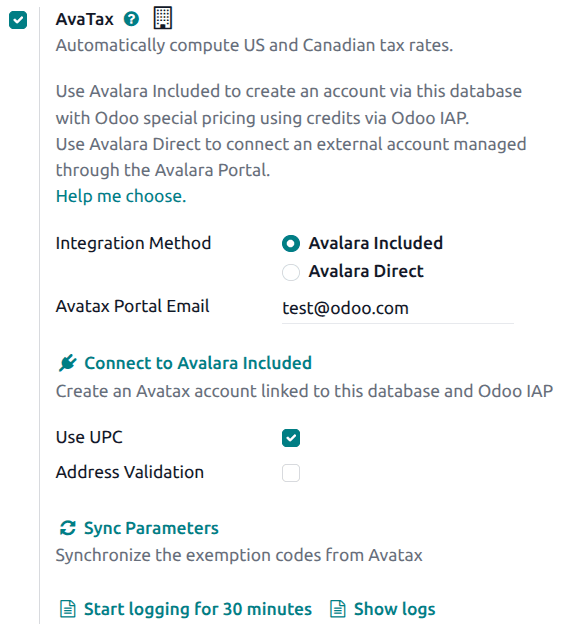
The activation process is designed to complete in a single sitting without involving Avalara’s sales team. From the Accounting settings page, enable the AvaTax checkbox, select “Avalara Included” as the account type, enter a valid email address, and click “Connect to Avalara Included.”
That triggers an account creation flow where the business accepts Avalara’s terms, completes a company profile, and the connection is live. Tax calculations start working on the next posted invoice. The entire process involves no API keys, no credential exchanges, and no environment configuration — the integration handles all of that behind the scenes.
For businesses already running Avalara Direct with fewer than 5,000 annual transactions, a migration path exists in the same settings panel. Enter the existing API credentials, click “Migrate to Avalara Included,” review the feature differences, purchase IAP credits, and the switch is done. This is useful for companies that signed up for Direct years ago but never used the filing or remittance services they were paying for.
The Credit Model Makes Costs Predictable
Every time an invoice or credit note posts with an AvaTax fiscal position assigned, one IAP credit is consumed. That’s the entire cost model. No monthly minimums, no per-seat fees, no overage charges beyond the credits used. For a business posting 150 invoices a month, the tax compliance cost is exactly 150 credits — predictable enough to budget as a line item.
The credit system also means there’s no cost for draft invoices, quotations, or sales orders that preview tax amounts. The calculation happens at those stages too — customers see accurate tax before committing — but the credit only deducts when the document posts. This incentivizes using tax previews throughout the sales process without worrying about burning credits on documents that never finalize.
Two Tiers, Clear Boundaries
Odoo now offers a clean comparison between the two Avalara integration tiers. Avalara Included provides the AvaTax calculation engine, pay-per-use pricing, Odoo-routed support, and a 5,000 transaction annual ceiling. Avalara Direct provides the same engine plus dedicated Avalara account management, direct Avalara support, filing and remittance services, unlimited transactions, and AvaTax portal access for audit reporting.
The decision point is straightforward: if the business needs Avalara to file returns and remit tax payments on its behalf, Direct is required. If the business handles its own filing and just needs accurate rate calculation, Included does the job at a fraction of the cost.
For the significant number of small businesses currently using Odoo with flat-rate tax tables or no tax automation at all, Avalara Included removes the last credible excuse for manual tax calculation. The setup is trivial, the cost scales with usage, and the accuracy is the same engine that enterprise Avalara customers rely on. The only difference is what happens after the tax is calculated — and for most small businesses, that’s a problem they’re already solving themselves.