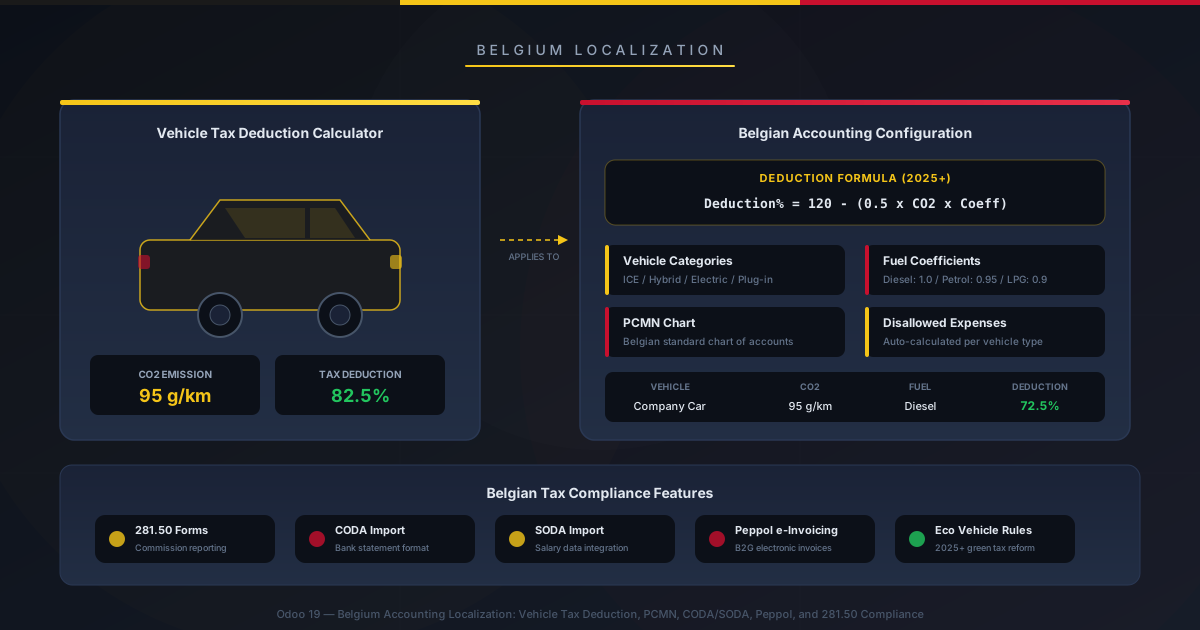
Belgium’s corporate tax code has a particular obsession with company cars. The deductibility of vehicle expenses depends on a matrix of factors — fuel type, CO₂ emissions, vehicle category — that creates a calculation most accountants handle in spreadsheets separate from their ERP. Odoo just brought that calculation inside the system.
The Belgian accounting localization has received a significant update that adds vehicle tax deduction visibility directly within the Fleet app, alongside a broader documentation refresh that now properly catalogs all eight modules that ship with the localization. It’s not a flashy feature release, but for the thousands of Belgian businesses running Odoo, it addresses a genuine operational gap.
Vehicle Tax Deductibility, Visible Where It Matters
Under Belgian tax law, the percentage of vehicle costs a company can deduct depends on the car’s environmental profile. Electric vehicles get the most favorable treatment. Diesel and gasoline vehicles face progressively lower deduction rates as their CO₂ emissions climb. Bicycles used for business purposes receive their own deduction category entirely.
Odoo now surfaces this information directly on the vehicle record in the Fleet app. Navigate to a vehicle’s Engine or Vehicle Information section, and a Tax Deduction field shows the applicable percentage based on the vehicle’s configuration. The rate updates when the fuel type or emission data changes, giving fleet managers and accountants a single source of truth without needing to consult external deduction tables.
One important distinction: the field is informative, not automated. It shows the correct deduction rate so accountants know what to apply, but it doesn’t automatically adjust expense entries or tax calculations. This is a deliberate design choice — Belgian vehicle deductions interact with enough edge cases in the tax code that automatic application would create more problems than it solves. Giving accountants the right number and letting them apply it is the pragmatic middle ground.
Eight Modules Under One Roof
The localization update also includes a proper catalog of every module that ships with the Belgian package. There are eight in total, each handling a specific slice of Belgian accounting requirements:
The base module delivers the Belgian chart of accounts, tax rates, and fiscal positions. A reporting module generates local report formats. The CODA module imports bank statements in Belgium’s standard banking format — a requirement for any business that wants automated bank reconciliation with Belgian financial institutions. SODA handles salary-related journal entries. A disallowed expenses module tracks costs that Belgian tax law prohibits from deduction. And the remaining modules handle intrastat reporting, stock valuation adjustments, and payroll integration.
For businesses that upgraded from an older version and found some modules missing, this documentation now makes it clear which packages should be installed and what each one does — a small quality of life improvement that saves time during post-upgrade configuration.
Intervat Tax Return Submission Gets Clearer Rules
Belgium requires periodic VAT returns submitted through the Intervat platform, and the format requirements have tripped up more than a few Odoo users over the years. The updated localization documentation now includes explicit guidance: when submitting tax returns, files must be in XML or VAT format to be accepted by Belgian tax authorities.
This seems like a minor documentation note, but it addresses a recurring support issue. Odoo’s reporting engine can export in multiple formats, and users who exported in the wrong one discovered the problem only when Intervat rejected their submission — usually close to a filing deadline. Making the accepted format explicit in the workflow prevents that particular fire drill.
Why Belgian Localization Quality Matters
Belgium sits at the intersection of three linguistic communities, two distinct tax regimes for sole proprietors and corporations, and a regulatory environment that produces new compliance requirements with remarkable regularity. For an ERP to work properly in this market, it needs more than a translated chart of accounts — it needs modules that understand the specific mechanisms Belgian accountants deal with daily.
CODA import is non-negotiable for bank reconciliation. Disallowed expenses tracking prevents deduction errors that trigger audits. Vehicle tax deductibility is a question that comes up for every company car in a country where company cars are the most common form of employee benefit. Each of these features addresses a real workflow that Belgian businesses perform regularly, and having them integrated rather than bolted on means fewer manual steps and fewer places where data can fall out of sync.
The update isn’t revolutionary — Belgium already had one of Odoo’s more complete localizations. But it closes gaps that had been accumulating as Belgian tax law evolved, and it brings the documentation up to a standard where a new implementation can configure the full localization without guesswork about which modules to install or how the pieces fit together.