Denmark has been running one of Europe’s more mature e-invoicing ecosystems for years. NemHandel—the country’s national electronic invoicing network—handles structured invoice exchange between businesses and public-sector entities, built on top of the PEPPOL infrastructure. Until now, Odoo users operating in Denmark had to piece together their own compliance setup or rely on third-party connectors. That changes with the addition of a dedicated Denmark fiscal localization that brings NemHandel support and bookkeeping compliance directly into Odoo’s accounting module.
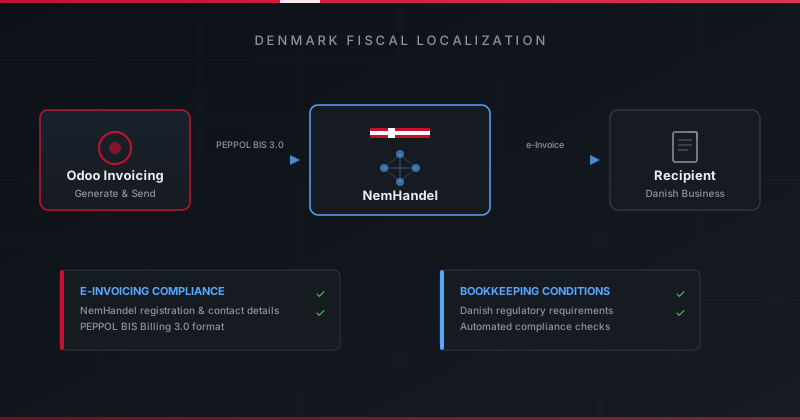
The update introduces two parallel tracks of documentation and functionality: electronic invoicing through NemHandel, and a bookkeeping conditions framework that codifies Denmark’s regulatory requirements within Odoo’s existing compliance architecture.
Native NemHandel E-Invoicing From Inside Odoo Invoicing
The e-invoicing side of the localization integrates directly with Odoo Invoicing. Danish businesses registered on the NemHandel network can now send and receive electronic invoices through Odoo without leaving the platform. The implementation follows the PEPPOL BIS Billing 3.0 standard, which is the format NemHandel expects for structured invoice data.
Setting up the connection requires registering your company on the NemHandel network and configuring the appropriate endpoint identifiers within Odoo. The system handles the formatting and transmission details—converting Odoo’s internal invoice representation into the XML structure that NemHandel participants expect to receive. For companies already sending invoices through other PEPPOL access points, the transition to Odoo’s built-in support should be straightforward since the underlying standard is the same.
Managing NemHandel Contact Details
One practical detail that trips up businesses during e-invoicing rollouts is keeping recipient information current. NemHandel relies on accurate endpoint data—specifically, each trading partner’s registered identifier on the network. Odoo’s Denmark localization includes a workflow for updating NemHandel contact details directly from the contact or invoicing screens.
This means that when a customer or vendor updates their NemHandel registration—changing their EAN or GLN number, switching access points, or modifying their receiving capabilities—the corresponding record in Odoo can be updated without navigating to a separate system. It is a small convenience that eliminates one of the more common sources of failed invoice deliveries: stale endpoint data sitting in an accounting system that nobody remembered to update.
Bookkeeping Conditions and Compliance Checks
The second half of the localization addresses Denmark’s bookkeeping requirements. Danish law imposes specific conditions on how businesses maintain their financial records—covering everything from retention periods to the structure of journal entries. Odoo’s new Denmark page within the fiscal localizations section lays out these conditions and maps them to the platform’s accounting configuration.
Rather than presenting compliance as a checklist that users must manually verify, the system integrates these conditions into the accounting workflow itself. When a company’s Odoo instance is configured for Denmark, the relevant bookkeeping rules become part of the validation logic that runs during normal accounting operations. Transactions that would violate Danish bookkeeping conditions are flagged before they are posted, not discovered during an audit months later.
A Country Page That Ties It Together
Both the e-invoicing and bookkeeping features are documented under a single Denmark page within Odoo’s fiscal localizations section. This follows the same pattern Odoo has established for other country-specific accounting setups—Belgium, Spain, Romania, and others each have their own dedicated pages that consolidate every localization detail in one place.
For Danish businesses evaluating ERP platforms, the practical implication is that Odoo now ships with Denmark-aware accounting out of the box. There is no module to hunt for, no marketplace add-on to vet, and no ambiguity about whether the e-invoicing integration is maintained by the core team or a third party. NemHandel support is part of the product, and the bookkeeping compliance layer is wired into the same validation engine that handles every other localized market Odoo supports. The update has been forward-ported across active Odoo versions from 18.0 through the current development branch, so existing installations can pick it up without waiting for a major release cycle.