Running an online store in Taiwan without ECPay is a bit like running one in Europe without Stripe. ECPay processes payments for over 200,000 merchants across the island, handling everything from Visa and Mastercard transactions to local ATM transfers and the convenience store payment counters that Taiwanese consumers rely on for daily purchases. Odoo has now added ECPay as a first-party payment provider, meaning businesses using Odoo for their storefront or invoicing can accept the full range of Taiwanese payment methods without bolting on a third-party plugin.
The timing makes sense. Taiwan’s e-commerce market has been growing steadily, and ECPay has evolved from a simple payment processor into a full-stack commerce platform covering logistics, invoicing, and the government-mandated uniform invoice system. For Odoo users operating in Taiwan, having a native connector eliminates the custom development work that previously sat between the ERP and the local payment ecosystem.
What ECPay Actually Covers
ECPay isn’t just a credit card processor. The platform aggregates multiple payment channels into a single merchant account: international credit cards (Visa, Mastercard, JCB), domestic bank ATM transfers, and payments at convenience store chains like 7-Eleven, FamilyMart, and Hi-Life. That last category matters more than most international observers realize — convenience store payments remain a deeply embedded habit in Taiwan’s consumer economy, and any serious merchant needs to support them.
The Odoo integration connects to all of this through ECPay’s unified API. A single set of merchant credentials — the Merchant ID, Hash Key, and Hash IV — authenticates every payment method, so there’s no separate configuration per channel.
Setting It Up Takes About Ten Minutes
The configuration splits across two systems. On ECPay’s side, merchants create a vendor account, apply for payment services at their desired membership tier, and upload verification documents. Once approved, the three credential values live under System Settings in ECPay’s vendor portal — specifically the System Interface Settings section.
On the Odoo side, the setup is three fields and a toggle. Navigate to the ECPay payment provider, paste in the Merchant ID, Hash Key, and Hash IV, then flip the state to Enabled. There’s also a Test Mode for merchants who want to validate the flow before going live — a sensible default given that payment integrations are one of those areas where breaking changes show up as actual customer complaints.
Why This Matters for the Broader Odoo Ecosystem
Odoo’s payment provider list has been steadily expanding beyond the North American and European defaults. Razorpay for India, Mercado Pago for Latin America, Xendit for Southeast Asia — and now ECPay for Taiwan. Each addition removes a friction point that previously required custom development or third-party apps from the Odoo marketplace.
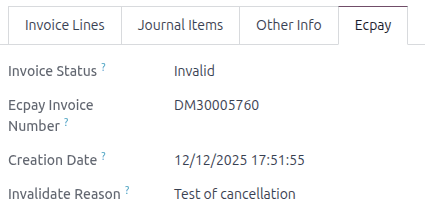
For Taiwanese businesses specifically, this closes a real gap. ECPay handles the government-mandated e-invoice system that every B2C transaction in Taiwan requires, and having the payment side natively connected to Odoo means the accounting trail from checkout to tax filing stays inside one system. No CSV exports, no manual reconciliation between platforms, no wondering why the numbers don’t match at month-end.
The Credential Architecture
ECPay uses a hash-based authentication model rather than OAuth tokens. The Hash Key and Hash IV are symmetric encryption parameters that sign every API request, ensuring that transaction data hasn’t been tampered with in transit. This is a common pattern among Taiwanese payment providers and reflects the island’s regulatory emphasis on transaction integrity over the token-exchange patterns popular in Western payment APIs.
From an implementation standpoint, this means credentials don’t expire the way OAuth tokens do. Once configured, the connection stays stable unless the merchant regenerates their keys in the ECPay portal. It’s one less moving part in production, which any operations team will appreciate.
What’s Not Included Yet
The initial integration focuses on the payment acceptance workflow — customers paying merchants through Odoo’s checkout or payment links. ECPay’s logistics API for shipping label generation and their invoice management endpoints aren’t part of this release. Those are separate product lines within ECPay’s platform, and integrating them would involve different API surfaces and business logic.
For now, the payment connector on its own addresses the most pressing need: letting Taiwanese businesses accept money through their Odoo storefront without third-party middleware. The rest can follow as demand justifies the engineering effort.