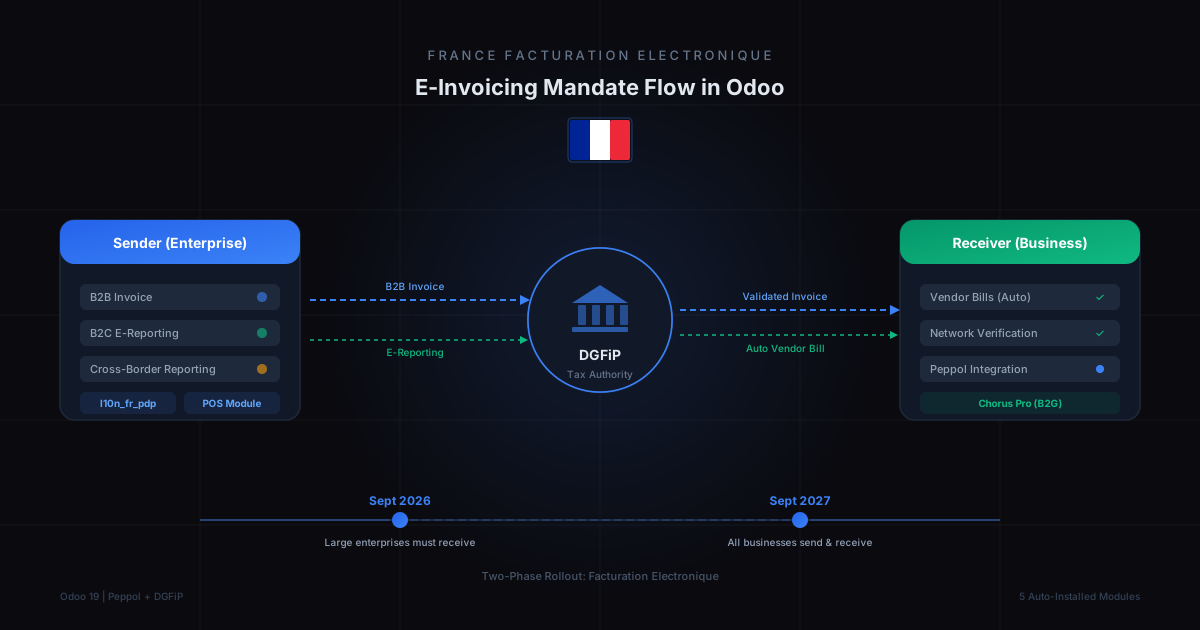
France’s electronic invoicing mandate is no longer a distant regulatory deadline — it’s arriving in September 2026, and Odoo has shipped the infrastructure to handle it. The new Facturation Électronique integration covers the full scope of what French businesses will need: B2B electronic invoicing between domestic companies, B2C and cross-border e-reporting to tax authorities, and even the reorganized Chorus Pro workflow for government invoicing. Five new modules auto-install when the French localization is activated, anchored by l10n_fr_pdp for core electronic invoicing and l10n_fr_pdp_posfor POS-based e-reporting. This isn’t a partial compliance patch — it’s a ground-up implementation that reflects how the French mandate actually works in practice.
The two-phase rollout is what makes France’s approach distinctive. Starting September 2026, all large enterprises must be capable of receiving electronic invoices. By September 2027, every business in France — regardless of size — must both send and receive them. That staggered timeline means companies can’t wait until the last minute. Receivers need their systems ready first, and senders need to follow within a year. Odoo’s implementation addresses both sides of that equation, with separate workflows for sending customer invoices and receiving vendor bills, plus the e-reporting layer that runs in parallel for transactions that fall outside the B2B e-invoicing scope.
DGFiP Authentication and the Peppol Shift
The setup process begins with something most ERP integrations skip: authenticating a legal representative through the DGFiP, France’s tax authority (Direction Générale des Finances Publiques). This isn’t just an API key exchange. Odoo walks the user through a verification flow where the company’s legal representative confirms their identity with the tax authority, establishing the trust chain that all subsequent invoice transmissions depend on. Once authenticated, the system can verify whether customers are registered on the invoicing network before sending — a critical check that determines whether a transaction routes through the electronic invoicing pipeline or falls back to e-reporting.
Perhaps the most significant technical shift is the move from Factur-X to Peppol as the underlying transport layer. Factur-X — the hybrid PDF/XML format that France initially championed — served as an intermediate step, but the government has aligned its infrastructure with the Peppol network that already underpins electronic invoicing across much of Europe. For Odoo users, this means invoices flow through standardized Peppol channels rather than proprietary French formats, which simplifies cross-border interoperability and positions French businesses on the same infrastructure their European counterparts already use.
B2C E-Reporting and the POS Connection
The mandate doesn’t stop at B2B transactions. France requires businesses to report B2C sales and cross-border transactions to the tax authority through a separate e-reporting mechanism. Odoo handles this automatically: when a transaction doesn’t qualify for B2B e-invoicing — because the buyer is a consumer, or because the transaction crosses borders — the system submits the data to DGFiP through the e-reporting channel instead. The dedicated l10n_fr_pdp_posmodule extends this to point-of-sale transactions, ensuring that retail businesses using Odoo’s POS system have their B2C sales reported without any manual intervention. This is where the five auto-installed modules earn their keep: they cover the full surface area of French commercial activity, not just the headline B2B use case.
Chorus Pro, Vendor Bills, and the Compliance Landscape
Two other details deserve attention. First, Chorus Pro — France’s existing platform for government invoicing — has been reorganized under a dedicated “B2G invoicing” section rather than sitting alongside the new electronic invoicing workflows. This separation makes sense: B2G invoicing through Chorus Pro has its own requirements and has been mandatory for years, so conflating it with the new B2B mandate would only create confusion. Second, the vendor bill workflow operates largely on autopilot. When a supplier sends an electronic invoice through the network, Odoo receives it and creates the corresponding vendor bill automatically — no manual data entry, no PDF uploads, no OCR guesswork. The invoice arrives structured and validated, ready for review and payment.
What Odoo has built here goes beyond checkbox compliance. The combination of DGFiP authentication, Peppol transport, automatic e-reporting, POS coverage, and restructured Chorus Pro support reflects a system designed around how French businesses actually operate — not just how the regulation reads on paper. With September 2026 now less than a year away, companies running Odoo in France have a clear path from configuration to compliance without needing to bolt on third-party middleware or manually manage parallel reporting obligations. For the broader European ERP landscape, it also signals that Peppol-native invoicing is becoming the default rather than the exception — and Odoo is building accordingly.