If you run a cash register in Germany, you already know the drill. Every transaction has to pass through a certified Technical Security System — a tamper-proof signing mechanism that feeds into the country’s strict Kassensicherungsverordnung framework. Odoo handles this through fiskaly, a cloud-based TSS that signs each sale in real time and packages the data for DSFinV-K tax exports. The catch, until now, was the word “cloud-based.” No internet connection meant no signing, which meant no compliant transactions. For a brick-and-mortar electronics store with fiber internet, that was barely a consideration. For a food truck at a Christmas market, a pop-up boutique in a converted warehouse, or a bakery in a village where the connection drops twice a day, it was a genuine operational risk.
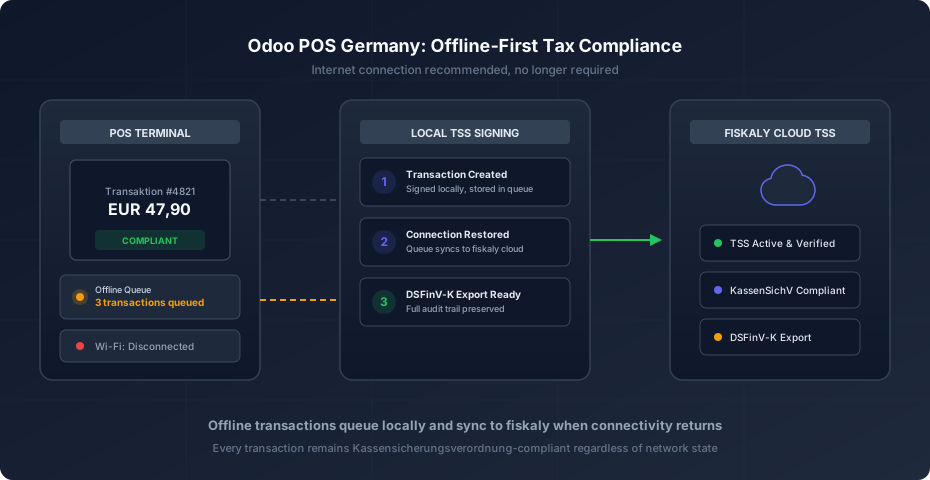
Internet Recommended, Not Required
Odoo has quietly changed the compliance posture of its German POS module. Where the system previously displayed an “Important” banner stating that an internet connection was required due to the cloud-based nature of the fiskaly integration, that language has been revised. The banner now reads that an internet connection is recommended, but POS orders can be placed offline. That single sentence shifts the operational model for every German retailer running Odoo at the register.
The underlying mechanics work the way you’d expect a well-designed offline system to behave. When the terminal loses connectivity, transactions continue to process at the register. Each sale is recorded locally with the data the TSS needs for signing. When the connection comes back — whether that’s thirty seconds later or at the end of the market day — the queued transactions sync to fiskaly’s cloud infrastructure, get signed, and fold into the DSFinV-K export pipeline as if they had been online all along.
What This Means for Tax Audits
Germany’s Kassensicherungsverordnung exists to make cash register fraud structurally impossible. Every transaction needs a verifiable signature chain, and the Finanzamt can request a DSFinV-K data export at any time. The offline capability doesn’t weaken any of that. Transactions processed without connectivity still carry the same data structure and still flow through fiskaly’s TSS once the connection is restored. The audit trail remains unbroken — the only difference is timing. A transaction that would have been signed in 200 milliseconds over a live connection might wait a few hours in the queue instead, but the end result in the DSFinV-K export is identical.
This distinction matters because some retailers had been avoiding Odoo’s POS for locations with unreliable connectivity, defaulting to standalone hardware terminals that handle signing locally but don’t integrate with the rest of the business system. With offline compliance in place, the argument for maintaining a separate register stack at those locations largely disappears.
Who Benefits Most
The obvious winners are mobile and temporary retail operations. Germany has one of Europe’s largest outdoor market cultures — weekly farmers’ markets, seasonal Christmas markets, trade fairs, and food festivals that set up in locations where cellular coverage is inconsistent at best. For these vendors, a POS system that locks up when the signal drops is more than an inconvenience; it’s a compliance hazard. Accepting cash without TSS signing isn’t an option under the Kassensicherungsverordnung, so a connectivity gap used to mean either turning customers away or risking a violation.
But the change also benefits fixed-location retailers in areas with spotty infrastructure. Rural bakeries, small-town hardware stores, and independent bookshops — the kinds of businesses that don’t have redundant internet connections and can’t justify a dedicated line just for the register. For these businesses, offline POS compliance removes a layer of anxiety from daily operations. The register keeps working, the law keeps being followed, and the data catches up when the router reconnects.
A Broader Pattern in ERP Design
This is part of a wider trend in Odoo’s architecture toward offline-first design. The platform has been investing heavily in letting field teams — warehouse workers, delivery drivers, construction crews — operate without constant connectivity. Extending that same philosophy to the point of sale in a compliance-heavy market like Germany is a natural progression, but it required careful engineering. The TSS signing can’t be faked or deferred indefinitely; it has to happen, just not necessarily in the same second as the sale. Getting that timing right without breaking the compliance chain is what makes this update substantive rather than cosmetic.
For German retailers evaluating ERP-integrated POS systems, the calculus just changed. The question is no longer whether Odoo can handle locations with unreliable internet. It can. The question is whether the rest of the feature set — inventory integration, accounting sync, multi-location management — justifies the switch. And with the connectivity barrier removed, a lot more businesses are going to get far enough in that evaluation to find out.