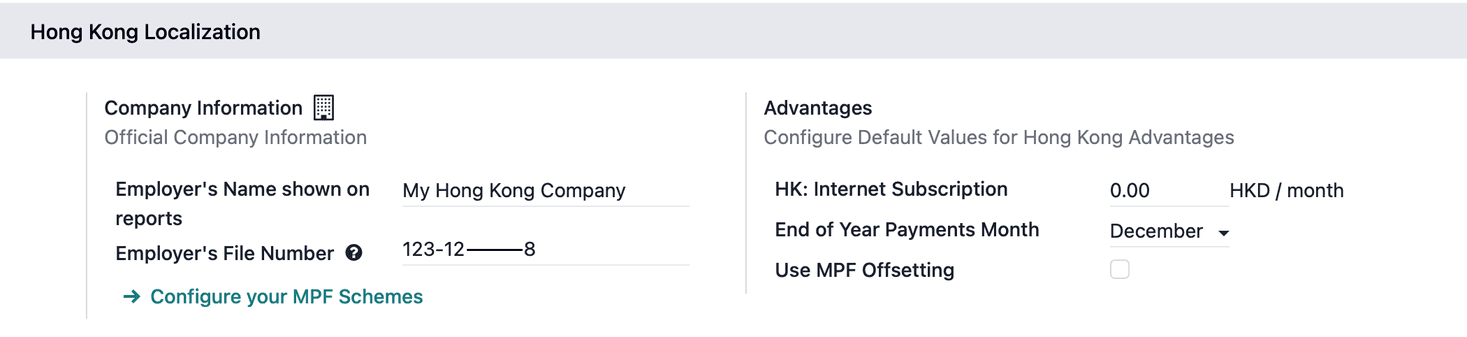
Payroll in Hong Kong operates under a set of rules that do not map neatly onto any other jurisdiction. Between the Mandatory Provident Fund contribution tiers, CAP57 employment ordinance requirements for casual workers, housing benefit tax implications that vary by lease arrangement, and bank-specific payment file formats, getting payroll right requires a system that understands these local nuances at a deep level. Odoo’s latest payroll update for Hong Kong tackles all of these in a single release.
A Dedicated Salary Structure for Casual Employees
Hong Kong’s Employment Ordinance (CAP57) creates a distinct category for casual employees — workers engaged on a day-to-day basis or for a fixed period of less than 60 days. These workers have different entitlements and calculation rules compared to continuous contract employees. Previously, handling casual employee pay in Odoo meant working around the standard salary structures or manually adjusting calculations each pay period.
The update introduces a purpose-built CAP57 Casual Employees Pay salary structure with its own calculation logic. The documentation now includes a worked example showing exactly how the system computes gross pay, statutory deductions, and net pay for this employment type. This is not a cosmetic relabeling of an existing structure — it is a separate payroll pipeline that respects the distinct rules that apply to casual employment under Hong Kong law.
Rental Benefits Get Full Lifecycle Management
Housing benefits are one of the most complex elements of Hong Kong compensation, largely because the tax treatment varies dramatically depending on how the benefit is structured. An employer-provided apartment creates one set of tax obligations. A cash housing allowance creates another. A lease held by the employer on behalf of the employee triggers yet another calculation. Getting these wrong means incorrect IR56 filings and potential penalties from the Inland Revenue Department.
Odoo now includes a dedicated Rental System section within the payroll module that tracks housing benefit types, calculates the corresponding tax impact, and manages lease details. The system sends rental notifications when leases approach key dates and generates submission reminders to ensure compliance deadlines are not missed. There is even duplicate detection that warns when a similar rental arrangement already exists in the system, preventing the kind of data entry errors that cascade into payroll miscalculations.
HSBCnet Payment Reports Replace Manual Export Workflows
Hong Kong businesses that bank with HSBC — which accounts for a significant share of the corporate banking market — now get a dedicated HSBCnet Payment Report export format. Previously, generating the payment file required either manual formatting or custom development to match HSBC’s bulk payment file specifications. The new export produces a file that HSBCnet accepts directly, covering the field layouts, currency formatting, and reference structures that the banking platform expects.
For businesses using other banks, a separate Other Payment Report format handles the generic export case. The two-track approach acknowledges that HSBC’s format requirements are specific enough to justify dedicated handling rather than forcing everything through a generic template that would need manual adjustment for either case.
MPF Scheme Configuration Gets Its Own Setup Flow
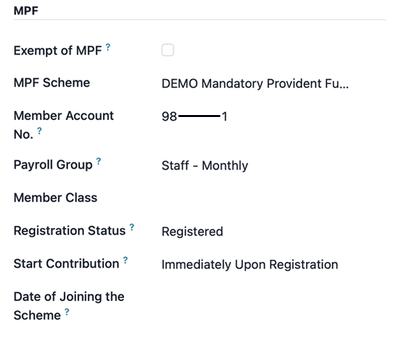
The Mandatory Provident Fund is Hong Kong’s mandatory retirement savings scheme, and every employer needs to configure their MPF scheme details correctly for contribution calculations and reporting. The update introduces a dedicated MPF Schemes configuration section within the localization settings, replacing what was previously a less structured setup process.
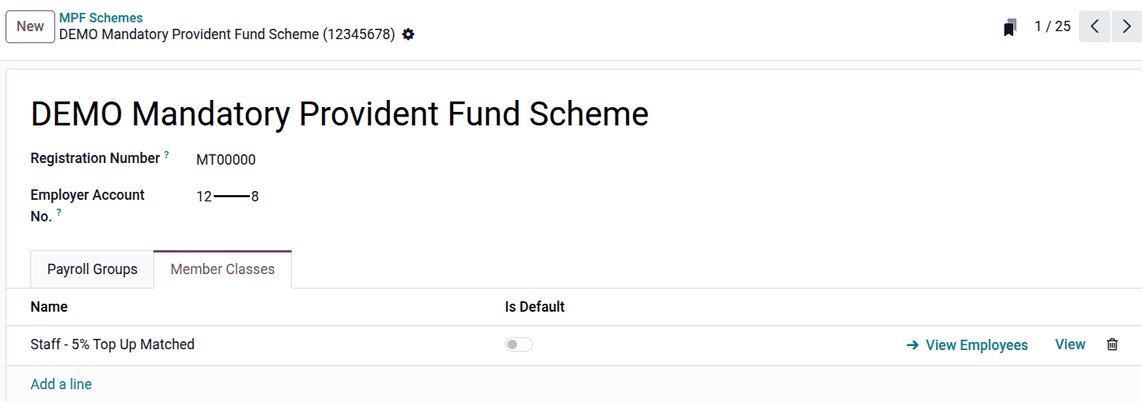
The documentation now walks through scheme selection, contribution rate configuration for both employer and employee portions, and the handling of voluntary contributions that sit on top of the mandatory minimums. For companies managing multiple MPF schemes — which happens when employees transfer from one scheme provider to another during employment — the system now tracks scheme history alongside contribution records.
Work Entry Types Gain a Validity Field
A smaller but operationally important change adds a Validity field to Work Entry Types. This controls the date range during which a particular work entry type is active and available for use. It addresses the common problem where obsolete work entry types linger in the system and get selected accidentally, or where new types need to be prepared in advance but should not appear in the interface until a specific effective date.
Collectively, these changes represent the most substantial Hong Kong payroll update Odoo has shipped in a single release. The casual employee structure and rental benefit system in particular fill gaps that previously required custom development or manual workarounds for any Hong Kong business running Odoo payroll in production.