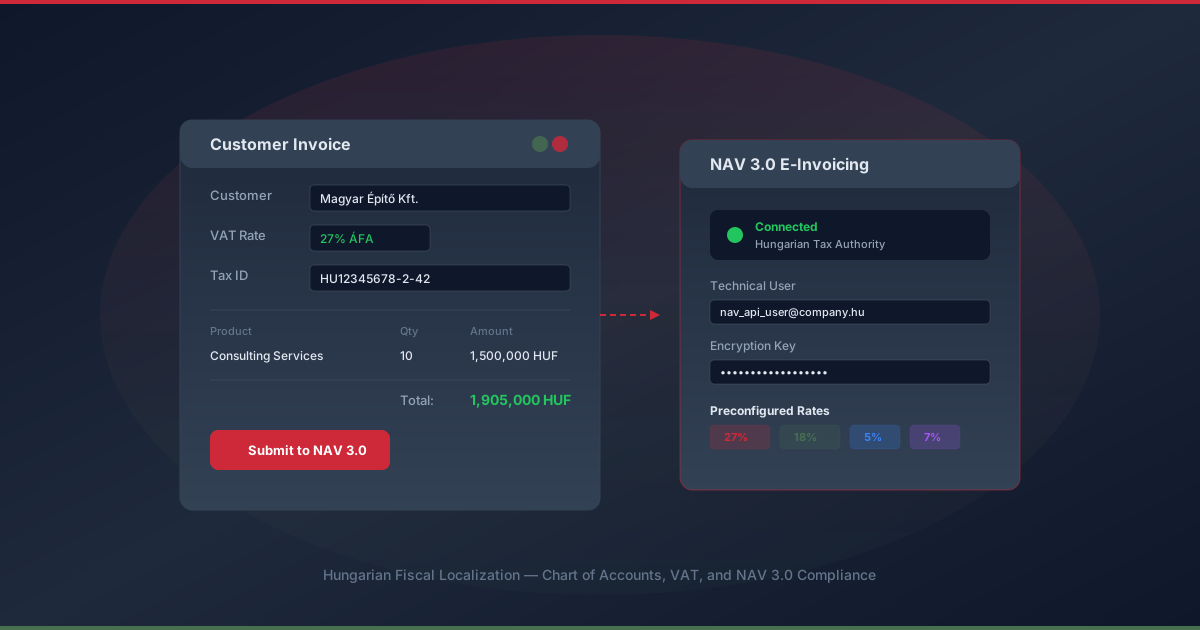
Hungary has been a conspicuous gap in Odoo’s localization map for a while. Businesses operating in Budapest and beyond had to piece together their own chart of accounts, manually configure tax rates, and deal with the Hungarian Tax Authority’s electronic invoicing requirements through workarounds or third-party modules. That era is over.
Odoo now ships a complete Hungarian fiscal localization that covers the full compliance stack: a locally adapted chart of accounts, preconfigured VAT rates at every tier the country uses, automated fiscal positions for tax adjustments, and — most critically — a native integration with NAV 3.0, Hungary’s mandatory e-invoicing platform.
Three Modules That Cover the Entire Compliance Surface
The localization arrives as three auto-installed modules, each handling a distinct layer of Hungarian accounting requirements. The base package delivers the Hungarian chart of accounts and tax structure. A second module plugs into Odoo’s reporting engine for local tax report formats. The third — and the one that matters most for day-to-day operations — handles the NAV 3.0 e-invoicing integration that Hungarian law requires for every domestic invoice above a certain threshold.
This three-module approach means businesses can install the localization and immediately start issuing compliant invoices without touching the chart of accounts or tax configuration. Everything arrives preconfigured.
VAT Rates That Actually Match Hungarian Tax Law
Hungary’s VAT structure is more layered than most European countries realize. The standard rate sits at 27% — the highest in the European Union — but two reduced rates at 18% and 5% apply to specific categories of goods and services. On top of that, an agricultural compensation surcharge of either 7% or 12% applies to certain farming transactions.
Odoo ships all of these preconfigured. The standard 27% rate is the default. The 18% rate covers accommodation services and certain food products. The 5% rate handles essentials like pharmaceuticals, books, and specific medical equipment. The agricultural surcharge rates are available for businesses dealing with compensated farming operations.
Fiscal positions handle the automatic switching. When an invoice targets an intra-community transaction or an export, the fiscal position remaps the tax lines without the accountant having to remember which rate applies. This is the kind of automation that prevents the small, costly mistakes that compound during VAT return season.
NAV 3.0: Real-Time Invoice Reporting to the Tax Authority
Since 2018, Hungary has required businesses to report invoices electronically to the National Tax and Customs Administration (known by its Hungarian abbreviation, NAV) through its Online Invoice System. Version 3.0 of this system represents the current standard, and compliance isn’t optional — every invoice issued to a Hungarian-registered business must be transmitted to NAV in near real-time.
Odoo’s integration handles this natively. When an accountant confirms an invoice, the system packages the invoice data according to NAV 3.0’s XML schema and submits it directly to the tax authority. No export step, no manual upload to a government portal, no third-party middleware sitting between the ERP and the tax authority.
The setup requires a technical user account on NAV’s government portal, which generates the credentials that Odoo needs: a username, a password, a signing key, and an exchange key. These four values get entered once in Odoo’s settings, and from that point forward, invoice submission is automatic.
Configuration That Respects How Hungarian Businesses Actually Work
The integration isn’t just a technical bridge to a government API. It understands Hungarian invoicing conventions at a practical level. Each customer record needs specific information for NAV compliance: a valid Hungarian tax number formatted as the standard eight-digit identifier with its two-digit VAT code and two-digit county code. The system validates these fields before attempting submission, catching formatting issues at the point of data entry rather than during a failed API call to the tax authority.
Company-level configuration covers the business’s own tax registration details, bank account information, and the NAV technical user credentials. Odoo surfaces all of these in the Accounting settings under a dedicated Hungary section, keeping the setup contained and discoverable rather than scattered across multiple configuration pages.
Credit Notes and the Storno Question
Hungarian accounting follows the Storno convention for corrections, which trips up systems designed around the Western European approach of issuing positive credit notes. In a Storno system, a correction reverses the original entry with negative amounts on the same side of the ledger, rather than creating a positive entry on the opposite side.
Odoo handles both scenarios. Standard credit notes work as expected for partial corrections and refunds. Full cancellations use the Storno method, which NAV requires for complete invoice reversals. The system transmits the appropriate cancellation type to NAV 3.0 based on whether the credit note represents a partial adjustment or a full reversal — a distinction that matters for tax reporting accuracy.
VAT Summary Reporting With Export Options
Beyond invoice-level compliance, Hungarian businesses need periodic VAT summary reports for their own records and for any additional filings beyond the real-time NAV submissions. Odoo’s reporting module generates these summaries with filtering by period, tax rate, and transaction type.
The reports can be exported in standard formats for accountants who need to cross-reference the ERP data with their own workpapers or with the transaction history visible on NAV’s online portal. This dual-verification workflow — checking Odoo’s records against NAV’s accepted submissions — is standard practice for Hungarian accounting firms, and the export functionality makes it straightforward rather than requiring manual data extraction.
Why This Matters for the Hungarian Market
Hungary’s e-invoicing mandate made it one of the first European countries to require real-time tax reporting, and the compliance requirements have steadily tightened since the system launched. For businesses running Odoo, the absence of a native localization meant relying on community modules of varying quality and maintenance commitment, or building custom integrations that required ongoing development effort every time NAV updated its API specifications.
A first-party localization changes that equation. The NAV 3.0 integration will track API changes as part of Odoo’s standard release cycle. The chart of accounts and tax rates will stay current with legislative changes. And businesses evaluating ERP options in Hungary can now consider Odoo without the asterisk of “but you’ll need a third-party module for tax compliance.”
For the growing number of companies that operate across Central Europe — with entities in Hungary, Austria, Czech Republic, and Slovakia — having a native Hungarian localization alongside the existing localizations for neighboring countries means one ERP can handle the full regional compliance picture without bolted-on workarounds.