Subcontracting in manufacturing is straightforward in concept — you send materials to an external vendor, they produce something, you receive the finished product. But the documentation for this process has historically been a minefield of confusing terminology, and Odoo’s was no exception. The words “contractor,” “contracting company,” and “company” were used interchangeably, sometimes within the same paragraph, making it genuinely difficult to tell who was doing what in any given step.
That ambiguity has been resolved. Odoo has rewritten its basic subcontracting documentation with a clear, consistent terminology framework: “company” always refers to the internal organization ordering the work, and “subcontractor” always refers to the external vendor performing the production. A note at the top of the page establishes these definitions upfront, so there’s no room for misinterpretation.
Every Label Updated to Match the Current Interface
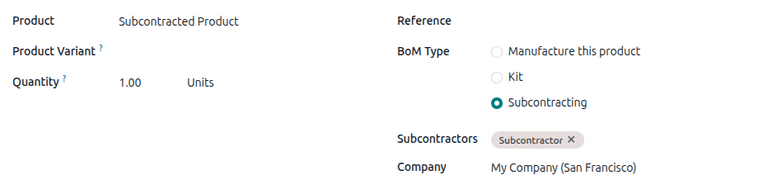
Beyond terminology, the documentation now reflects the actual field labels in Odoo 19’s interface. “Price” has become “Unit Price.” “Delivery Lead Time” is now just “Lead Time.” The “Receive Products” button is labeled “Receive.” These might seem like trivial changes, but documentation that uses different words than the actual interface is documentation that makes users second-guess themselves at every step.
The reference-linking has improved as well. Where the old version described a “subcontracting-type BoM” in passing, the new version links directly to the bill of materials configuration section. References to inventory locations now point to the locations management documentation. These cross-references turn a linear walkthrough into a navigable reference that acknowledges users might need to set up prerequisites before they can follow the subcontracting workflow.
A Workflow Diagram That Reflects Reality
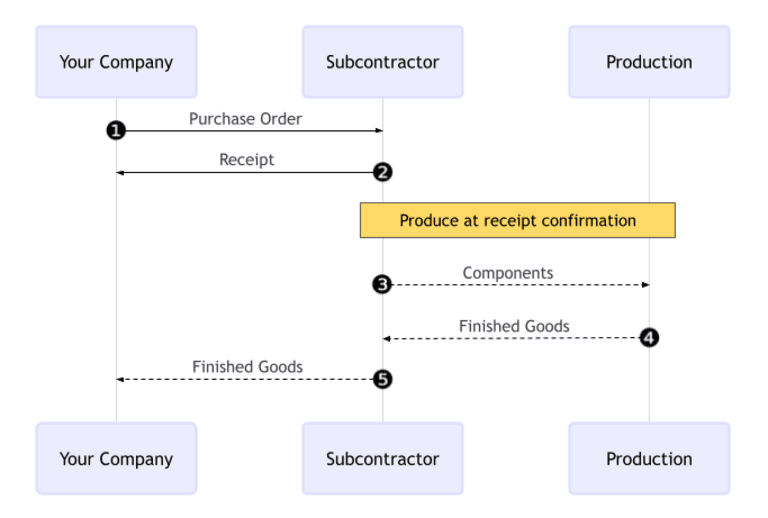
The old subcontracting flow diagram used the label “YourCompany” to represent the internal organization — a CamelCase placeholder that looked like a developer variable rather than a documentation label. The new diagram simply says “Your Company,” with a space, matching the natural language used throughout the rest of the documentation.
The replacement diagram also restructures the visual flow to better represent the actual sequence of operations: purchase order confirmation, goods receipt, and the behind-the-scenes manufacturing order that Odoo generates automatically. For a process that confuses new users precisely because so much happens automatically, a clear visual map is worth more than several paragraphs of explanation.
What the Rewrite Reveals About Odoo’s Approach to Manufacturing
The subcontracting workflow itself hasn’t changed — this is a documentation update, not a feature release. But the investment in rewriting documentation for clarity says something about where Odoo sees growth in its manufacturing module. Subcontracting is one of the features that separates a simple production tracker from a real manufacturing ERP, and it’s also one of the features most likely to be evaluated by companies considering a move from larger, more established manufacturing platforms.
Companies evaluating ERP systems don’t just test features; they test documentation. If the subcontracting docs are confusing, the implementation partner will need more hours to train staff, the go-live will take longer, and the total cost of ownership goes up. Clear documentation isn’t a cosmetic improvement — it’s a competitive advantage that reduces the cost of every implementation.
The terminology fix, in particular, solves a problem that was probably generating support tickets. When “contractor” could mean either party in the transaction, users following the documentation would inevitably perform steps in the wrong context — confirming receipts as the subcontractor instead of as the company, for instance. That kind of error is invisible in the documentation but very visible in a production database.