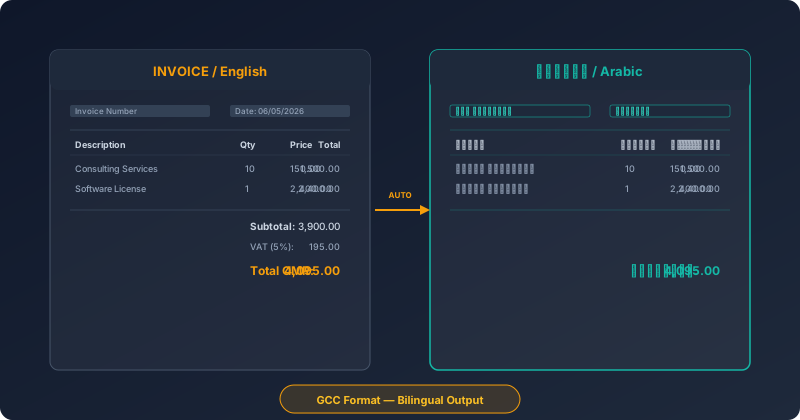
Businesses operating in Oman have long needed invoices that speak two languages at once. Clients may conduct business in English, Hindi, or Urdu, but regulatory and cultural norms across the Gulf Cooperation Council region expect Arabic to appear on official financial documents. Until now, Odoo’s Oman localization supported the country’s chart of accounts and tax rates but left bilingual invoicing as an exercise for the user.
That gap is closed. Odoo’s Oman fiscal localization now includes a dedicated invoicing language feature that automatically generates bilingual documents — combining the language configured on the contact form with an Arabic translation on every invoice, credit note, debit note, vendor bill, and refund.
How It Works
The feature lives behind a single toggle. In the Accounting app, navigating to Configuration → Settings reveals a Gulf Cooperation Council Format option under the Customer Invoices section. Enabling it is all that is required. Once active, every billing document the system generates will include both the primary language (determined by the language field on the customer or vendor’s contact form) and a full Arabic translation rendered alongside it.
The dual-language output covers all document types that pass through Odoo’s invoicing pipeline: standard invoices, credit notes for returns and adjustments, debit notes for additional charges, vendor bills received from suppliers, and refund documents. Every field that appears on the printed or PDF version of these documents — line descriptions, headers, totals, payment terms — gets the bilingual treatment.
Why GCC Format Matters
The Gulf Cooperation Council — Bahrain, Kuwait, Oman, Qatar, Saudi Arabia, and the UAE — represents a commercial bloc where Arabic is the official language but English dominates daily business communication. Companies routinely issue invoices to clients who prefer English while needing to maintain Arabic records for local compliance, audits, and government submissions. Having a single document that satisfies both requirements eliminates the need to maintain parallel invoicing workflows or manually translate documents after the fact.
Odoo already offered GCC Format support for other countries in the bloc — the UAE and Saudi Arabia had bilingual invoicing earlier. Adding Oman brings the feature to another major GCC economy where the same business reality applies: international trade conducted in English, domestic record-keeping expected in Arabic.
Verifying the Output
The documentation includes a practical tip for accountants: after confirming an invoice, clicking the Preview button shows exactly how the document will appear to the recipient. This lets teams verify that the bilingual layout renders correctly before sending — particularly useful during the initial setup when users want to confirm that the Arabic translation covers all the expected fields and that the layout handles right-to-left text properly alongside left-to-right content.
What This Means for Oman-Based Businesses on Odoo
For companies already using Odoo with the Oman localization, the upgrade path is a single settings toggle. There are no new modules to install, no additional localization packages to configure. The GCC Format option appears in the existing Accounting settings and applies globally to all billing documents from that point forward.
For businesses evaluating Odoo for the Omani market, bilingual invoicing removes one of the common blockers that pushed companies toward more expensive, region-specific ERP solutions. The ability to handle Arabic alongside any other language — natively, without third-party add-ons — brings Odoo’s Oman support in line with what the platform already offers for neighboring GCC countries.