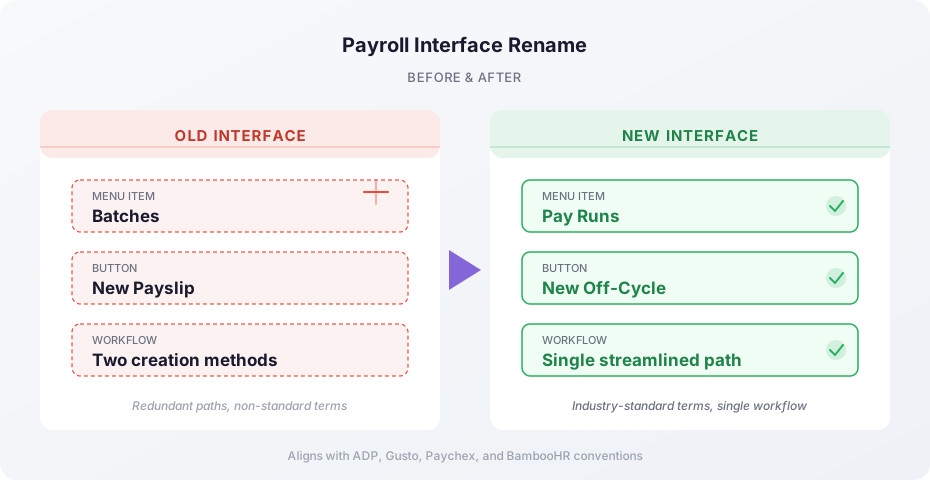
Every payroll administrator who has ever switched from ADP, Gusto, or Paychex to Odoo has hit the same friction point within the first hour: the thing every other payroll system calls a “pay run” was labeled “Batch” in Odoo. It was technically accurate — a batch of payslips processed together — but it broke the muscle memory of anyone who had touched payroll software before. That label is now gone. Odoo has renamed Batches to Pay Runs across its entire Payroll module, and the change runs deeper than a find-and-replace.
Pay Runs: Speaking the Language Payroll Teams Already Know
The rename touches every surface where “Batch” appeared: the main navigation menu, list views, form headers, breadcrumbs, and help text. A payroll manager opening the module for the first time now sees “Pay Runs” in the sidebar — the same term they would find in BambooHR, Rippling, or any enterprise HRIS.
This matters more than it looks. Payroll is one of the most error-sensitive processes in any organization, and unfamiliar terminology slows people down at exactly the wrong moment. When a controller asks an Odoo user “has the pay run been submitted?” and the Odoo screen says “Batches,” there is a cognitive gap that costs seconds every time. Multiply that by twice-monthly pay cycles across a multi-entity company, and the accumulated confusion is real. Adopting the industry term eliminates that gap entirely.
Off-Cycle Payslips Get Their Own Dedicated Button
The old “New Payslip” button served double duty: it was the entry point for both regular payslips processed inside a batch and one-off payslips created outside the normal cycle. That ambiguity caused problems. New administrators would click “New Payslip” intending to start a full pay run, only to create a single standalone record they then had to delete.
Odoo now replaces that button with “New Off-Cycle,” making the intent explicit. Off-cycle payslips are exactly what the name implies: payments that fall outside the regular schedule. A termination payout that cannot wait for the next cycle. A commission adjustment that needs to go out this week. A bonus tied to a project milestone. A correction to a payslip that was already finalized and submitted.
By labeling the action “Off-Cycle,” Odoo makes it clear that this button is an exception path. Regular payslips belong inside a pay run. The button exists for the cases where the regular cycle does not apply. That distinction is fundamental to payroll operations, and it was invisible under the old generic label.
One Way to Create a Payslip, Not Two
Odoo previously offered two separate methods for creating individual payslips. One went through the batch workflow; the other was a standalone form accessible from a different menu path. Both produced the same result — a payslip record tied to an employee — but the existence of two paths created genuine confusion about which one to use and whether they behaved differently.
The second method is now gone. There is exactly one way to create a payslip: either inside a pay run (the normal path) or via the “New Off-Cycle” button (the exception path). The directions for creating payslips have been rewritten from scratch to reflect this single, unambiguous workflow.
Removing a feature is often harder than adding one, because it requires confidence that the surviving path covers every use case. In this instance, the redundant method added nothing that the pay run and off-cycle paths do not already handle. Its removal makes the module easier to document, easier to train on, and harder to misuse.
What This Means for Teams Running Payroll on Odoo
None of these changes alter the underlying payroll computation engine. Salary rules, tax calculations, and journal entry generation work exactly as they did before. What changes is the surface layer that payroll teams interact with every pay cycle — and that surface layer now speaks the same language as the rest of the industry.
For companies evaluating Odoo against dedicated payroll platforms, the terminology alignment removes one of the small but persistent objections that came up in demos. For existing users, the streamlined workflow means fewer clicks and less second-guessing during the most time-sensitive process in HR. And for the consultants who implement Odoo payroll across different organizations, the standard vocabulary means less time spent explaining what “Batch” means and more time spent on the configuration that actually matters.