In the world of payment infrastructure, stability is the product. Merchants don’t care how elegant your API design is or how slick your developer portal looks — they care that money moves from buyer to seller without interruption, every single time. When that stability fractures, the consequences cascade immediately through every system that depends on it. This month, Odoo found itself navigating both sides of that equation at once: welcoming a major new payment provider into its ecosystem while scrambling to contain the fallout from another provider’s sudden regional collapse.
PayU Arrives as a First-Class Odoo Payment Provider
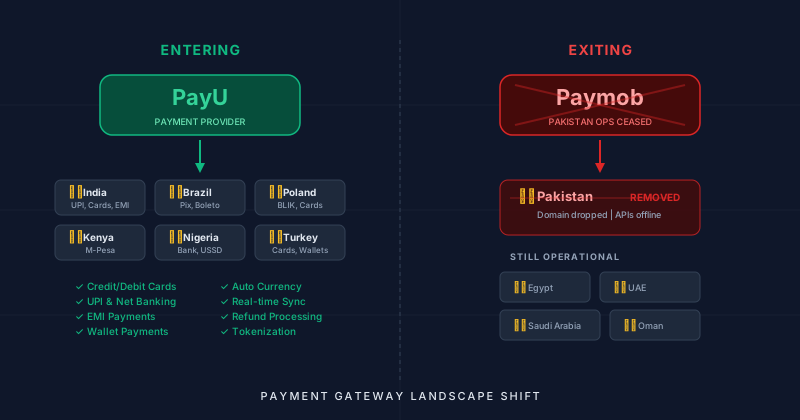
PayU, the fintech giant operating across India, Latin America, Eastern Europe, the Middle East, and Africa, is now a native payment provider in Odoo. The integration isn’t a third-party connector or a community module requiring manual maintenance — it ships as part of Odoo’s core payment provider framework, with full configuration available through the standard payment provider settings interface.
The timing is significant. PayU processes billions of dollars in transactions annually across markets where digital payment adoption is accelerating faster than anywhere else in the world. India alone has seen UPI transaction volumes grow at a pace that would have seemed implausible five years ago, and PayU sits at the center of that infrastructure. For Odoo merchants operating in these regions, native PayU support means they can finally accept the full spectrum of local payment methods without bolting on external integrations that break with every platform update.
What the PayU Integration Actually Supports
The breadth of payment methods available through the new integration reflects the diversity of how people actually pay in PayU’s markets. Credit and debit card processing covers the expected Visa, Mastercard, and RuPay networks. UPI payments — India’s dominant real-time payment rail — are supported natively, which is critical for any merchant doing serious volume in the Indian market. Net banking connects directly to customer bank accounts for direct transfers. EMI options let customers split large purchases into monthly installments at checkout. And wallet payments integrate with the mobile wallets that have become primary payment instruments across much of South Asia and Africa.
Beyond payment acceptance, the integration handles the operational complexity that separates a usable payment system from a checkbox feature. Automatic currency conversion manages cross-border transactions without requiring merchants to manually configure exchange rates. Real-time payment status synchronization keeps Odoo’s order and invoice records accurate as transactions move through authorization, capture, and settlement. And refund processing works directly from within Odoo — no logging into a separate PayU dashboard to issue a return.
For merchants who have been managing PayU through custom code or third-party connectors, the native integration eliminates an entire category of maintenance burden. Configuration happens through Odoo’s standard payment provider settings, with the same interface patterns used for Stripe, Adyen, and other supported gateways.
Paymob’s Pakistan Operations Collapse Overnight
While PayU’s addition to Odoo was a planned, orderly expansion, the other half of this month’s payment provider story was anything but. Paymob, the Egyptian-founded payment gateway that had expanded into Pakistan as part of its regional growth strategy, abruptly ceased operations in the country. The Pakistan domain was dropped entirely. The APIs stopped responding. There was no deprecation period, no migration guide, no advance warning that merchants could use to prepare alternatives.
For businesses running Odoo with Paymob configured as their Pakistan payment provider, this was an immediate crisis. Transactions started failing. Checkout flows broke. Payment status callbacks stopped arriving, leaving orders stuck in limbo between “pending” and “confirmed.” The kind of cascading failure that payment infrastructure is specifically supposed to prevent.
The reasons behind Paymob’s exit remain somewhat opaque. Pakistan’s fintech regulatory environment has been tightening, and operating a payment gateway in the country requires navigating a complex web of State Bank of Pakistan regulations, foreign exchange controls, and licensing requirements that have tripped up multiple international players. Whatever the specific trigger, the result was the same: a payment provider that merchants depended on simply stopped existing in their market.
Odoo’s Response: Remove What’s Broken, Fast
Odoo’s response was to remove Pakistan from the list of supported countries in the Paymob payment provider configuration. It’s a pragmatic decision — there’s no value in keeping a non-functional integration visible to merchants. Leaving Pakistan as an option would only create confusion, with new deployments potentially selecting a payment provider that cannot process a single transaction.
Paymob itself continues to operate in its other markets. Egypt, where the company was founded, remains its strongest market. The UAE and Saudi Arabia operations appear unaffected. Odoo’s Paymob integration continues to work for merchants in those countries — this was a surgical removal of a single country from a multi-market provider, not a wholesale abandonment of the Paymob connector.
But for Pakistani merchants who had built their payment flows around Paymob, the path forward requires migration. Alternative payment providers operating in Pakistan — including local players and other international gateways with Pakistani operations — become the immediate options. The new PayU integration, while not a direct replacement for every market Paymob served, does expand the set of natively supported alternatives available within Odoo.
The Fragility of Payment Infrastructure in Emerging Markets
This dual event — one provider entering, another’s regional operations evaporating — illustrates a tension that ERP platforms face as they expand into emerging markets. In mature payment ecosystems like the EU or the United States, payment providers rarely disappear without warning. Regulatory frameworks enforce orderly wind-downs. Merchant funds are protected by established insurance and escrow requirements. The infrastructure is boring in the best possible sense.
Emerging markets don’t have that luxury. Payment providers operate under regulatory regimes that can shift quickly, in countries where licensing requirements may change with a new government directive. A provider that’s fully operational on Monday can be functionally dead by Friday. For an ERP platform like Odoo that serves merchants globally, this creates a maintenance obligation that goes far beyond writing integration code. It requires continuous monitoring of provider health across dozens of markets and the ability to respond — updating configurations, removing broken options, communicating alternatives — on a timeline measured in days, not quarters.
What This Means for Odoo Merchants
For merchants in PayU’s markets — India, Latin America, Eastern Europe, the Middle East, and Africa — the new integration is straightforwardly good news. A major payment provider is now available without custom development, with the full range of local payment methods and operational features like automatic currency conversion and integrated refund processing. Configuration is handled through Odoo’s standard interface, and the integration benefits from the same update cycle as the rest of the platform.
For merchants affected by Paymob’s Pakistan exit, the situation is more urgent. Payment provider migrations are never trivial — they involve updating configurations, testing transaction flows, verifying webhook endpoints, and ensuring that refund and chargeback processes work correctly with the new provider. The sooner that migration begins, the sooner the risk of failed transactions is eliminated.
And for the broader Odoo ecosystem, this month serves as a reminder that payment infrastructure in a globalized ERP isn’t a “set it and forget it” proposition. The landscape shifts. Providers enter and exit markets. Regulatory environments change. The platforms that serve merchants well are the ones that respond quickly when the ground moves — adding new options when providers mature, and removing broken ones before they cause more damage than they already have.