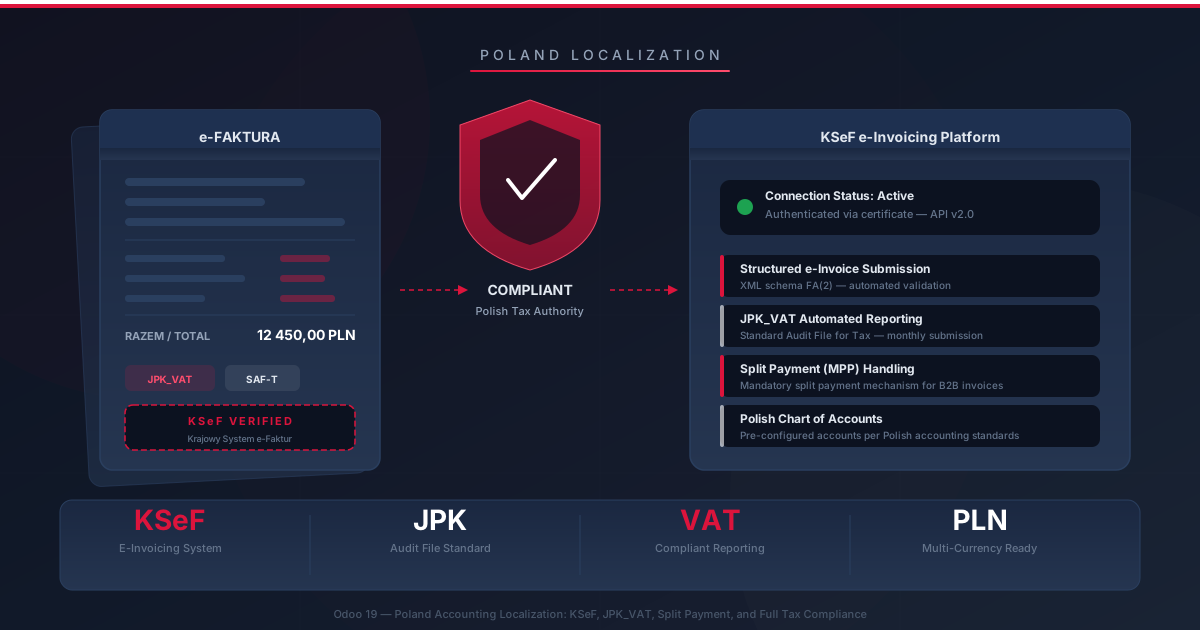
Poland’s tax landscape has been moving fast. The Krajowy System e-Faktur — KSeF for short — has gone from pilot program to mandatory infrastructure in just a few years, and every business operating in the country now needs to issue structured electronic invoices through the government’s centralized platform. For Odoo users, that requirement just got dramatically easier to meet.
Odoo now includes a complete Polish fiscal localization that handles everything from the chart of accounts to real-time invoice submission through KSeF. It’s not a single module bolted onto the side of the accounting app — it’s eight interconnected packages that cover the full compliance surface Polish businesses need to operate without workarounds.
Eight Modules, One Installation
The localization ships as a set of automatically installed modules, each covering a distinct area of Polish accounting requirements. The base package delivers the Polish chart of accounts and tax configuration. A reporting module handles the local tax report formats that accountants need for periodic filings. The KSeF module manages the electronic invoicing pipeline. A bank verification module confirms account details against government registries. And the JPK modules generate the standardized audit files that Polish tax authorities require for inspections.
For businesses upgrading to a newer version, any modules that weren’t previously available will need a manual install. But for fresh deployments, everything arrives together — select Poland as the country, and the full localization package activates automatically.
KSeF: The Centerpiece of Polish E-Invoicing
KSeF is Poland’s answer to the European-wide shift toward real-time tax reporting. Every invoice issued in Poland must pass through this centralized system, which validates the document structure, assigns an official identification number, and stores it as the legal record of the transaction. Paper invoices and PDFs sent directly between businesses are no longer sufficient on their own.
Odoo’s integration connects directly to KSeF through a certificate-based authentication system. The setup starts on the Polish tax authority’s portal, where businesses generate a certificate that authorizes their ERP to submit invoices on their behalf. That certificate gets imported into Odoo, and from that point forward, invoice submission happens from within the accounting app without touching the government portal again.
How Invoice Submission Actually Works
The workflow is straightforward once the certificate is in place. An accountant confirms an invoice in Odoo, clicks send, and selects KSeF as the delivery method. Odoo packages the invoice data into the required XML format, transmits it to KSeF, and monitors for the response. When KSeF accepts the invoice, it returns an official receipt certificate called a UPO — the Urzędowe Potwierdzenie Odbioru — which Odoo automatically attaches to the invoice record.
This UPO is the legal proof that the invoice was properly submitted. Accountants can check the submission status directly from the invoice view without switching to the KSeF portal. If something goes wrong — a validation error, a formatting issue, a connectivity problem — the status updates in Odoo with enough detail to diagnose and fix the issue.
Automatic Vendor Bill Import
The integration isn’t just outbound. Odoo can pull incoming invoices from KSeF as well. When a supplier submits an invoice through KSeF that targets your business, Odoo can automatically retrieve it and create a vendor bill draft. This eliminates the manual data entry that traditionally accompanies accounts payable — the invoice arrives pre-populated with the supplier’s details, line items, and tax information exactly as submitted to the tax authority.
For businesses with high invoice volumes, this alone justifies the integration. Every vendor bill that arrives automatically through KSeF is one fewer document that needs to be manually keyed in, scanned through OCR, or reconciled against a paper copy.
Bank Account Verification Built In
Poland’s split payment mechanism and white list requirements mean businesses need to verify that they’re paying into registered bank accounts. Sending funds to an unverified account can result in the buyer losing the right to deduct VAT on that transaction — a penalty that makes verification a financial necessity, not just a compliance checkbox.
The localization includes a bank account verification module that checks supplier bank details against the Ministry of Finance’s official registry. This happens within the payment workflow, catching potential issues before funds leave the account rather than during a post-payment audit.
JPK Audit Files for Tax Authority Requests
JPK — Jednolity Plik Kontrolny — is Poland’s standardized audit file format. Tax authorities can request these files during inspections, and businesses must be able to generate them on demand. The localization includes the modules needed to export accounting data in the required JPK structure, covering the various file types that Polish regulations specify for different aspects of the financial records.
What This Means for Polish Businesses on Odoo
Until now, Odoo users in Poland relied on community modules or custom development to handle KSeF integration, JPK reporting, and bank verification. Those solutions varied in quality, maintenance commitment, and compatibility with Odoo’s upgrade cycle. A first-party localization changes the equation — these modules will track legislative changes and KSeF API updates as part of Odoo’s standard release process.
For companies evaluating ERP platforms in Poland, this closes what was one of Odoo’s most visible gaps in the Central European market. Combined with the recently added Hungarian localization, Odoo now covers the two largest economies in the region that were previously missing native fiscal support — a clear signal that the platform is investing seriously in European compliance coverage.