If you run a restaurant on Odoo and want to accept orders from delivery platforms, the question has always been straightforward: does your preferred provider work with UrbanPiper? The answer, until now, was buried in UrbanPiper’s own website. Odoo’s documentation told you how to connect the integration but didn’t tell you which platforms were available or where they operated.
That gap is now closed. Odoo has restructured its entire delivery platform documentation from a generic setup guide into a comprehensive reference that maps every supported provider to its geographic coverage area — organized by region, with specific country availability listed for each platform.
Eight Platforms Go Global
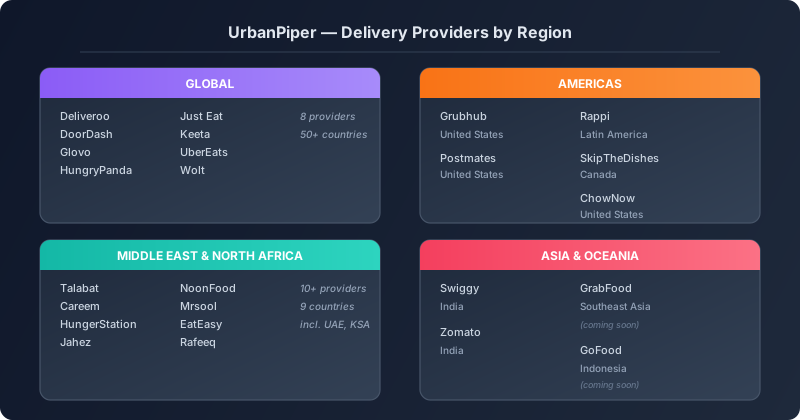
The documentation now clearly identifies eight delivery providers operating across multiple continents: Deliveroo, DoorDash, Glovo, HungryPanda, Just Eat, Keeta, UberEats, and Wolt. These are the platforms that restaurant owners in most major markets can connect to immediately through the UrbanPiper integration.
What makes the global category useful is the implicit message: if you’re running Odoo in Western Europe, North America, or Australia, at least three or four of these platforms are probably already operating in your city. You don’t need to research each one individually to figure out if the integration is relevant to your location.
The Middle East Gets Serious Coverage
The most substantial addition is the Middle East and North Africa section. More than ten providers now appear with specific country coverage: Talabat across nine Gulf states, Careem in the UAE and Saudi Arabia, HungerStation and Jahez serving the Saudi market, NoonFood expanding from its e-commerce roots into food delivery, plus regional players like Mrsool, EatEasy, Rafeeq, and Ninja.
For restaurant operators in Dubai, Riyadh, or Cairo, this is the information that actually matters. Knowing that UrbanPiper supports Talabat is only useful if you also know that Talabat covers Bahrain, Egypt, Iraq, Jordan, Kuwait, Oman, Qatar, Saudi Arabia, and the UAE. A restaurant in Muscat needs different platforms than one in Jeddah, and the documentation now makes those distinctions visible without requiring a separate research step.
The Americas Get Their Own Tab
Delivery in the Western hemisphere gets a dedicated section listing Grubhub, Postmates, and ChowNow for the United States, Rappi for Latin America, and SkipTheDishes for Canada. The split makes practical sense — a restaurant chain operating across the US and Mexico needs to know at a glance which platforms serve which side of the border.
Rappi’s inclusion is particularly notable. The Colombian-born super-app has been expanding aggressively through Latin America, and its presence in the Odoo integration opens the door for restaurant operators in markets like Mexico, Brazil, Colombia, and Argentina to connect their POS to delivery orders without third-party middleware.
Asia and Oceania: Present With More Coming
The Asia-Oceania section currently lists Swiggy and Zomato for India — the two dominant platforms in one of the world’s largest food delivery markets. But the more interesting signal is what’s coming next: GrabFood for Southeast Asia and GoFood for Indonesia are flagged as upcoming integrations.
Southeast Asia is arguably the most competitive food delivery market on the planet, with Grab, GoJek, Foodpanda, and local players fighting for market share across Thailand, Vietnam, the Philippines, Malaysia, Indonesia, and Singapore. Once GrabFood and GoFood join the UrbanPiper roster, Odoo’s POS becomes a viable central hub for restaurant chains operating across the region.
The Structural Overhaul Behind the Content
Beyond the provider tables, the update also involved a significant documentation restructure. The entire section was renamed from “Online Food Delivery” to “UrbanPiper” — a more accurate label since UrbanPiper is the specific integration layer that makes these connections work. All internal cross-references, image paths, and redirect rules were updated to match, ensuring that existing bookmarks and links from other documentation pages still resolve correctly.
The provider information is organized using tabbed interfaces with striped table rows for readability — a format that works particularly well when you’re scanning a long list of platform names looking for the one that operates in your country.
Why Regional Visibility Matters for Multi-Location Restaurants
The practical impact of this update scales with the number of locations a restaurant operates. A single-location cafe in Amsterdam probably already knows that Deliveroo and UberEats are their main delivery channels. But a restaurant group with locations in Dubai, London, Mumbai, and São Paulo needs a quick reference for which platforms to activate at each site — and that reference now lives directly in the tool they use to manage those locations.
The integration itself hasn’t changed — UrbanPiper still handles the middleware layer between Odoo’s POS and the delivery platforms. What changed is that the information needed to make configuration decisions now lives where you make those decisions, instead of requiring a detour through a third-party website to figure out what’s available in your market.