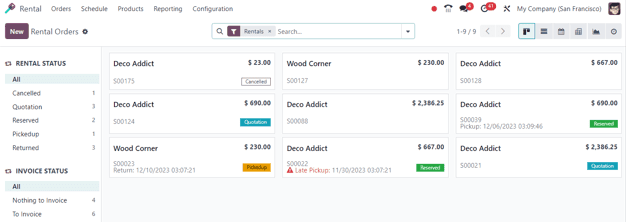
Rental businesses have always had to deal with two fundamentally different kinds of products. A construction equipment company rents out excavators — physical machines that leave the yard, need to be tracked, and eventually come back. A staffing agency rents out labor — people who provide a service but don’t show up in a warehouse count. These two models have different inventory implications, different availability rules, and different billing patterns. Until now, Odoo’s Rental module treated them with the same configuration path.
Odoo 19.3 introduces a standalone product type configuration page that formally separates goods from services in the rental context, each with its own set of rules for how products are tracked, when they can be booked, and which other modules need to be active.
Goods: Physical Items That Leave and Return
Goods in the rental context are physical items. When a customer rents a projector, a vehicle, or a piece of furniture, that item is removed from the company’s available stock, delivered to the customer, and eventually returned. The rental module now explicitly ties into inventory management for goods: enabling inventory integration automatically creates a dedicated internal location called Customer/Rental that tracks where rented items are at any given time.
This is a meaningful change for businesses that struggled with rental inventory visibility. Previously, rented items would show as transferred to a customer location, but there was no rental-specific location that made it easy to see at a glance how many units were out on rental versus sitting in the warehouse. The dedicated Customer/Rental location fixes that.
Services: Labor and Non-Physical Rentals
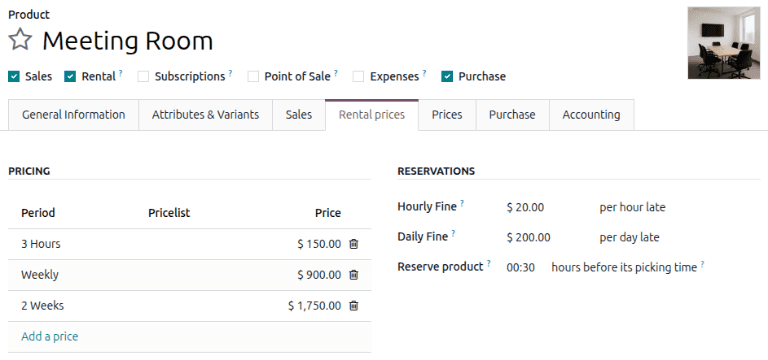
Services cover everything that doesn’t involve a physical item changing hands. This includes labor rentals, consulting time, equipment operation services, and physical items that technically never leave the company’s premises (like a conference room or a studio space). These don’t need inventory tracking because there’s nothing to ship or receive back.
The distinction matters for billing and scheduling. A service rental might still need time-based pricing and availability management, but it doesn’t generate delivery orders, doesn’t trigger stock moves, and doesn’t need return processing. By separating the product type at the configuration level, the system stops generating unnecessary warehouse operations for service-type rentals.
Unavailability Days Control Online Booking Windows
The new product type page also consolidates the unavailability days setting. This controls which days of the week customers can book or return rental products through the online portal. A business that doesn’t operate on weekends can block Saturday and Sunday from the booking calendar, preventing customers from selecting pickup or return dates that the warehouse can’t actually fulfill.
This setting applies specifically to online bookings — internal users creating rental orders through the back office can still override these restrictions when needed. The separation ensures that the customer-facing experience reflects real operational capacity while preserving flexibility for the internal team.
App Dependencies Made Explicit
The configuration page surfaces the app integrations that the Rental module depends on, including Sales, Sign, Planning, Project, Inventory, and eCommerce. This is more useful than it sounds. Rental sits at the intersection of multiple Odoo modules, and it’s not always obvious which ones need to be installed for specific features to work. A rental business that wants customer signatures on pickup forms needs the Sign app. One that wants to schedule employee delivery shifts needs Planning. The new page makes these dependencies visible without requiring administrators to discover them through trial and error.
What This Means for Rental Operations
The product type split isn’t a new capability so much as a structural clarification that prevents misconfiguration. Rental businesses that mix physical goods and services — common in event management, construction, and hospitality — now have a clear path for setting up each type correctly from the start. The goods path activates inventory tracking and warehouse operations. The services path skips them. And the unavailability days setting ensures that online customers can only book windows the business can actually support.
For existing Odoo Rental users, this is the kind of change that reduces support tickets. Half the configuration questions around rental products came from people setting up service-type rentals and wondering why the system was generating delivery orders, or setting up physical goods without inventory integration and wondering where their stock counts went. The dedicated product type page makes the right path obvious.