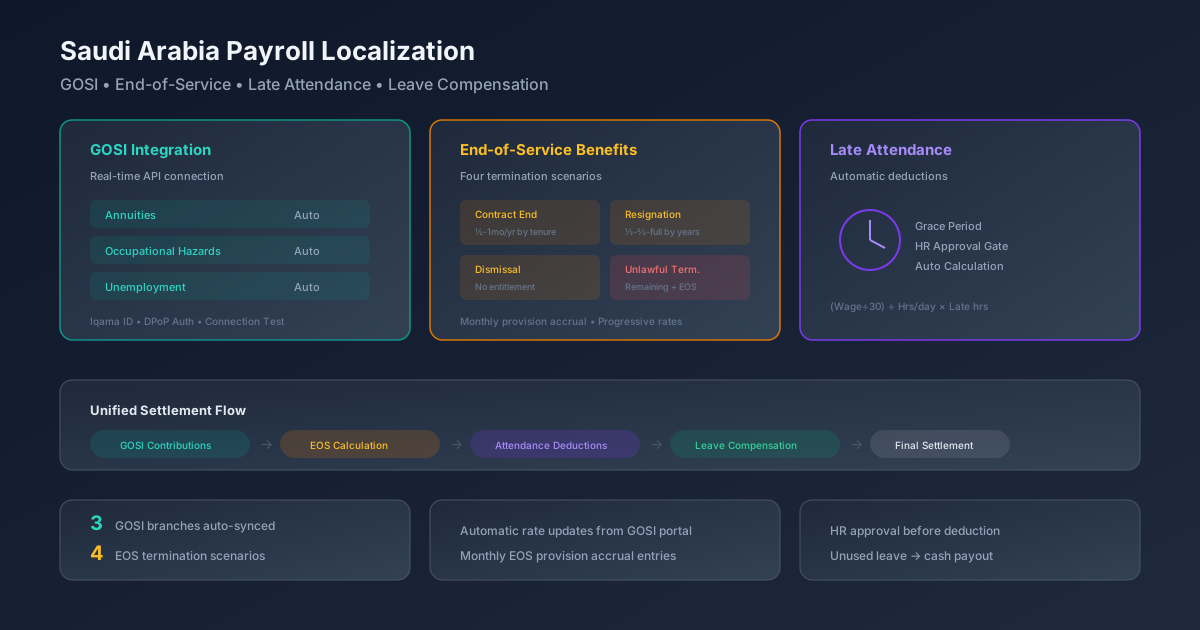
Saudi Arabia’s payroll landscape is one of the more complex in the Gulf region. Between the General Organization for Social Insurance (GOSI) contributions that vary by branch, end-of-service benefit entitlements that shift based on how and why an employee leaves, and attendance deduction rules that require grace period calculations, Saudi payroll is the kind of system where a single missed rule can cascade into compliance problems.
Odoo has just expanded its Saudi localization to handle all of this natively. The update covers four major areas: live GOSI integration for social insurance, detailed end-of-service benefit calculations for every termination scenario, automatic late attendance deductions, and unused leave compensation. Together, they bring the Saudi payroll module from a basic salary calculator to something that handles the regulatory details companies actually spend hours on every month.
GOSI Integration: Real-Time Social Insurance Data
The headline feature is the direct API integration with GOSI. Instead of manually looking up contribution percentages and entering them into the system, Odoo now retrieves the rates automatically across all three GOSI branches: Annuities, Occupational Hazards, and Unemployment insurance.
Setting it up requires a set of API credentials: a Registration Number, API Key, Client ID, Client Secret, and a DPoP Key for token authentication. Once the credentials are entered and the connection test passes, the system pulls the current contribution percentages directly from GOSI and applies them to payslip calculations without manual intervention.
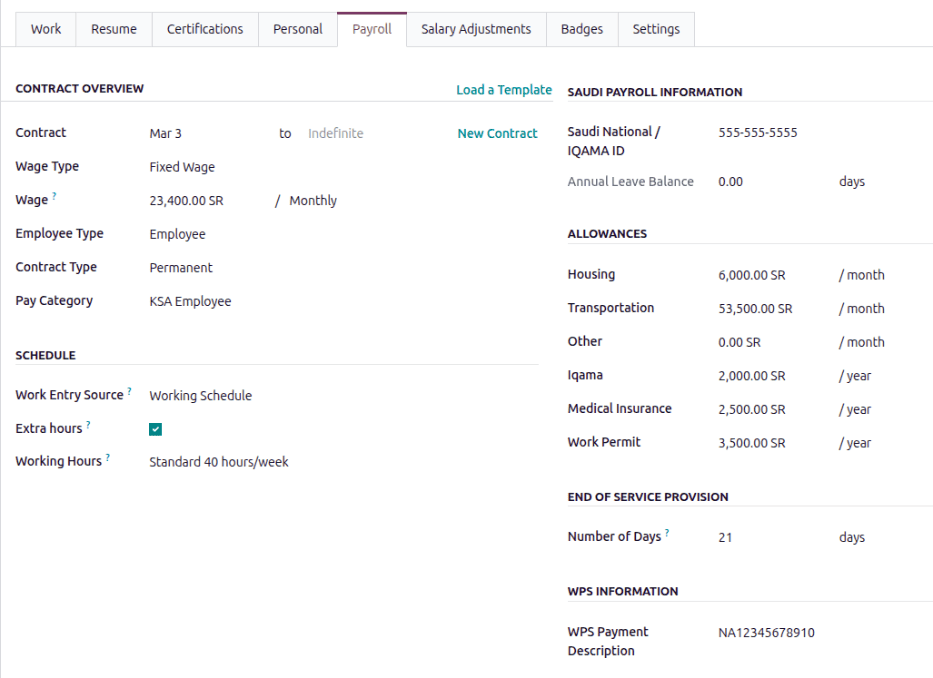
On the employee side, each Saudi worker’s profile needs their Iqama number — the national identification number that GOSI uses to match contribution records. This is a one-time setup per employee that links their payroll record to their GOSI account, ensuring that contribution calculations use the correct rates for their specific insurance profile.
The practical impact is significant for companies with large Saudi workforces. GOSI periodically adjusts contribution rates, and those changes need to be reflected immediately in payslip calculations. With the API integration, rate updates propagate automatically — no more monthly check of the GOSI portal to see if anything has changed, and no more risk of running a payroll cycle with stale percentages.
End-of-Service Benefits: Four Termination Scenarios
Saudi labor law ties end-of-service (EOS) benefits directly to how and why an employee’s contract ends. The calculation isn’t a flat formula — it varies based on the type of separation, and getting it wrong can create legal liability. Odoo now handles all four scenarios natively.
End of contract or retirementis the most straightforward. Employees with one to five years of service receive half their latest monthly salary for each year worked. Those with more than five years receive a full month’s salary for each year beyond the fifth, on top of the half-salary entitlement for the first five years. Employees with less than a year of service receive a proportional amount.
Resignationapplies a different formula. Employees who resign after two to five years of service receive one-third of the standard EOS amount. Between five and ten years, that rises to two-thirds. Beyond ten years, they receive the full entitlement. Those who resign within the first two years receive nothing — a rule designed to discourage very short tenures.
Dismissal for cause strips the EOS entitlement entirely. The system records the termination type and applies a zero calculation, which matters for audit trails even though no payment is generated.
Unlawful terminationcreates the most complex calculation. For limited-duration contracts, compensation equals the remaining contract period’s wages. For unlimited-duration contracts, the employee receives 15 days’ wages per year of service, with a minimum of two months’ total compensation. In both cases, the standard EOS benefit is added on top.
EOS Provision: Monthly Accrual for Financial Planning
Beyond the settlement calculation itself, the module includes a monthly EOS provision accrual. This creates a recurring journal entry that recognizes the growing EOS liability over the course of employment, rather than recording the entire cost at termination.
The provision is calculated based on service duration and adjusts progressively — accruing at the lower rate during the first five years and at the higher rate thereafter. For finance teams, this means the balance sheet accurately reflects the company’s future EOS obligations at any given month, rather than taking a sudden hit when a long-tenured employee departs.
Late Attendance Deductions With Grace Periods
Saudi labor practices typically include salary deductions for late arrivals, but applying these manually creates a constant stream of HR work: checking attendance records, calculating deduction amounts, getting approvals, and applying them to the correct payslip. The new module automates this entire chain.
The configuration starts with a grace period — a buffer window that determines how many minutes of lateness are tolerated before a deduction applies. Beyond the grace period, the system calculates the deduction using a straightforward formula: basic wage divided by 30, divided by the expected hours per day, multiplied by the number of late hours. The result is automatically added to the payslip as a deduction line item.
Before the deduction hits the payslip, it goes through an HR approval workflow. This prevents edge cases — an employee who was late because of a client meeting, or a system clock discrepancy — from generating deductions without human review. HR managers can approve or reject each deduction, and only approved entries flow into the payroll calculation.
Unused Leave Compensation on Exit
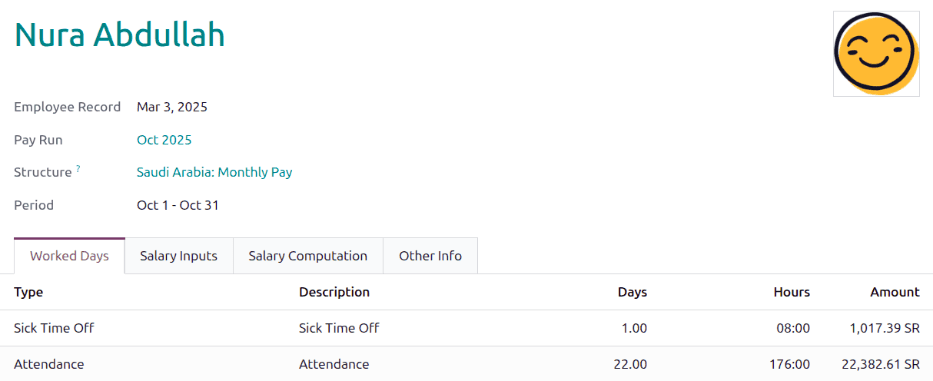
When an employee leaves the company, any accrued but unused annual leave gets converted to a cash payment. The calculation follows the daily wage formula: the employee’s daily rate multiplied by the number of remaining leave days. This is processed as part of the final settlement, alongside the EOS benefit, ensuring the departing employee receives everything owed in a single payout.
What This Means for Saudi Operations
For companies operating in the Kingdom, the GOSI integration alone removes a recurring manual task that touches every single payslip. The EOS calculations eliminate the spreadsheet gymnastics that HR teams typically resort to when navigating the four termination scenarios. And the late attendance automation turns what’s usually a monthly argument between HR and line managers into a system-managed process with an approval gate.
The combination matters because these aren’t independent features — they interact. An employee’s GOSI contributions affect their net pay, which factors into EOS calculations, which need to account for unused leave. Having all of these in the same system, pulling from the same data, eliminates the reconciliation work that comes from running GOSI in one system, attendance in another, and EOS in a spreadsheet.