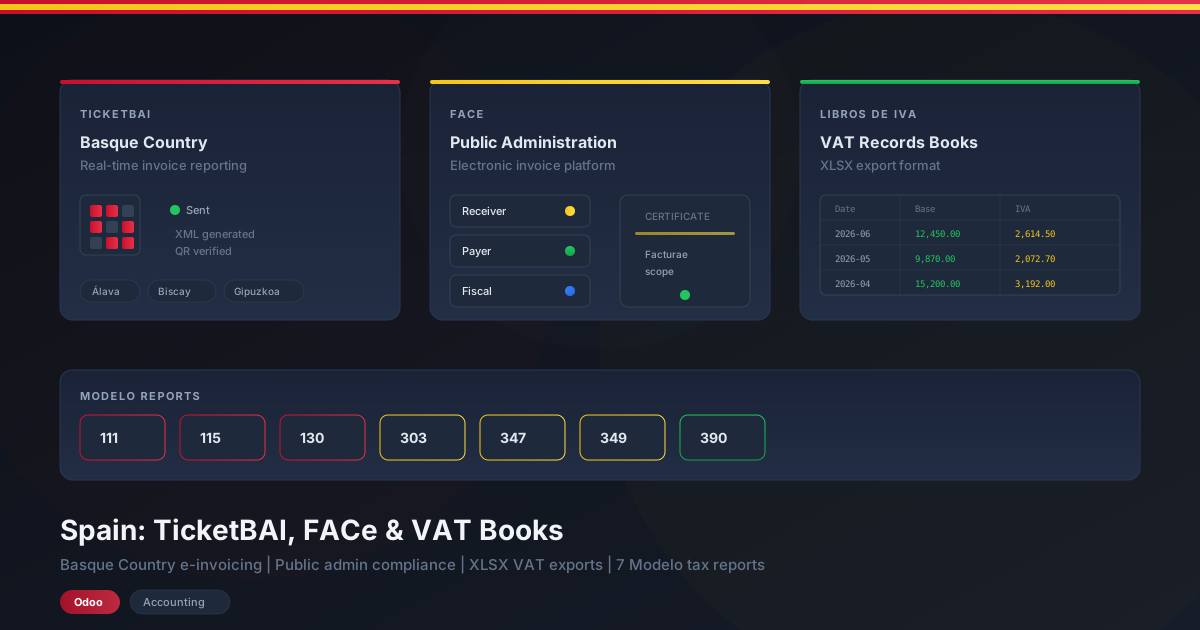
Spain’s tax compliance landscape is one of the most fragmented in Europe. The central government runs one electronic invoicing system. The Basque Country — a region with significant fiscal autonomy — runs its own. Public administrations require yet another format entirely. And then there are the Modelo tax declarations, each with its own filing schedule, its own calculation rules, and its own consequences for getting the numbers wrong.
Odoo has just shipped a substantial update to its Spanish localization that tackles all of these systems at once. The headline additions are TicketBAI support for businesses operating in the Basque Country, FACe integration for anyone invoicing Spanish public entities, and a clean XLSX export for VAT record books. Together with expanded Modelo report coverage, this turns the Spanish localization from a basic chart of accounts into something approaching a complete fiscal compliance toolkit.
TicketBAI: Real-Time Invoice Reporting for the Basque Country
TicketBAI is the e-invoicing system mandated by the Basque government and its three provincial councils: Álava, Biscay, and Gipuzkoa. Unlike Spain’s national SII system, which focuses on periodic batch reporting to the AEAT, TicketBAI requires real-time transmission of every invoice to the provincial tax authority at the moment it’s issued.
The integration works at the point of invoice confirmation. When an accountant confirms an invoice in Odoo, the system generates the required XML file, packages the invoice data according to TicketBAI specifications, and sends it to the relevant provincial council. The invoice status updates to “Sent” once transmission completes, and the XML file is stored in the invoice record for reference.
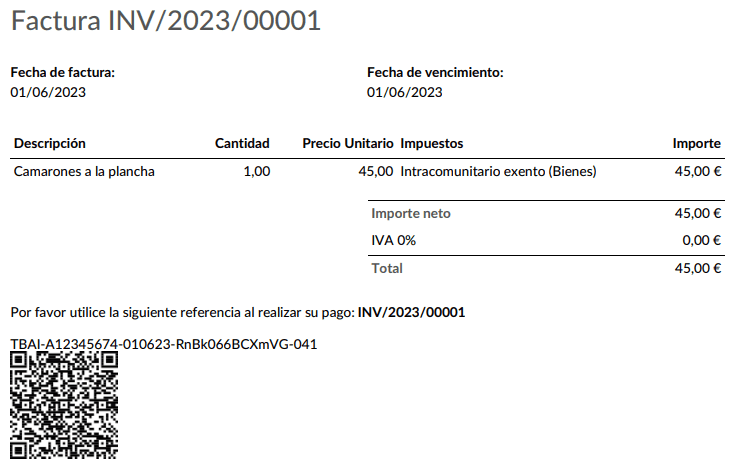
Every TicketBAI-compliant invoice also gets a QR code printed directly on the PDF. This isn’t decorative — it’s a verification mechanism that allows anyone receiving the invoice to confirm its authenticity with the tax authority. The QR code links the physical document back to the digital record in the government’s system, creating a chain of trust from the ERP all the way to the tax office.
Setting up TicketBAI requires the company’s tax ID, the installation of the Spain-TicketBAI module, and selection of the appropriate region in the Tax Agency field. Certificates issued by the provincial tax authority need to be uploaded with their associated passwords. A test mode is available for validating the certificate configuration before going live — a thoughtful touch that prevents the first real invoice submission from becoming a debugging session.
FACe: Electronic Invoicing for Public Administrations
If TicketBAI handles the Basque dimension of Spanish tax compliance, FACe covers the public sector dimension. FACe is the electronic invoicing platform used by public administrations across Spain — central government, regional governments, municipalities, universities, and other public entities. Any business that bills a Spanish public body needs to submit invoices through FACe in the Facturae format.
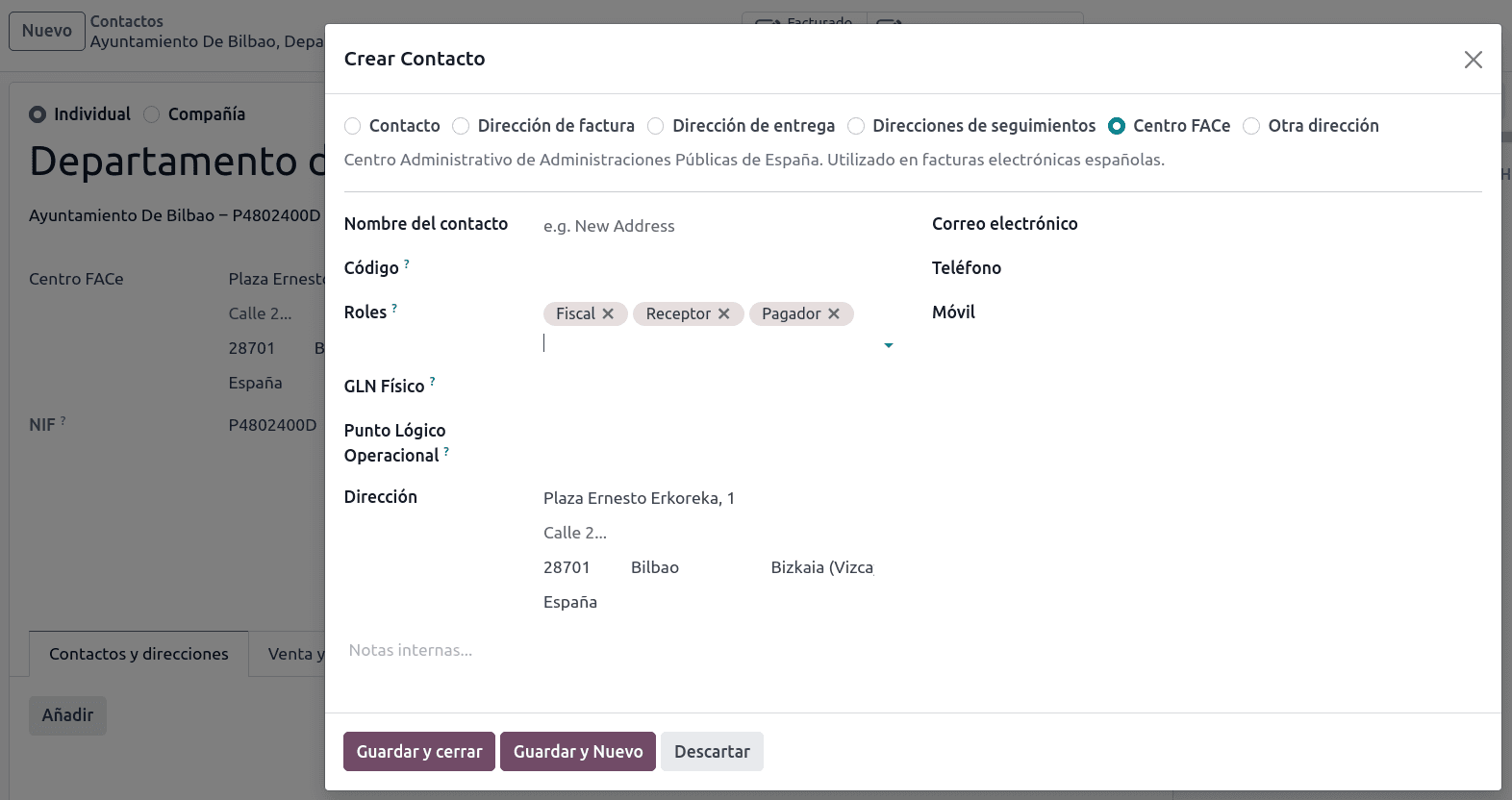
Odoo’s FACe integration introduces the concept of administrative centers — a layer of organizational structure that public entities use to route invoices internally. Each contact can be designated as a FACe Center with an assigned role: Receiver, Payer, or Fiscal. A single public entity might have different departments playing different roles, and multiple contacts can hold different designations for the same partner.
This matters in practice because getting the administrative center wrong means the invoice bounces. A hospital might have one department that receives the invoice, another that approves payment, and a third that handles the fiscal side. Odoo lets businesses map this structure once on the contact record, and every subsequent invoice to that entity routes correctly without manual intervention.
The certificate configuration for FACe lives in its own section, with the scope specifically set to “Facturae.” The generated XML files follow the Facturae standard but need to be submitted manually through the FACe governmental portal — direct API submission isn’t part of the current implementation. While that adds a manual step, it also means businesses aren’t dependent on API availability or changes to the government’s submission interface.
Libros de IVA: VAT Records Books in XLSX
The third major addition is the ability to export VAT records books in XLSX format directly from the Tax Report interface. Spanish businesses are required to maintain detailed VAT records — the Libros de IVA — that document every transaction subject to value-added tax. These records need to be available for inspection and are periodically submitted to the tax authority.
Previous versions of the localization required businesses to extract this data manually or use third-party tools to compile the records into the required format. The new export option adds a “VAT Records Books (XLSX)” selection to the Tax Report’s report options dropdown, producing a properly formatted spreadsheet that can be submitted directly or reviewed by the accounting team before filing.
It’s a small feature in terms of code, but it eliminates one of those recurring pain points that accountants deal with every reporting period — the gap between where the data lives and the format the tax authority expects it in.
Seven Modelo Reports, Each With Its Own Calculation Logic
Spain’s Modelo system is the tax declaration framework that covers everything from withholding tax on employee income to annual VAT summaries. The updated localization now supports Modelo 111 (income withholdings), 115 (rental withholdings), 130 (quarterly income estimates), 303 (periodic VAT declarations), 347 (annual third-party transaction reports), 349 (intra-community operations), and 390 (annual VAT summary).
Each report has its own calculation engine. Modelo 130, for instance, supports customizable percentage calculations and agriculture activity reporting through industry classification on contact records — a detail that matters for Spain’s large agricultural sector, where simplified tax regimes apply to certain farming operations.
Having all seven Modelo reports available natively means the quarterly and annual tax filing cycle can stay entirely within Odoo. No spreadsheet side-calculations, no manual data transfers to a filing application, no second set of books maintained in parallel just to satisfy the tax authority’s format requirements.
Why the Timing Matters
Spain has been steadily tightening its electronic invoicing requirements. TicketBAI is already mandatory in parts of the Basque Country and expanding to additional business categories each year. FACe compliance is non-negotiable for any company that works with public entities. And the Modelo reporting deadlines arrive with the same inexorable regularity as the seasons.
For businesses running Odoo in Spain, this update means the difference between an ERP that handles bookkeeping and one that handles compliance. The Basque Country no longer requires a specialized third-party module. Public sector invoicing no longer requires a separate workflow. And VAT record books no longer require a manual export-and-reformat step that eats hours every quarter.
For companies operating across multiple Spanish regions — say, a business headquartered in Madrid with operations in Bilbao and clients in the regional government — having TicketBAI, FACe, SII, and Modelo reporting all in the same system eliminates the patchwork of tools that regional tax fragmentation used to demand.