The End of Pick-and-Pay ERP
For years, Odoo’s enterprise pricing worked like a menu at a restaurant: you picked the apps you wanted — CRM, Accounting, Inventory, Manufacturing, HR — and paid for each one individually on a per-user, per-month basis. It was granular, transparent, and gave businesses the feeling of control over their software spend. It was also, as Odoo has now implicitly acknowledged, a model that created friction at exactly the wrong moment: when a company was ready to adopt more of the platform.
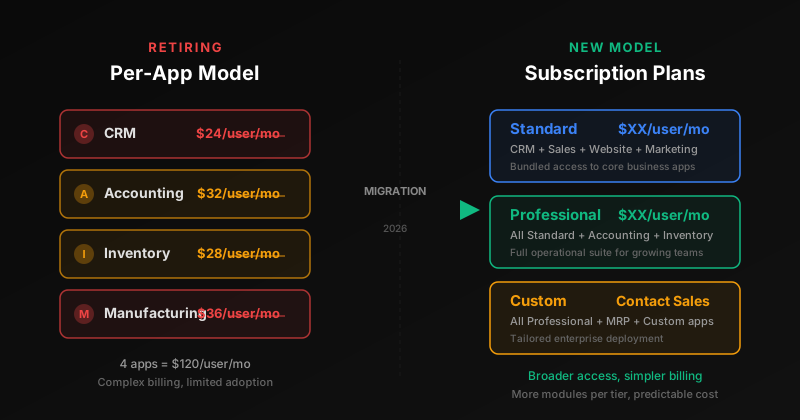
That model is now officially retired. Odoo has transitioned its enterprise licensing to subscription-based plans — bundled tiers that grant access to groups of applications under a single price point. The legal terms governing enterprise subscriptions have been rewritten, with both English and French documentation updated simultaneously, and the change carries the direct approval of CEO Fabien Pinckaers. This is not a quiet experiment. It is a structural overhaul of how Odoo monetizes its software.
The timing is deliberate. As Odoo pushes deeper into mid-market and enterprise accounts — organizations that deploy eight, twelve, or twenty modules — the per-app model was becoming a liability. Every additional module added a visible line item to the invoice, making expansion feel expensive even when the incremental value was clear. The subscription model flips that dynamic: broader access is the default, and the pricing incentive shifts toward adoption rather than restraint.
What the Per-App Model Got Wrong
The per-app pricing structure had a logic to it that made sense in Odoo’s early enterprise days. Small businesses running CRM and nothing else shouldn’t subsidize the cost of a manufacturing module they’d never touch. Charging per app meant customers paid only for what they used. The problem was that “what they used” was increasingly determined not by need, but by the psychological weight of adding another line item to the contract.
Consultants and implementation partners have long reported the same pattern: a business completes its initial Odoo deployment with three or four apps, then hesitates to activate a fifth — not because the module isn’t useful, but because the incremental cost feels like a separate purchasing decision. Accounting teams see the new line item. Procurement gets involved. What should be a simple configuration toggle becomes a budget approval process. The per-app model was turning Odoo into its own adoption bottleneck.
There was also the billing complexity. Multi-app deployments produced invoices that were difficult to parse, reconcile, and forecast. When different teams added different modules at different times, the resulting invoice became a patchwork of prorated charges, mid-cycle additions, and per-user counts that varied by app. Finance departments wanted a single number. Odoo was giving them a spreadsheet.
How Subscription Plans Restructure the Economics
Under the new model, Odoo’s enterprise offering is organized into subscription tiers. Each tier bundles a defined set of applications, and customers pay a single per-user fee that covers everything in their plan. Want CRM, Sales, and Marketing? That falls under one tier. Need Accounting and Inventory on top of that? Move to the next tier up. The mechanics are familiar to anyone who has purchased HubSpot, Microsoft Dynamics, or another modern SaaS platform in the last decade.
The economic shift is subtle but significant. In a per-app model, Odoo captured more revenue from customers who adopted more modules — but it also lost potential revenue from customers who didn’t adopt modules they could have used, because the pricing structure discouraged experimentation. Subscription plans reverse this: the marginal cost of trying an additional module within your tier is zero. A company on a mid-tier plan that hasn’t activated Inventory yet can turn it on tomorrow with no financial consequence. The barrier to deeper adoption disappears.
For Odoo, the bet is that increased adoption will offset any revenue lost from customers who were previously paying for individual modules at higher effective rates. It is the same bet that Adobe made when it moved from perpetual licenses to Creative Cloud, and the same bet Microsoft made with Office 365. In both cases, the short-term revenue disruption gave way to higher lifetime value as customers embedded more deeply into the platform.
The Legal and Operational Overhaul Behind the Scenes
Changing a pricing model for an enterprise software company is not a marketing exercise. It requires rewriting the legal framework that governs customer relationships. Odoo updated its enterprise subscription terms — the contractual documents that define what customers are entitled to, how billing works, and what happens at renewal — in both English and French simultaneously. The dual-language update reflects Odoo’s Belgian roots and its global customer base, where French- language terms carry the same legal weight as their English counterparts.
The involvement of CEO Fabien Pinckaers in approving the change signals its strategic importance. Pricing model transitions in enterprise software carry real risk: existing customers need migration paths, partners need updated sales materials, and the support organization needs to handle the inevitable wave of questions about how current contracts translate into the new structure. This was not a decision delegated to a product manager. It went through Odoo’s legal team and landed on the CEO’s desk before it went live.
The operational implications extend to Odoo’s partner ecosystem as well. Thousands of implementation partners worldwide have built their sales processes around per-app pricing — quoting customers based on which modules they need, calculating costs by multiplying apps by users. The subscription model changes that conversation entirely. Partners now sell tiers, not apps. The pitch shifts from “which modules do you need?” to “which plan fits your business?” — a simpler question, but one that requires retraining a global sales force.
What This Means for Existing Customers
The most immediate question for Odoo’s installed base is straightforward: what happens to my current contract? Pricing transitions in enterprise software are notoriously sensitive. Customers on per-app agreements need to understand whether they’ll be migrated automatically, whether their costs will change, and whether they’ll gain or lose access to specific modules in the process.
The subscription plan structure suggests that most customers will end up with broader access than they had before. If you were paying for four individual apps and those four apps fall within a single subscription tier, the tier likely includes additional modules you weren’t previously paying for. Whether the total cost goes up, down, or stays roughly the same depends on the specific tier pricing and the customer’s existing app configuration. The details of the migration path — grace periods, grandfathering terms, renewal timing — will determine how smoothly the transition lands.
For new customers, the change is unambiguously simpler. Instead of building a custom stack of modules and calculating a bespoke price, they choose a plan. The sales cycle gets shorter. The proposal gets simpler. The finance team sees one line item instead of twelve. This is the experience that competing SaaS platforms have offered for years, and Odoo’s adoption of it removes what had been a genuine point of friction in competitive evaluations.
Aligning With How the Industry Already Works
Odoo’s per-app model was, in many ways, a relic of the on-premise software era — a time when you bought specific modules because you were installing them on your own servers and each one carried real deployment overhead. In the SaaS world, where all modules run on the same infrastructure regardless of which ones are activated, the per-app cost structure was increasingly an artificial construct. Customers were paying for access to code that was already deployed and running.
The broader ERP and business software market has already converged on subscription tiers. Microsoft bundles Dynamics 365 into operations-focused and customer-focused plans. HubSpot tiers its Marketing, Sales, and Service hubs. Even SAP has moved toward cloud subscription bundles for its S/4HANA offering. Odoo was the outlier, clinging to a modular pricing approach that gave it granularity at the expense of simplicity.
The shift also positions Odoo more effectively for the mid-market, where purchasing decisions are made by business leaders rather than IT departments. A CTO evaluating ERP options doesn’t want to build a pricing spreadsheet. They want to compare Plan A at $X per user against Competitor B at $Y per user. Subscription tiers make that comparison possible. Per-app pricing made it an exercise in Excel.
The Bigger Bet: Platform Depth Over Module Revenue
Behind the pricing mechanics lies a more fundamental strategic shift. Odoo is signaling that its growth will come from platform depth — from customers using more of the system — rather than from maximizing revenue per module. This is a maturation play. It says that Odoo believes its product is strong enough that giving customers broader access will make them stickier, not less profitable.
The logic is sound. A company using Odoo for CRM alone can switch to a standalone CRM with relatively low friction. A company using Odoo for CRM, Accounting, Inventory, and Manufacturing is deeply embedded — its data flows, its workflows, its reporting all depend on the integrated platform. Subscription plans accelerate that depth of adoption by removing the financial barrier to activating the next module. The lock-in comes from usage, not from contracts.
Whether this bet pays off depends on execution. The tier structure needs to be intuitive. The migration for existing customers needs to be painless. The partner ecosystem needs to adapt its sales motions. And the pricing itself needs to be competitive at each tier, not just in aggregate. But the direction is clear: Odoo is done selling apps one at a time. It’s selling the platform. And for a company that has spent two decades building one of the most comprehensive ERP suites on the market, that might be the smartest pricing decision it has ever made.