Payroll in the UAE has never been a simple affair. Between the Wage Protection System requirements, multi-currency salary splits, and a labor law framework that keeps tightening, even routine disbursements demand precision. But it’s the non-routine payments — the mid-month commission, the emergency salary advance, the one-off relocation allowance — that have historically caused the most headaches for payroll teams running on Odoo.
The latest update to Odoo’s UAE payroll localization tackles this head-on with two significant additions: a proper instant pay structure for off-cycle disbursements and a salary advance mechanism with built-in automatic recovery. These aren’t cosmetic tweaks. They’re the kind of structural changes that eliminate entire categories of manual workarounds that UAE payroll administrators have been living with for years.
The Instant Pay Structure
The core idea is straightforward: not every payment should wait for the monthly payroll cycle. Commissions earned mid-month, performance bonuses approved on a Tuesday, housing allowances that kick in when an employee relocates — these all have legitimate reasons to be disbursed immediately rather than queued for the next scheduled run.
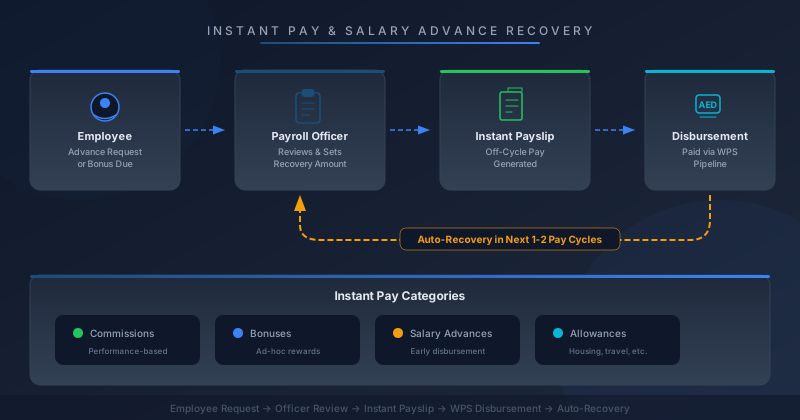
Odoo now provides a dedicated instant pay payslip type that sits alongside the regular monthly structure. When a payroll officer needs to issue an off-cycle payment, they generate an instant payslip that applies the correct salary rules for the specific payment category. The system handles commissions, bonuses, allowances, and even penalty deductions through this mechanism. Each category flows through its own set of computation rules, so a bonus payslip calculates differently from an allowance payslip — the tax implications, if any, and the WPS reporting category are handled automatically.
What makes this more than just a “create a payslip manually” button is the integration with the broader payroll pipeline. The instant payslip feeds into the same WPS submission workflow as regular monthly pay. It appears in the same reporting views. It reconciles against the same accounting journals. For auditing purposes, there’s no ambiguity about where the payment came from or why it was issued outside the normal cycle — the payslip carries its category, its approval chain, and its computation breakdown just like any regular disbursement.
Salary Advances With Built-In Recovery
Salary advances are a fact of life in UAE workplaces. An employee needs funds before payday, the company agrees, and the money goes out. The problem has always been the recovery side. In most Odoo implementations, tracking advance repayments meant maintaining spreadsheets alongside the system, manually adjusting payslips each month, and hoping nobody forgot a deduction two cycles later.
The new advance recovery mechanism changes this fundamentally. When an employee requests a salary advance, the payroll officer processes it through the instant pay structure and simultaneously sets the recovery parameters — specifically, the amount to be recovered and the number of subsequent pay cycles over which the recovery should happen. The system supports recovery across one or two pay cycles, which covers the vast majority of advance scenarios in practice.
Once the advance is disbursed, the recovery amount is automatically applied as a deduction on the employee’s next regular payslip. If the recovery is split across two cycles, each payslip carries the correct proportional deduction. The payroll officer doesn’t need to remember to apply it — the system handles it. More importantly, the deduction shows up transparently on the employee’s payslip with a clear line item referencing the original advance, so there are no surprises when they review their pay stub.
For companies processing dozens of advances per month — common in industries with large workforces like construction, hospitality, and facilities management — this eliminates a significant source of payroll errors and audit findings.
Sick Leave Calculations Get Clearer Rules
The update also codifies UAE sick leave compensation rules directly into the payroll engine. UAE labor law prescribes a specific tiered structure for sick leave pay: the first 15 days of sick leave in a year are compensated at full salary, the next 30 days at half salary, and any sick leave beyond that 45-day mark is unpaid. Previous Odoo configurations often required custom salary rules or manual overrides to enforce this structure correctly.
Now, the sick leave computation is built into the localization with a daily rate formula that adjusts automatically based on where the employee falls in the annual sick leave entitlement. The system tracks cumulative sick leave days across the year, determines the applicable tier, and calculates the correct pay amount without manual intervention. For employees who cross between tiers within a single pay period — say, using their 14th through 18th sick days in one month — the system splits the calculation correctly, applying full pay for the first day and half pay for the remaining three.
This is the kind of edge case that previously required payroll specialists to manually calculate and override, and it’s exactly where errors crept in. Having it automated removes both the effort and the risk.
The Master Report for Payroll Auditing
A new master payroll report introduces Excel export capabilities designed specifically for auditing. The report pulls payslip data across all localizations — not just UAE — into a single exportable view. For companies operating across multiple countries from a single Odoo instance, this means one consolidated report instead of generating separate exports from each localization and merging them manually.
The report includes every payslip line item, broken down by salary rule, with employee identification, pay period, and payment status. Auditors can filter by date range, department, localization, or payment type, and the Excel output preserves all grouping and subtotals. For UAE operations specifically, this report pairs well with WPS compliance reviews — the payroll officer can cross-reference the master report against submitted SIF files to verify that every disbursement matches what was reported to MOHRE.
The fact that it spans all localizations is a thoughtful touch for the growing number of UAE-headquartered companies with operations in Saudi Arabia, Egypt, or other markets. A single audit artifact covers the entire payroll operation, which simplifies both internal reviews and external audit engagements.
What This Means for UAE Employers
Taken individually, each of these changes solves a real but bounded problem. Taken together, they represent a meaningful shift in how Odoo handles the messier parts of UAE payroll — the parts that don’t fit neatly into a monthly cycle.
The instant pay structure eliminates the need for workaround payslips and manual journal entries when issuing mid-cycle payments. The advance recovery mechanism removes an entire category of spreadsheet-based tracking that has been a compliance risk for years. The sick leave tier calculation closes a gap that most implementations were solving with custom code. And the master report gives payroll teams and auditors a single source of truth across their entire operation.
For companies evaluating whether Odoo can handle UAE payroll without heavy customization, this update significantly strengthens the case. The localization now covers the day-to-day operational scenarios — not just the standard monthly cycle, but the exceptions, advances, and ad-hoc payments that make up a substantial portion of real-world payroll workload. And with MOHRE continuing to tighten WPS enforcement, having these transactions flow through the same compliant pipeline as regular salary payments isn’t just convenient — it’s increasingly essential.