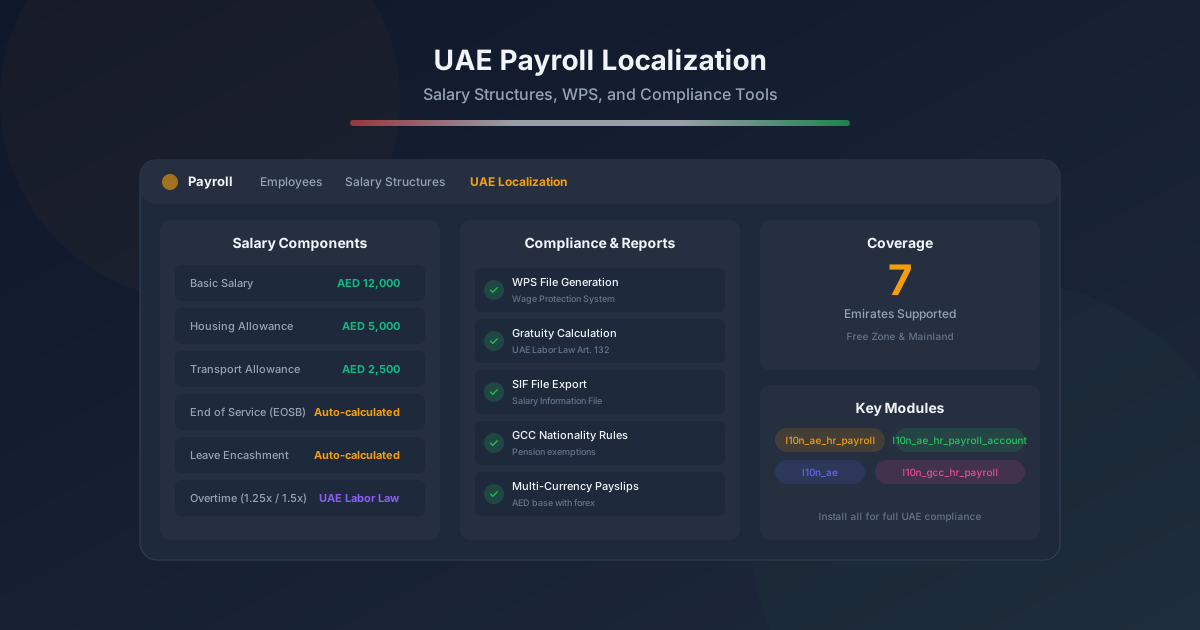
Running payroll in the UAE is not like running payroll in Europe or North America. There’s no income tax, which sounds simple until you realize that the complexity shifts elsewhere — into allowance structures, end-of-service benefits, the government’s Wage Protection System, and a web of labor law provisions that vary depending on whether an employee is a GCC national, which emirate the company operates in, and whether it sits in a free zone or on the mainland.
Odoo has been steadily building out its Middle East presence, and the latest payroll update for the UAE represents a significant step in that expansion. The localization isn’t a surface-level translation job — it’s a ground-up implementation of salary structures, statutory calculations, and government reporting formats specific to how payroll actually works in the Emirates.
Salary Structures Built for UAE Compensation Norms
UAE compensation packages are structured differently from Western norms. A typical offer includes a basic salary plus a housing allowance, a transport allowance, and potentially several other components. These aren’t just line items on a payslip — they affect how end-of-service benefits are calculated, how overtime rates are determined, and how the Wage Protection System reports are generated.
Odoo’s UAE payroll module ships with pre-configured salary rules that handle this structure natively. Basic salary, housing, and transport allowances are distinct components with their own calculation rules, and the system understands how each feeds into downstream calculations. When an employee’s housing allowance changes, the ripple effects on overtime rates and gratuity provisions update automatically.
Wage Protection System File Generation
The UAE’s Wage Protection System requires employers to pay salaries through approved banks and financial institutions, and to submit structured data files documenting every payment. These files follow a specific format mandated by the Ministry of Human Resources and Emiratisation, and getting the format wrong means rejected submissions and potential compliance issues.
Odoo now generates WPS-compliant files directly from processed payslips. The export pulls employee bank details, salary amounts broken down by component, and the employer identification data that the system requires. For companies processing payroll for dozens or hundreds of employees, this eliminates the spreadsheet-based workaround that most organizations have been using to bridge the gap between their payroll system and the WPS submission portal.
End-of-Service Benefits That Follow the Law
End-of-service benefits — known locally as gratuity — are one of the most complex aspects of UAE employment law. The calculation depends on the employee’s length of service, whether they resigned or were terminated, whether they completed their probation period, and which components of their salary are included in the base calculation. Article 132 of the UAE Labor Law specifies the formula, but applying it correctly requires tracking service dates, contract types, and salary history.
The Odoo implementation handles this automatically. The system tracks each employee’s service tenure, applies the correct gratuity formula based on their employment status, and provisions the liability on an ongoing basis. When an employee exits, the final settlement calculation pulls from the system’s records rather than requiring an HR manager to work through the formula manually with a calculator and a copy of the labor law.
Overtime at Statutory Rates
UAE Labor Law mandates specific overtime multipliers: 1.25 times the normal hourly rate for standard overtime, and 1.5 times for overtime worked between 9 PM and 4 AM. These rates apply to the employee’s basic salary, not their total compensation package, which is a distinction that’s easy to get wrong.
Odoo’s implementation ties overtime calculations to the basic salary component specifically, applies the correct multiplier based on when the overtime was worked, and includes the result in the payslip with full traceability back to the attendance records.
GCC Nationality Rules and Pension Handling
One of the nuances of payroll in the Gulf states is that GCC nationals are subject to different social security and pension rules than expatriate workers. The Odoo localization includes a dedicated GCC payroll module that handles these nationality-based exemptions and contributions. Pension calculations are applied or skipped based on the employee’s nationality, and the corresponding deductions appear on payslips only where applicable.
What This Means for the Region
The UAE is one of the fastest-growing business hubs in the world, and payroll compliance is a non-negotiable requirement for every company operating there. By building a localization that handles WPS, gratuity, overtime, and GCC-specific rules out of the box, Odoo is positioning itself as a viable alternative to the regional payroll systems that have dominated the Gulf market.
For companies already running Odoo for accounting, sales, or inventory in the UAE, the payroll localization closes a significant gap. Instead of maintaining a separate payroll system and manually syncing data, everything from hiring through final settlement now lives in one platform. That’s the kind of integration that justifies an ERP — and it’s exactly the argument Odoo is making with this expansion.