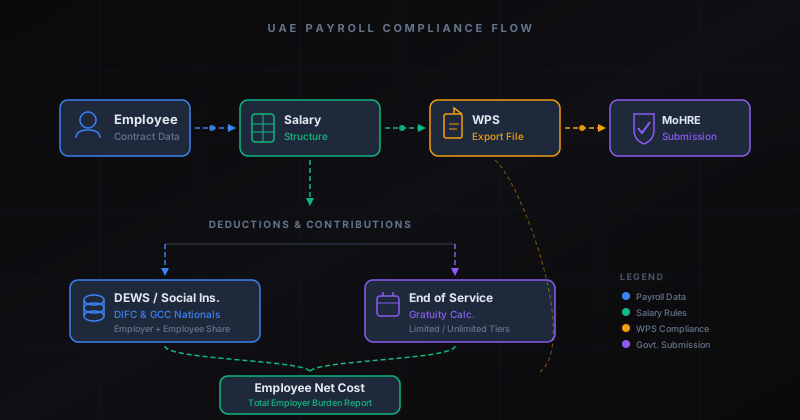
Running payroll in the UAE is not like running payroll in most other countries. There is no income tax, which simplifies one dimension considerably, but in its place sits a web of employer obligations that trips up even experienced operations teams — mandatory wage protection filings, end-of-service gratuity accruals that differ based on contract type and tenure, DIFC-specific pension alternatives, and social insurance requirements that apply only to certain nationalities. Get any of these wrong and the consequences range from rejected WPS files to MoHRE fines.
Odoo’s latest UAE payroll localization update addresses these pain points head-on. The changes span five areas: tighter WPS export formatting, recalculated end-of-service gratuity logic, DEWS contribution handling for DIFC-based employees, updated salary structures with UAE-specific allowance categories, and a new Employee Net Cost report that shows the full employer burden for every headcount. Taken together, it’s the most comprehensive payroll localization refresh Odoo has shipped for the Emirates in years.
WPS Export Formatting Now Aligns With MoHRE Specifications
The UAE’s Wage Protection System requires every employer to pay salaries through approved banks and exchange houses, with each payment batch accompanied by a structured data file submitted to the Ministry of Human Resources and Emiratisation. The file format is rigid: fixed-length fields, specific character encodings, and mandatory header and trailer records that include employer registration numbers, agent codes, and transaction counts. A single misaligned field causes the entire batch to be rejected.
Previous versions of Odoo’s UAE payroll module generated WPS files that occasionally needed manual adjustment — trailing spaces in the wrong positions, incorrect padding in the salary amount fields, or missing routing codes for certain exchange houses. The updated export logic now produces files that conform to the current MoHRE SIF (Salary Information File) specification out of the box, including proper handling of the employer’s 14-digit Mol ID, the agent routing code, and the salary and allowance breakdowns in the detail records.
For businesses that process payroll for hundreds of employees each month, eliminating the manual SIF cleanup step saves hours of work and removes a category of error that previously only surfaced when the bank rejected the upload. The system now validates the file structure before export, flagging missing employee bank details or invalid IBAN formats before you ever send the file downstream.
End-of-Service Gratuity Calculations Reflect Actual Labour Law Tiers
UAE Labour Law entitles employees to an end-of-service gratuity based on their length of service and contract type. The calculation is not a flat formula — it steps up at specific tenure thresholds. For unlimited contracts, employees who have completed between one and five years of service receive 21 calendar days of basic salary per year. After five years, the rate increases to 30 calendar days per year for the additional period. The total gratuity is capped at two years’ worth of basic salary regardless of tenure.
Limited contracts follow different rules for early termination. If an employee resigns before completing one year, no gratuity is owed. Between one and three years, the employee receives one-third of the 21-day calculation. Between three and five years, it steps up to two-thirds. Only after five years does the employee receive the full amount. These fractional tiers are where most payroll errors occur, and where spreadsheet-based calculations tend to silently produce wrong numbers.
Odoo’s updated gratuity engine now models both contract types with the correct tier breakpoints. The system pulls the employee’s contract type, start date, and basic salary to compute the accrued gratuity obligation at any point in time. This matters not only for final settlement when an employee leaves, but also for monthly provisioning — finance teams need to book the accruing liability on the balance sheet, and an inaccurate gratuity model produces inaccurate financial statements.
DEWS Contributions for DIFC Employees
Businesses operating within the Dubai International Financial Centre face a different set of rules entirely. DIFC replaced the traditional end-of-service gratuity with the DEWS (DIFC Employee Workplace Savings) scheme in February 2020. Under DEWS, employers make monthly contributions into a qualifying investment fund rather than accruing a lump-sum gratuity liability. The contribution rate is tied to the employee’s basic salary and length of service: 5.83% of basic salary for employees with less than five years of service, and 8.33% for those who have crossed the five-year mark.
Odoo now handles DEWS as a distinct contribution type within the payroll module. When an employee’s work location is flagged as DIFC, the system automatically substitutes the gratuity accrual with the appropriate DEWS contribution calculation. The monthly amount is included in payslip generation and can be exported separately for remittance to the DEWS fund administrator. This eliminates the common workaround of running DIFC employees on a parallel payroll configuration or manually overriding gratuity rules each month.
Social Insurance for GCC Nationals Gets Proper Treatment
While the UAE has no income tax, it does require social insurance contributions for Emirati nationals and, through reciprocal agreements, for nationals of other GCC states. The rates and structures differ by emirate. In Abu Dhabi, for example, the employer contributes 12.5% of the employee’s contributory salary to the General Pension and Social Security Authority (GPSSA), while the employee contributes 5% and the government adds 2.5%. In other emirates, the employer rate is 15% with a 5% employee share.
Previous Odoo configurations often handled social insurance through manual salary rules or custom payroll inputs. The updated localization now includes pre-built salary rules for GCC national contributions, with the correct employer and employee split percentages configured per emirate. The contribution amounts flow through to the payslip, the journal entries, and the WPS export — ensuring that the social insurance deduction on the employee’s payslip matches what gets reported to the pension authority and what gets filed in the wage protection system.
For organizations with a mixed workforce — which is virtually every company in the UAE — this means the payroll engine correctly distinguishes between employees who owe social insurance and those who don’t, without requiring manual classification overrides on every payroll run.
Salary Structures Rebuilt Around UAE Allowance Norms
Compensation in the UAE is almost never expressed as a single base salary figure. The standard practice is to break total compensation into a basic salary component plus a set of named allowances: housing allowance, transport allowance, mobile allowance, and sometimes education or utility allowances. This breakdown matters because end-of-service gratuity is calculated only on basic salary, so the split between basic and allowances directly affects the employer’s future obligations.
Odoo’s updated UAE salary structure ships with pre-configured rule categories for housing, transport, and mobile allowances. Each rule is defined as either a fixed amount or a percentage of basic salary, and the structure correctly excludes allowance amounts from gratuity and social insurance base calculations. This is one of those details that sounds trivial until you realize that an incorrectly configured salary structure can overstate gratuity provisions by 30–40% — a material misstatement on any company’s balance sheet.
The structure also supports the common UAE practice of paying a 13th-month salary or annual bonus. These components can be configured to either include or exclude from the WPS filing depending on how the company classifies them, giving finance teams the flexibility to match their specific compensation policies without rewriting payroll rules from scratch.
Employee Net Cost Surfaces the True Employer Burden
One of the less obvious but most practically useful additions is the Employee Net Cost report. In the UAE, the gap between what an employee sees on their payslip and what the employer actually spends per headcount can be substantial. Beyond gross salary, employers bear the cost of health insurance (mandatory since 2014 in Abu Dhabi and Dubai), annual airfare allowances for expatriate employees, gratuity or DEWS contributions, social insurance for nationals, and various visa and Emirates ID processing fees.
The Employee Net Cost view aggregates all of these components into a single per-employee figure that represents the total cost of employment. It pulls data from payroll (salary and allowances), benefits (insurance premiums), and accrued liabilities (gratuity or DEWS provisions) to produce a number that finance and HR leaders can use for headcount budgeting, department cost allocation, and hiring decision-making.
This is the kind of reporting that most companies in the UAE build in spreadsheets because their ERP only shows them one piece of the picture at a time. Having it integrated into the payroll module means the numbers stay current with every payroll run, rather than going stale in a quarterly spreadsheet that someone eventually forgets to update.
Configuration Without Customization
The broader significance of this update is that it moves UAE payroll compliance from “possible with customization” to “correct out of the box.” Every element — the WPS file format, the gratuity tiers, the DEWS contribution rates, the social insurance splits, the allowance structure — was previously achievable in Odoo if you had a developer or implementation partner who understood both the software and UAE labour law. That’s a narrow intersection of expertise, and the result was often a brittle configuration that broke when Odoo upgraded or when MoHRE changed its specifications.
By baking these rules into the standard localization, Odoo ensures that they get maintained alongside the platform itself. When MoHRE updates the SIF specification or when GPSSA adjusts contribution rates, the fix ships as part of the regular update cycle rather than requiring each customer to patch their custom code independently. For businesses operating in a regulatory environment that updates its requirements more frequently than most companies update their ERP, that’s a meaningful reduction in compliance risk.
What This Means for UAE Operations Teams
The practical impact of these changes is felt most acutely by the people who run payroll every month. HR managers no longer need to maintain side spreadsheets for gratuity calculations. Finance controllers can trust that the payroll journal entries reflect the correct social insurance splits without manual verification. Payroll administrators can generate and submit WPS files without the anxiety of a rejected upload and the scramble to fix and resubmit before the salary payment deadline.
None of these features are revolutionary in isolation. WPS export, gratuity calculation, and social insurance handling are table stakes for any payroll system claiming UAE support. But the difference between having these features and having them work correctly — with the right tiers, the right file format, the right contribution percentages — is the difference between a payroll module that technically exists and one that an operations team can actually rely on. Odoo’s latest update closes that gap considerably.