The Clock Is Running on Odoo’s Oldest Integration Protocol
For as long as most Odoo developers can remember, XML-RPC has been the default way to talk to an Odoo instance from the outside. It’s the protocol behind thousands of custom integrations, ETL pipelines, mobile apps, and third-party connectors that have kept Odoo databases connected to the rest of the enterprise stack. JSON-RPC arrived later as a lighter alternative, but both protocols share the same architecture and the same three underlying services. Now, both are on a firm countdown to removal — and the timeline just got tighter for cloud customers.
Two Deadlines, Two Deployment Models
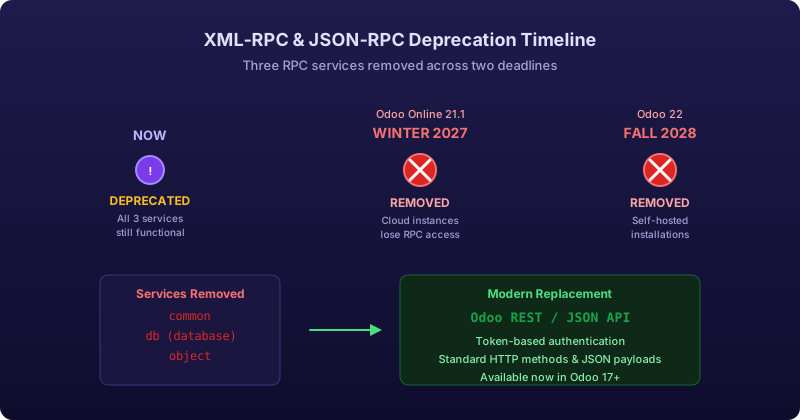
Odoo is splitting the deprecation into two phases based on where your instance runs. If you’re on Odoo Online — the fully-managed cloud offering — the XML-RPC and JSON-RPC endpoints disappear with the release of version 21.1, scheduled for winter 2027. That’s roughly fourteen months from now. If you run Odoo on your own servers, you have until Odoo 22 arrives in fall 2028 before the endpoints are stripped from the codebase entirely. The staggered approach gives self-hosted teams an extra year to migrate, but cloud customers are now firmly against a wall.
What’s Actually Being Removed
Both XML-RPC and JSON-RPC expose three services that together form the backbone of Odoo’s external API: common, which handles authentication and version checks; db, which manages database operations like listing, creating, and dropping databases; and object, which provides theexecute_kwmethod that most integrations rely on for reading and writing business data. All three services across both protocols are now marked as deprecated, and all three will cease to function once the removal dates hit. There is no partial deprecation — if your integration touches any of these services through either RPC protocol, it needs to move.
Why This Matters More Than a Typical API Sunset
XML-RPC has been part of Odoo since its earliest days as TinyERP. Over fifteen years of tutorials, Stack Overflow answers, integration guides, and third-party libraries have been built around it. Thexmlrpc.client pattern in Python, theripcord library in PHP, the odoo-xmlrpcnpm package in Node.js — these are not fringe tools. They’re the standard way an entire generation of developers learned to integrate with Odoo. Removing the underlying protocol doesn’t just break code. It obsoletes documentation, training materials, and institutional knowledge that many shops have relied on for years.
The Migration Path: Odoo’s Modern REST API
The replacement has been available since Odoo 17 in the form of a modern REST API that uses standard HTTP methods and JSON payloads. Authentication moves from the old session-based model to API keys and token-based flows that align with how every other modern web service handles credentials. The new API covers the same operations — reading, writing, creating, and deleting records, calling methods, searching with domains — but through a cleaner, more predictable interface that plays better with API gateways, monitoring tools, and modern infrastructure.
For most integrations, the migration is mechanical: swap the transport layer, update the authentication, and adjust the response parsing. The business logic stays the same because the underlying ORM operations haven’t changed. The biggest headache will be for teams running integrations they didn’t write themselves, where the RPC layer is buried inside a vendor’s connector and the upgrade path depends on that vendor shipping a new version.
Code Examples Are Getting Cleaned Up Too
Alongside the deprecation timeline, Odoo has been quietly correcting the external API documentation to reflect the new reality. Several code examples that previously showed XML-RPC patterns without caveats have been updated with deprecation notices and fixed for accuracy. Broken examples that had drifted from the actual API behavior have been repaired, which suggests the documentation team is preparing for a world where new developers go straight to the REST API and never encounter the RPC layer at all.
What Developers Should Do Right Now
The first step is an audit. Search your codebase forxmlrpc, xmlrpclib, json-rpc, and any library that wraps these protocols for Odoo. Check your scheduled scripts, your data sync jobs, your middleware, and any third-party apps that connect to your Odoo instance. Anything that calls the /xmlrpc/2/common,/xmlrpc/2/object, or /jsonrpc endpoints is on the deprecation list.
If you’re on Odoo Online, you have until winter 2027 — which means the migration needs to be planned and budgeted now, not when the deadline is six weeks out. If you’re self-hosted, the fall 2028 deadline is more comfortable, but starting early means you can test the new API against your current version and catch issues before the upgrade pressure kicks in. Either way, the transition is coming. The only variable is whether you do it on your schedule or Odoo’s.